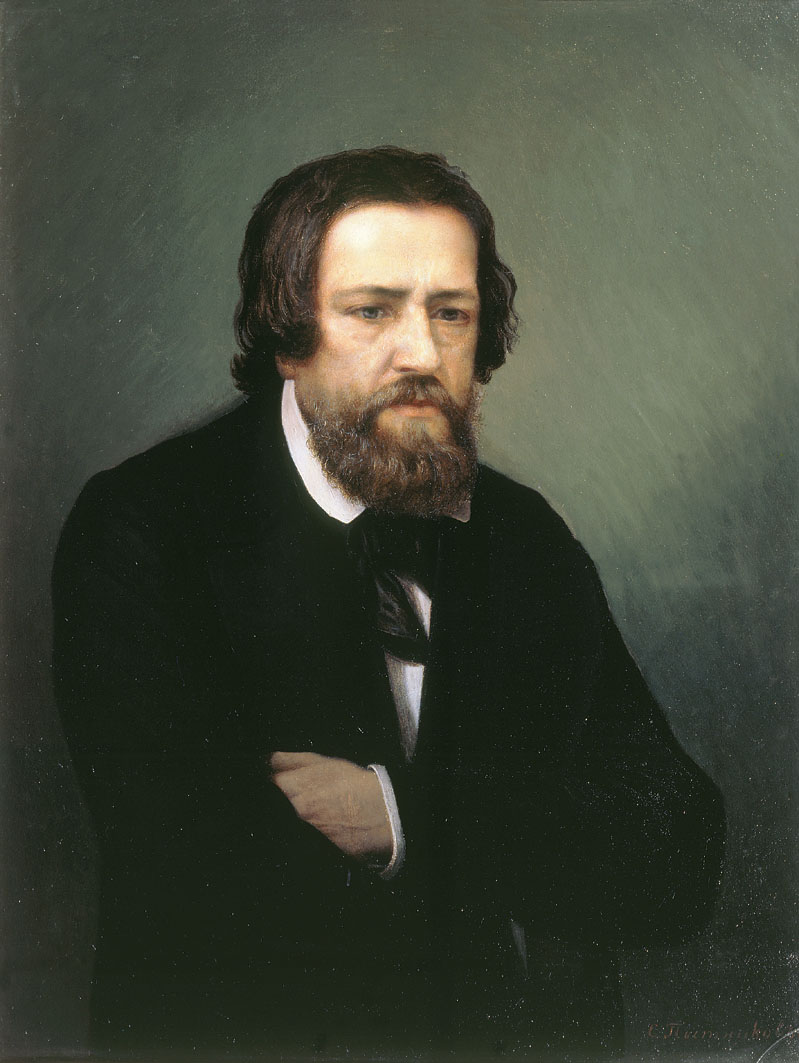
There are painters of many pictures, and there are painters of one. Alexander Andreevich Ivanov (1806–1858) belongs to the latter — and this is not poverty but choice. He could have lived the easy life of a master with a name: early talent, academic training, awards, commissions. Instead he left for Italy and vanished for decades into work on a single canvas, to which he decided to give everything he had — time, eyesight, faith, health. This is how a rare kind of destiny is born: not a career, but service to a single conception.
The conception was immense not in the size of the canvas, though the canvas itself turned out to be gigantic. Ivanov took the moment in which, by his conviction, the whole of human history turns. The bank of the Jordan, the crowd that had come to the water, and John the Baptist stretching out his hand toward the figure approaching in the distance — toward Christ. Nothing has happened yet: there is no sermon, no miracle, no cross. There is only the pointing gesture and the collective turning of heads. But it is precisely here that the eternal enters the flow of time for the first time, becomes part of our history. The artist wanted to paint not a scene from the Gospel, but the very point where the world divides into "before" and "after."
For the sake of this he settled in Rome and worked as few ever dare to. Ivanov did not invent figures out of his head — he sought them in living nature. Hundreds of preparatory studies: the heads of old men and youths, nude bodies, branches, stones, water, the slopes of the Roman Campagna under the open sky. In these studies, without declaring any manifesto, he arrived at what would later be called plein air painting: light captured directly in the open air, pure color, the living reflection of the sky on skin and foliage. Many connoisseurs today still rank these studies above the painting itself — they contain less design and more freedom, less duty and more discovery.
Rome in these years was, for Ivanov, also bound up with friendship. Here he was close with Nikolai Gogol — the two of them Russians, each obsessed with his own enormous labor far from home. Many recognize Gogol's features in one of the figures in the canvas, among those who turned at the Baptist's voice. Thus the writer, who for years had been carrying his own unbearable book about the salvation of the soul, found himself inscribed into a painting about the appearance of the Savior — two kindred efforts, two attempts to hold on to something disproportionate to man.
But the longer the work went on, the harder it became to believe in it with the old, simple faith. Ivanov underwent a severe inner crisis. He read seriously into the new biblical criticism of his century, into Strauss's analysis of the Gospel narratives, where the miraculous was interpreted as myth. The ground was slipping from under the conception: how does one paint the appearance of God if the very reality of that appearance has been called into question? Out of this struggle was born a new, still more grandiose plan — the cycle of "Biblical Sketches," murals on the themes of all sacred history. Ivanov covered sheets with dozens of compositions, full of a new, anxious, and inspired vision. He did not have time to realize this temple on paper — the cycle remained sketches, a promise that no one would ever fulfill.
The return was bitter. In 1858, Ivanov finally brought the great painting to St. Petersburg — after so many years of waiting, it was shown to the public. The reception was cool: what had been the work of a lifetime for the artist, the capital met with indifference, arguing and perplexed. A few weeks later he died of cholera. Almost immediately after his death, the Emperor bought the canvas — recognition came at the moment when its author could no longer hear of it. So it often happens with those who are ahead of their time and work not for success, but for truth.
Today "The Appearance of Christ Before the People" hangs as the summation of an entire life given to a single question: what happens to man and the world in the instant when, in the midst of a crowd, someone is pointed out as the One who is coming. Ivanov gave no easy answer — he left behind expectation, spread across the faces, and his own immense effort to see the invisible. The painter of one picture turned out to be the painter of one theme, the largest one possible — and in this lies his quiet greatness.