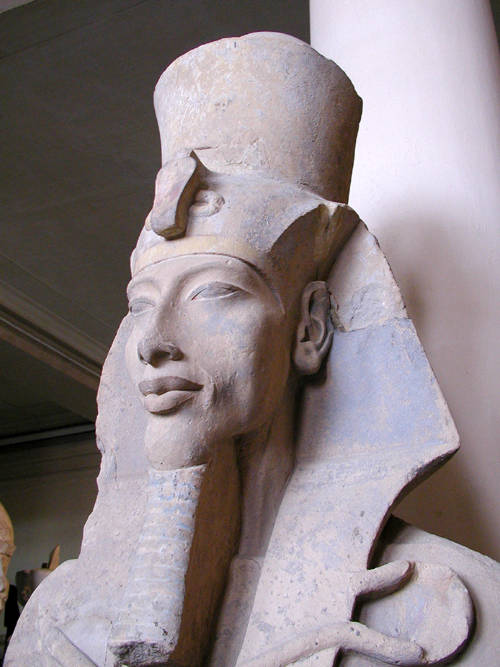
The theology of the Aten — what, exactly, Akhenaten preached. Atenism was not the mere exaltation of one god above the rest. Akhenaten went radically further: he renounced the very word netjer, "god," as a category. Not a single inscription at Amarna uses the word, even of the Aten. The Aten is not a deity in the traditional Egyptian sense: it has no mythology, fights no cosmic battles, makes no barque journeys through the underworld. The Aten is sunlight itself — the visible radiance that creates and sustains life. The Egyptologist James Hoffmeier calls this naturalistic monotheism; Erik Hornung and Donald Redford insist on the term monolatry: Akhenaten did not deny that other gods existed, but refused them worship and erased their names.
The break with tradition. Traditional Egyptian religion was a supple polytheism: gods merged with one another (Amun-Ra), exchanged functions, coexisted. The priesthood of Amun at Thebes had amassed colossal power — the temple of Karnak was the largest landholder in Egypt. In the fifth year of his reign Akhenaten moved the capital from Thebes to a new city, Akhetaten (Amarna), closed the temples of Amun, confiscated their property, and set about effacing the name of Amun from monuments across the country. It was a political revolution as much as a religious one — a blow against the priestly aristocracy.
The Great Hymn to the Aten and Psalm 104. The text was found in the tomb of Ay at Amarna; its authorship is ascribed to Akhenaten himself. As early as the beginning of the twentieth century, Breasted pointed out its startling parallels with the biblical Psalm 104 — parallels not merely of theme but of structure, the motifs following in the same order: night as the hour of danger, lions abroad from their dens; sunrise and the stirring of human activity; ships upon the river; the dependence of every creature on the divine gift of food. That the hymn (fourteenth century BC) precedes the psalm (a post-exilic text) is beyond dispute.
The question of Moses. In Moses and Monotheism (1939) Freud advanced a hypothesis: Moses was an Egyptian who, after the collapse of Atenism, led away a band of followers and passed on to them the idea of a single god. The Egyptologist Jan Assmann has approached the matter more rigorously, working with the notion of mnemohistory — how the memory of Akhenaten's upheaval may have shaped the formation of biblical monotheism. Assmann coined the term "Mosaic distinction" for the fundamental rupture between a supple polytheism, in which the gods of different peoples are translatable into one another, and an exclusive monotheism, which declares all foreign gods false. On Assmann's account, Akhenaten was the first to make that rupture.
Why the revolution failed. The sole intermediary between the Aten and humankind was the pharaoh himself: Egyptians prayed to Akhenaten, who prayed to the Aten. With the pharaoh's death the one channel to the deity vanished. In the third year of his reign Tutankhamun returned the capital to Memphis, restored the cult of Amun, and changed his name. The general Horemheb ordered Akhetaten destroyed and Akhenaten's name struck from the royal lists. Thirty years of history were expunged.
Akhenaten remains the first documented attempt to establish the cult of a single god on the scale of a state. That a man, fourteen centuries before our era, tried to rethink the nature of the divine — to give up mythology, anthropomorphic images, the judgment of Osiris beyond the grave — and to reduce it all to visible light remains one of the most astonishing intellectual gestures in history.