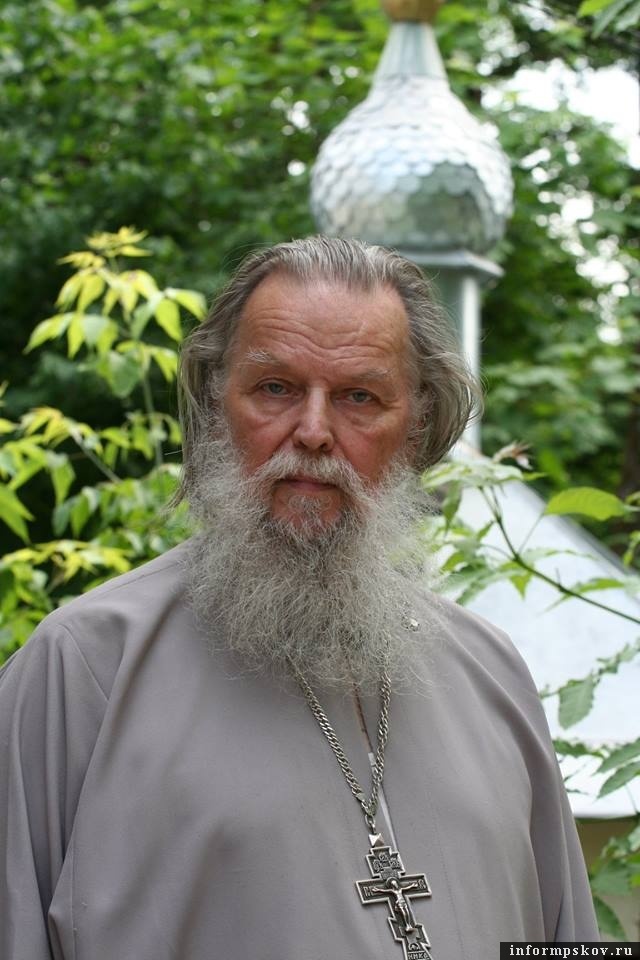
Pavel Adelgeim (born 1 August 1938 in Rostov-on-Don; died 5 August 2013 in Pskov) was a remarkable priest of the Russian Orthodox Church and a martyr for the faith, the author of numerous articles on church questions and of the books “With My Own Eyes” and “The Dogma of the Church in Canons and Practice”, the latter of which stirred a wide response within the Church. Father Pavel was a spiritual disciple of the elder Sevastian of Karaganda, of Archbishop Ermogen (Golubev), and of the archimandrites Boris (Kholchev) and Serafim (Sutorikhin), among other confessors of the faith. His whole life was given to God and to the Church.
He did much to restore historical truth to public life. The son of “enemies of the people”, he himself spent three years in the camps on a charge of “slandering the Soviet system”; in 1971, while still a prisoner, he lost a leg in an attempt on his life. He was also a preacher of rare brilliance.
Father Pavel was the grandson and son of “enemies of the people”: his father and grandfathers were shot. His mother was arrested twice, and the boy passed through an orphanage before joining her in exile in Karaganda. In Kazakhstan Tatyana Nikolaevna Adelgeim and her son settled in barracks in the settlement of Aktau. In Karaganda the future Father Pavel came to know the priest Sevastian — since glorified as a saint — and joined the church community gathered around the elder.
After Stalin's death in 1953 mother and son were allowed to return from exile. By then all of Father Pavel's relatives had either been destroyed or had suffered as members of the families of enemies of the people. Pavel went back to Kiev and lived at the Kiev-Pechersk Lavra.
In 1956, at eighteen, he entered the Kiev Theological Seminary, where he met the hieroschemamonk Kuksha (Velichko), since glorified by the Synod of the Ukrainian Church of the Moscow Patriarchate. Among his classmates was Leonid Svistun, who was acting as a provocateur; implicated in several affairs of Leonid's contriving, Pavel Adelgeim was expelled from the seminary in 1959, on the eve of his final examinations.
Father Kuksha blessed Pavel to marry. He met a seventeen-year-old girl named Vera, who agreed to become his wife.
After the marriage Pavel was invited to Tashkent by Archbishop Ermogen (Golubev), formerly superior of the Kiev-Pechersk monastery. In Tashkent Archbishop Ermogen ordained him deacon and kept him at the cathedral, where he served for seven years. In 1964 he was ordained priest and sent to Kagan, where he and his parish built a church in two months. For this, in 1969, Father Pavel was given three years on a charge of slandering the Soviet regime. By then he had three children: Anya, Vanya and Masha.
In 1970 the priest was taken from prison to a labour camp. A year later he and other prisoners were moved from a camp with tolerable conditions to one where the administration practised the beating of inmates. Father Pavel tried to stand in the way of this, and the camp commandant arranged an attack on him in which the priest lost a leg. Exactly three years to the day after his arrest, he was released.
After his release Father Pavel served for two and a half years in Fergana, fighting throughout that time for his parish against the state plenipotentiary Rakhimov. In the end the parish held, but Father Pavel had to leave Fergana. His bishop transferred him to Krasnovodsk, fearing that his registration would be taken away. A year later came an invitation from Leonid (Polyakov) to move to Latvia.
In 1976 Father Pavel settled in Pskov. For the first five years he had no parish of his own and filled in at various churches. In 1981 he was given the half-ruined church of the Apostle Matthew in the village of Piskovichi near Pskov, where he would serve for twenty years.
His activity in those years was extraordinarily varied. He built and restored churches, gathered people into the church, did social work, wrote articles on pressing church questions, corresponded with a great many people, and in 1988 stood — unsuccessfully — for the Supreme Soviet of the USSR. In the early 1990s he founded a home in Piskovichi for orphans with disabilities.
On 23 February 1993 the Pskov diocese received a new hierarch. In 2001 the new bishop, Eusebius (Savvin), dismissed Father Pavel from Piskovichi, where he had served for twenty-one years. The orphanage collapsed, and places for its children had to be found in haste.
Father Pavel helped bring back to life the church of the Holy Myrrh-Bearing Women in Pskov, which had stood closed for fifty-five years; the first service there was held on Radonitsa, 8 May 1989. In 1992 a full-curriculum Orthodox school for church choir directors opened at the church. For sixteen years Father Pavel maintained the school and taught in it, with his son Ivan as its director. It became one of the best schools of general education in Pskov and remained so until Bishop Eusebius closed it in 2008 — the same year in which the Pskov hierarch stripped Father Pavel of the rectorship of the Myrrh-Bearers church.
Father Pavel spoke out sharply against the Regulation on the church court, against the new parish statute, and against other innovations that diminished the conciliar principle in the Church. He defended Archimandrite Zinon, the celebrated icon painter, whom Metropolitan Eusebius had barred from communion for communing with Catholics.
In 2002 his book “The Dogma of the Church in Canons and Practice” was published, and after it open persecution by the ruling hierarch began. In March 2003 Father Pavel survived an attempt on his life only by a miracle: examination showed that the brakes of his car had been deliberately damaged. In 2011 his Myrrh-Bearers parish in Pskov became the only one in the Russian Orthodox Church to refuse the new model statute of the Moscow Patriarchate.
On 5 August 2013 Father Pavel was killed at his home by a knife blow to the heart. The murderer was twenty-seven-year-old Sergei Pchelintsev, whom forensic examination found to be suffering from paranoid schizophrenia.