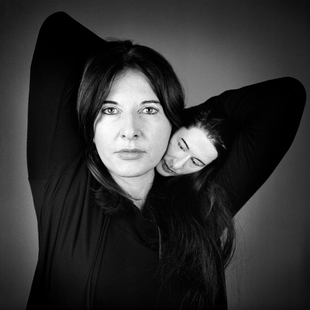
Marina Abramović was born in Belgrade in 1946, into a family over which the shadow of war seemed to hang forever: her parents, Danica Rosić and Vojin Abramović, had been Yugoslav partisans and received for it high postwar posts and the status of national heroes. At home an almost military discipline reigned, and for the first six years of her life the girl was raised mainly by a deeply religious grandmother — a childhood divided between the sternness of her parents and the Orthodox rite of her grandmother's house.
She studied at the Academy of Fine Arts in Belgrade, then in the graduate program of the Academy in Zagreb, and in the early 1970s taught in Novi Sad while beginning her own performances. Fairly quickly she arrived at the conviction that her chief and only material would be neither canvas nor clay but her own body — the limit of its pain, its exhaustion, its vulnerability.
The culmination of the early "Rhythm" series was the performance Rhythm 0 (1974) at the Naples studio Studio Morra. Abramović laid out seventy-two objects on a table — a feather, honey, scissors, a rose, and a loaded pistol — and announced that for six hours the viewer could do with her whatever he wished, and that all responsibility lay with him. At first people acted cautiously, but gradually they ventured ever more aggressive gestures; the performance was broken off when someone raised the loaded pistol to her head. Abramović later said that the experiment was not about her own endurance but about what a crowd is capable of once responsibility is lifted from it.
In 1976 she met the German artist Uwe Laysiepen, known as Ulay, and for twelve years they became not just a couple but a single creative organism: together they devised performances on the edge of endurance, trust, and rupture. The relationship ended in a performance as well — in 1988 each of them set out to walk toward the other from opposite ends of the Great Wall of China. By the original plan the meeting in the middle was to end in a wedding; instead, having walked some two and a half thousand kilometers, they simply said goodbye.
Real fame beyond the narrow world of contemporary art came to Abramović in 2010, when the Museum of Modern Art in New York mounted her retrospective "The Artist Is Present." At the center of the exhibition was a new performance: for 736 and a half hours the artist sat motionless at a table, and any visitor could sit down opposite and gaze silently into her eyes for as long as they liked. One of the visitors turned out, unexpectedly, to be Ulay, whom she had not seen for many years; their wordless meeting, caught on video, spread around the world.
After MoMA, Abramović founded her own institute, where she teaches the so-called "Abramović Method" — techniques of concentration, of slowing down, of presence, which she had used in her performances. She continues to exhibit, to teach, and to speak of performance not as spectacle but as a discipline that demands of the viewer the same effort as of the performer.
Over half a century of her career Abramović has turned her own body into a laboratory in which the limits of pain, of trust, and of human attention to one another are tested. Few artists of her generation have managed so literally to make the material of art not an image but presence itself — her own and that of others.