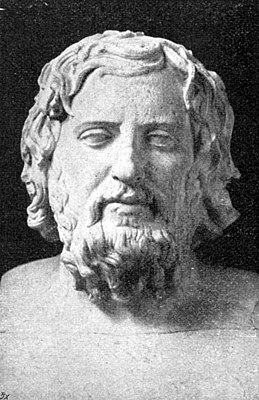
Xenophon was born in Athens around 430 BC, to a well-to-do family that may have belonged to the equestrian class. His childhood and youth passed under the shadow of the Peloponnesian War, which did not prevent him from receiving a broad general education as well as a military one. From his early years he was a follower of Socrates.
The collapse of democratic Athens after its defeat by Sparta in 404 BC Xenophon witnessed as a grown man, and in the political upheavals that followed he apparently sided with the reaction.
It was probably these antidemocratic sympathies that led him to leave his native city in 401 BC and join, as a private individual, the expedition of Cyrus. When Cyrus was killed and the Greek commanders treacherously slaughtered by the Persians, Xenophon was one of the six newly elected generals who led the rearguard on the retreat of the Ten Thousand through hostile country.
He went through the whole campaign with the Greek mercenaries: the advance on Babylon, the battle of Cunaxa, the retreat through Armenia to Trapezus and on westward to Byzantium, Thrace, and Pergamon. At Pergamon — having been chosen one of the army's generals back in Mesopotamia, and in Thrace serving in effect as its commander-in-chief — he handed the surviving soldiers, some 5,000 men, over to Thibron, a Spartan commander then raising an army for war against the satrap Pharnabazus. Xenophon himself set out for Greece with the Spartan king Agesilaus.
At Athens he was condemned for treason, as a man who had gone over to the Spartans, the enemies of the people, and his property was confiscated. This sealed the further course of his life.
In Asia Minor Xenophon had grown close to Agesilaus; he crossed to Greece with him and served under his command, taking part in battles and campaigns against Sparta's enemies, the allies of Athens among them.
The Spartans rewarded him with an estate near the Elean town of Scillus, where he lived in retirement, occupied with his writing, until the war between Thebes and Sparta broke his peace. After the battle of Leuctra, in 370 BC, he fled Scillus and barely got away to Corinth. From there he renewed relations with his homeland, which had by then allied itself with the Lacedaemonians against Thebes, and the sentence of exile against him was rescinded.
He died at Corinth around 354 BC.