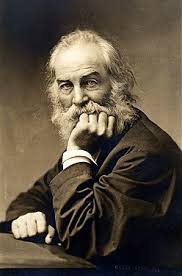
Walt Whitman, the American poet and journalist, was the second of nine children born to Louisa Van Velsor and her husband, the carpenter Walter Whitman. The poet's grandfather had been a slaveholding farmer; his father inherited only a small strip of land at West Hills, where he built the house now preserved as Walt Whitman's birthplace. His mother was the daughter of the Dutch stock-farmer Cornelius Van Velsor, though her forebears on both sides had been seafarers. Whitman was devoted to his kind, warm-hearted mother, but the habit of thinking for himself he owed, most likely, to his stern and irritable father — a friend of the democratic freethinker and deist Thomas Paine, and an admirer of the utopian socialists Robert Owen and Frances Wright.
When Whitman was four, the family moved to Brooklyn. There he attended a municipal school for six years, and with that his formal education ended. After a stint as an errand boy he was apprenticed to a compositor, and it was in the print shop that he got his first taste of imaginative prose. From sixteen to twenty-one he worked as a printer in New York and a schoolteacher on Long Island, founded the local weekly Long Islander in Huntington and ran it for nearly a year, and began a series of newspaper sketches called Sun-Down Papers from the Desk of a Schoolmaster. In May 1841, done with teaching, he returned to New York and set type at the shop that printed the New World. He formed ties with the Democratic Party. In the spring of 1842 he edited the daily Aurora, but friction with the publishers cost him the post; for another four years he edited various Democratic papers or contributed to them.
In 1842 Whitman took up literary work in earnest. His sentimental, moralizing stories and verses — which had nothing in common with the later Leaves of Grass — were written to suit the taste of the day and found an easy welcome in the Democratic Review and journals of that kind. That same year, on commission from a temperance society, he produced the novel Franklin Evans; or, The Inebriate, a book he later preferred not to remember. After several months at the Long Island Star, he became editor of the Brooklyn Daily Eagle, then one of the best dailies in the city. His editorials backed the Mexican-American War and the annexation of the western territories. Northern Democrats were divided over whether the new lands should go to slaveholders or to ordinary farmers; Whitman fought fiercely for the free-soil cause, which called for granting land to farmers outright, and when the faction of the party allied with the Southern Democrats gained the upper hand in New York State, he had to give up the editorship in January 1848.
Within days he was offered the editorship of the Crescent, a newly founded New Orleans paper. He accepted, arriving with his younger brother Jeff on February 25, 1848. For half a century biographers painted the poet's life there in the rosiest colors, forgetting that his brother was constantly ill and that Whitman himself could not get along with the paper's owners. On May 25 he resigned and went home. Losing no time, he set about creating a newspaper of his own to champion free soil. The first issue of the Brooklyn Freeman appeared on September 9, 1848; the next day a fire broke out in the print shop and most of the run was destroyed. Whitman could not resume publication until the November elections, in which the Democrats lost New York State. The paper survived another year, but in the summer of 1849, with the emergence of a radical group of Democrats, its days were plainly numbered; the last issue came out on September 11. Whitman would still appear from time to time in New York and Brooklyn papers, but for the moment his journalism was over. In 1857–1858 he edited the Brooklyn Times, after which he was finished with editing for good. He could easily have gone back to it, but only at the price of compromises. To earn a living he took whatever work came; from 1852 to 1854 he worked as a building contractor.
In the spring of 1855 he began preparing Leaves of Grass for the press. His Brooklyn friends the Rome brothers were to print it; unable to find a publisher willing to bear the cost, Whitman brought the book out at his own expense and set part of the type himself. It appeared in the first week of July. In this collection the idea of nature's cleansing nearness to man took on a cosmic character: every person and every thing is perceived as sacred against the background of a universe evolving without end in time and space. The sense of kinship with all people and all phenomena of the world is conveyed through the lyric hero's transformation into other people and into inanimate objects. Whitman is the singer of a "world democracy," of the universal brotherhood of working people, of the positive sciences, of love and comradeship that know no social boundaries — an innovator of free verse and a reformer of American poetry.
In the twentieth century Leaves of Grass came to be recognized as one of the most important literary events of its age, marking the revolution in poetry bound up with the emergence of free verse. Whitman's vers libre was an intricate synthesis: folk and biblical verse, the syntactic parallelism of oratorical prose, rhythmically uniform passages of enumeration — the "catalogues" — and internal alliterations and assonances that give finish to the line and to the whole strophe. Believing that his verse should be as natural as breathing, Whitman decisively rejected the canonical poetic forms, on which, as he saw it, lay the stamp of lifeless literariness, and laid the foundations of a new poetics that would develop with extraordinary intensity throughout the twentieth century, above all in the English-speaking world.
In 1873 the poet was struck by paralysis, from which he never recovered. He went on writing all the same, and his work remained full of optimism and confidence. One of his last poems, a farewell to the world, is "Good-Bye My Fancy." Whitman died on March 26, 1892.