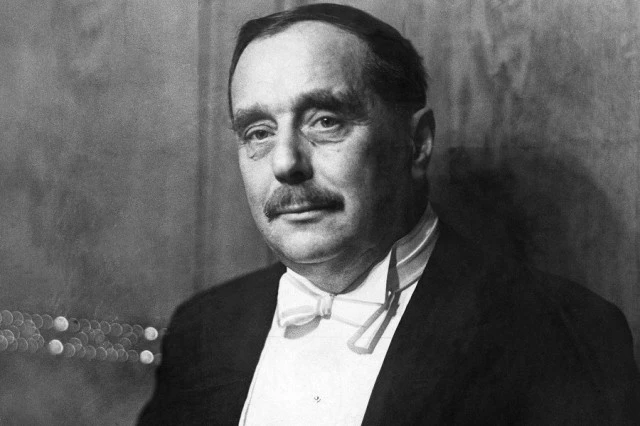
Herbert George Wells, British novelist and essayist, was the greatest master of critical realism. He was born on 21 September 1866 in Bromley, Kent, a suburb of London. His father, Joseph Wells, and his mother, Sarah Neal, had once been gardener and housemaid on a wealthy estate; later they kept a small china shop. The shop earned almost nothing, and the family lived chiefly on what the father brought in as a professional cricketer.
At eight the boy "had the good fortune," as he later put it, to break his leg — and it was then that he fell in love with reading. That same year he entered Mr Thomas Morley's Commercial Academy, which was to fit him for a career in trade. But when Herbert was thirteen his father broke his hip, and the cricket was over. His schooling was deemed complete, and he had to make his own way in the world.
He was educated at King's College, University of London, graduating in 1888; by 1891 he had taken two degrees in biology. After an apprenticeship to a draper and a spell in a pharmacy, he worked as a schoolmaster, a teacher of the exact sciences, and an assistant to Thomas Huxley. In 1893 he turned professionally to journalism. From 1903 to 1909 he belonged to the Fabian Society, which urged caution and gradualism in politics, science, and public life. In 1895 he wrote his first work of fiction, the novel The Time Machine.
Wells lived in London and on the Riviera, lectured often, and traveled a great deal. He was married twice: from 1891 to 1895 to Isabel Mary Wells, and from 1895 to 1927 to Amy Catherine ("Jane") Robbins, who bore his two sons, George Philip Wells and Frank Richard Wells.
He died in London on 13 August 1946. At the funeral John Boynton Priestley called him "a man whose word brought light into many of the dark corners of life." As his will directed, after the cremation his sons, standing on the Isle of Wight, scattered his ashes over the English Channel.