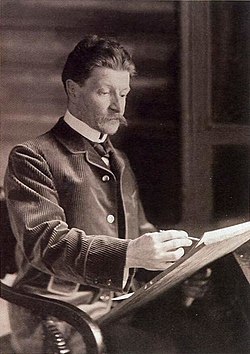
Mikhail Alexandrovich Vrubel (March 5 [17], 1856, Omsk — April 1 [14], 1910, St Petersburg) was a Russian painter whose singular art, close in manner to Art Nouveau, joined brilliant decorative form to dramatic, tragic content — visual opulence to dark and anxious moods.
He was a dazzling colourist — the poet Blok spoke of the 'struggle of gold and blue' in his canvases — and an unsurpassed draughtsman, achieving in his Lermontov illustrations and other graphic work a kind of 'black-and-white colourfulness'. He was drawn to monumental painting, making sketches for the frescoes of St Vladimir's Cathedral in Kiev and large panels on mythological subjects, and to the decorative and applied arts: among his works are majolica sculpture, stove tiles, ceramic vases, designs for theatrical costumes and sets, interior schemes and even architectural projects.
His best-known paintings: The Demon Seated, The Demon Downcast, the illustrations to Lermontov's Demon, The Swan Princess, The Snow Maiden, Lilac, Girl Against a Persian Carpet.
Vrubel lived as he painted: headlong, vivid, in broad strokes, intriguing his 'audience' and leaving it with a sense of impending catastrophe. He injured himself to dull the pain of an unrequited love, drank hard, was perpetually broke. He was always in a dive. He strolled about Kiev in short breeches and stockings. He announced at the top of his voice that Repin could not draw. Those around him had long since grown used to his eccentricities, so that when madness began to claim him — not the creative kind, but the kind that requires doctors — not everyone noticed the change. Not at once, at any rate.
The Demon Rising
Mikhail Vrubel was born in Omsk, where his father, a military lawyer, served as staff adjutant of the Separate Siberian Corps. His mother died of consumption when he was three, and the four children of Alexander Vrubel's first marriage were brought up by their father together with a stepmother, Elizaveta Vessel.
Mikhail was a frail child. He began to walk only at three, kept away from active games, avoided physical effort. It was the stepmother who set him on his feet, holding the boy to a regimen and to a diet 'of raw meat and cod-liver oil'. Her other unquestionable contribution to his life and character was music. In those days every young lady of a decent family was expected to play the piano; Elizaveta Vessel, by the testimony of contemporaries, was a genuinely remarkable performer. The children could watch her play for hours — watch, precisely: the ringed, fluttering fingers, the light wrists glinting with bracelets. Somewhere here, for the young Vrubel, form and content, image and décor, magic and gilded trinkets must have fused into one; somewhere here began the aesthetics of the artist who would one day declare: 'Everything is decorative, and only decorative!'
His relations with his stepmother were good, if without particular warmth. He was closest to his sister Anna (between themselves, with friendly mockery, they called Elizaveta Vessel 'our wondrous Madrinka — a pearl among mothers').
The father's postings kept the family constantly on the move, and everywhere the family library followed. From infancy Mikhail was surrounded by books, many of them old, lavishly illustrated editions. In books — and in his beloved journal, the Picturesque Review — the gifted, precocious boy found plots for home theatricals in which he appeared now as a fearless traveller, now as a noble pirate.
When the Vrubels lived in Saratov, the ten-year-old Mikhail acquired his first admirer — the daughter of the writer Daniil Mordovtsev, a friend of the family. Vera Mordovtseva later wrote in her memoirs that she was charmed by the boy — by his rich imagination, his pleasant looks, and by the fact that 'there was much softness and tenderness in his nature, something feminine'.
His gift for drawing showed itself early. At nine he went with his father to see a copy of Michelangelo's fresco The Last Judgment and, on coming home, reproduced it from memory. His father did not object to the boy's developing his talent — Mikhail worked with private teachers and later attended art schools as an auditor. For a long time, however, drawing remained in his life merely as a hobby.
In 1867 Vrubel entered the Fifth City Gymnasium in Petersburg — a progressive establishment where the intensive study of ancient languages went hand in hand with lessons in dancing and gymnastics. He continued to study painting at the school of the Society for the Encouragement of the Arts. In 1870 his father was posted to Odessa, and the fourteen-year-old entered the famous Richelieu Lyceum (by then reorganized as the Novorossiysk Imperial University). Study came easily to him; he was a serial top of his class. In a letter to his sister, who had gone to study in Petersburg, he lamented that he had gone entirely to the bad over the holidays: instead of translating the Roman classics and reading Faust in the original, as planned, the young man had been copying Aivazovsky — such was the desperado he was. For all these hair-raising adventures, life in Odessa oppressed him. 'A thousand, a thousand times I envy you, dear Aniuta, for being in Petersburg: do you understand, madam, what that means... for a man crawling about the salt steppes of Scythia — or, more plainly, residing in the city of Odessa,' he wrote to her.
Finishing the lyceum with a gold medal, Vrubel went on to Petersburg University to read law. The longed-for capital took the young man in hand at once, closed its granite embrace around him, surrounded him with temptations. His passion for the theatre, and an awakened taste for highly extravagant dress, required money, and he took private pupils — his brilliant Latin proved useful above all. It was as tutor to one of his fellow students that he entered the house of the wealthy sugar refiners, the Papmels. Here, among the sugar kings, he tasted the truly sweet life. 'At the Papmels' Vrubel lived like one of the family,' writes his biographer Alexander Ivanov. 'In winter he went with them to the opera; in summer he moved with the whole household to the dacha at Peterhof. The Papmels denied themselves nothing, and everything there was unlike the strict and modest order of Vrubel's own family; the house was a full cup, even in a rather too literal sense, and it was at the Papmels' that Vrubel first showed the inclination to wine, of which there was never any shortage.' A bohemian crowd was forever milling about the house — musicians, painters, sympathetic hangers-on. It must have been this circle that nudged Vrubel toward taking up painting in earnest.
Having finished the university with middling results (in the rank of 'actual student') and served his military obligation, the twenty-four-year-old Vrubel entered the Academy of Arts as an auditor. It is no great exaggeration to say that the decision came as a surprise not only to his father, who had counted on Mikhail's continuing the family profession, but to himself.
The Demon Diving
At the Academy the first oddity showed itself. In those days it was, among the creative young, at the very least good form to criticize the Academy's ossification and its methods of teaching. Vrubel proved not merely a diligent student — he was genuinely devoted to his teacher, Pavel Chistyakov. 'When I began my studies with Chistyakov, I was passionately taken with his fundamental principles,' he wrote to his sister, 'because they were nothing other than the formula of my own living relation to nature, the one implanted in me.' Chistyakov was an outstanding teacher — from his studio came Repin, Serov, Vasnetsov, Surikov. With some of them Vrubel at first found a common language. For a while he was close to Repin, too — until it all ended in a major quarrel over Repin's Religious Procession in Kursk Province, which Vrubel attacked furiously for its excess of ideology. Even in those years his aesthetic priorities were fully formed. Put crudely, Vrubel held that not only art but everything in nature was 'decorative, and only decorative'.
In 1881 his sketch The Betrothal of the Holy Virgin Mary to Joseph won him the Academy's second Silver Medal. And in 1883 his relations with the Academy ended as suddenly as they had begun. The noted archaeologist Adrian Prakhov, on Chistyakov's recommendation, invited Vrubel to take part in the restoration of St Cyril's Church in Kiev. The offer promised a decent income, and Vrubel went. To his studies at the Academy he never returned.
In Kiev Vrubel acquired priceless experience. Frescoes and icons of his own, restoration work in St Cyril's Church and the Cathedral of St Sophia — a grandiose labour stretched over five years. The art historian Nina Dmitrieva wrote that, working 'in co-authorship' with the masters of the twelfth century, Vrubel became one of the first major artists to 'throw a bridge from archaeological inquiry to living contemporary art'. As for his social life in Kiev, it too was full and vivid.
On his colleagues his arrival in the city made an unforgettable impression. The painter Lev Kovalsky, then a student of the Kiev drawing school, recalled: 'Against the primitive hills of St Cyril's there stood behind me a fair-haired, almost white-blond young man with a most distinctive head, his small moustaches also nearly white. Short of stature, very well proportioned, and dressed — this was what could astonish me most in those days — all in a black velvet suit, in stockings, short breeches and ankle-boots. Altogether he was a young Venetian from a canvas by Tintoretto or Titian — though that I learned only many years later, when I was in Venice.'
In Kiev Vrubel lived through a stormy infatuation with the wife of his employer — Emilia Prakhova. Emilia was a talented pianist, a pupil of Liszt himself. She kept a literary salon in Kiev and was, in the words of her granddaughter Alexandra, 'a lady with a streak of oddity'. Given the peculiarity of Vrubel's own nature, it is no wonder he was smitten. Her face he gave to the icon Mother of God with Child, painted for the altar of St Cyril's Church. The feeling was platonic, and unrequited — at first it amused both Emilia herself and Adrian Prakhov. But after Vrubel moved out to the Prakhovs' dacha it began to irritate them both, and he was soon dispatched to Italy — to study Byzantine art.
It did not help. Scarcely back, Vrubel informed Adrian Prakhov that he firmly intended to marry Emilia. And though Prakhov did not break off relations with the eccentric young man, by the account of those close to him he now regarded him with a certain wariness.
Vrubel, meanwhile, had become a fixture at the café-chantant Château des Fleurs, drinking away his modest fees to the last coin. To the torments of the heart a creative crisis was soon added. The only picture he managed to finish in the Kiev period after his return from Italy was Girl Against a Persian Carpet — and the client did not like it. His father, visiting him in Kiev, was appalled: 'No warm blanket, no warm coat, no clothes but those he stands in... It is painful, bitter to the point of tears.'
In 1889 Alexander Vrubel decided to retire on grounds of ill health and settle in Kiev. Mikhail promised to look after his ailing father. In September 1889 he went to Moscow — 'to see acquaintances'. He stayed fifteen years.
The Demon Outcast
Konstantin Korovin, with whom Vrubel grew close in Moscow, recalled: 'Vrubel surrounded himself with strange people — snobs of some sort, carousers, circus artists, Italians, paupers, alcoholics.' In all likelihood his sudden move to Moscow was bound up precisely with a passion for the circus — for one circus equestrienne in particular.
However that may be, he settled in Korovin's studio. The friends meant to work as a threesome, with Valentin Serov, but Vrubel soon quarrelled with Serov and the artel died unborn. Korovin managed to place Vrubel in the house of Savva Mamontov — the famous Moscow patron of the arts, whose sons could use a tutor. The acquaintance became the beginning of a long friendship: the shrewd Mamontov saw a great artist in Vrubel from the first. And though his wife could not abide Vrubel, calling him 'a drunkard and a blasphemer', Savva Ivanovich endured, waited and hoped.
Soon Vrubel had his chance to take up the theme of the Demon, which had begun to possess him back in Kiev. In 1890 it was decided to publish a jubilee two-volume Lermontov, illustrated by 'the best artistic forces'. Eighteen illustrators in all were engaged, Repin, Shishkin and Aivazovsky among them. Vrubel presumably owed his place among them to Mamontov's protection, and he was the only artist unknown to the public. Yet it was precisely his sheets that raised a din in the press: the critics noted their 'coarseness, ugliness, caricature and absurdity'.
Having stoically weathered the critics' attacks, in that same year, 1890, Vrubel painted The Demon Seated — one of his mightiest and most recognizable pictures. It, too, drew no ovations.
In July 1890 Mamontov's twenty-two-year-old son Andrei, to whom Vrubel had been close, died at Abramtsevo. Coming for the funeral, Vrubel lingered, and soon wrote to his sister that he had 'taken charge of the factory of tile and terracotta decorations'. Mamontov's Abramtsevo workshops allowed him to plunge headlong into the decorative art he loved so much. He fell passionately for ceramics. In this field, indeed, Vrubel was universal and irreplaceable. He decorated majolica chapels and fireplaces, worked on façades and interiors, created panels, sculptures, stained glass, theatre sets and costumes. Commissions appeared. The fees, as before, he ran through at speed, and drank with real abandon. Within the nascent 'Russian moderne' the ambitious Vrubel felt cramped, and though he would never have admitted it even to himself, he thirsted for recognition.
In 1894 Vrubel sank into a depression so evident that Mamontov sent him to Italy — to clear his head, and at the same time to keep an eye on the elder son, Sergei, who was in Europe treating his kidneys. On his return Vrubel showed the sculpture Head of a Giant at an exhibition of the Moscow Fellowship of Artists. The newspaper Russkie Vedomosti singled him out as 'an example of how a subject can be stripped of artistic and poetic beauty'.
The peak of his unpopularity came with the All-Russian Industrial and Art Exhibition in Nizhny Novgorod (1896), for which Mamontov secured the artist a commission for two large panels in the pavilion of the art section. On seeing the sketches, Albert Benois, who was curating the project, sent the Academy of Arts a laconic telegram: 'Vrubel's panels are monstrous, must be removed, awaiting jury.' The commission found it impossible to exhibit Vrubel's works, and Mamontov bought the unfinished panels, which Vrubel completed at Abramtsevo. For the ill-starred Mikula Selyaninovich and Princess of Dreams Mamontov built a separate pavilion, where they were shown under the sign 'Exhibition of decorative panels by the artist M. A. Vrubel, rejected by the jury of the Imperial Academy of Arts'. No true Salon des Refusés came of the venture, but the furore in the press was again considerable. In his memoirs Korovin quoted an anecdote then in circulation. While Vrubel was ill and in hospital, the Diaghilev exhibition opened at the Academy of Arts, and the sovereign attended. Seeing Vrubel's Lilac, the emperor said: 'How beautiful. I like it.' Grand Duke Vladimir Alexandrovich, standing beside him, protested hotly: 'What is this? This is decadence...' 'No, I like it,' said the emperor. 'Who painted this picture?' Vrubel, they told him. Turning to his suite and catching sight of Count Tolstoy, vice-president of the Academy of Arts, the emperor said: 'Count Ivan Ivanovich — isn't that the man they executed in Nizhny?'
The Demon Downcast
In 1896, in Petersburg, Vrubel met the singer Nadezhda Zabela — she was performing in the opera Hansel and Gretel, whose sets the artist had been commissioned to design. Zabela later remembered being a little frightened: 'I was astonished and even somewhat shocked when some gentleman ran up to me and, kissing my hand, exclaimed: "A lovely voice!" T. S. Lyubatovich, who was standing there, hastened to introduce him — "Our artist, Mikhail Alexandrovich Vrubel" — and said to me aside: "A very expansive man, but perfectly decent."' Vrubel proposed to her almost that same day (in a letter to his sister he swore he would have killed himself had she refused). Zabela had heard that Vrubel drank heavily and lived in near-permanent destitution, but she said yes all the same.
They were married in Switzerland. Vrubel, arriving in Geneva after his bride, was once again out of money, and walked from the station to the church.
For a time they lived in Kharkov, where Nadezhda had an engagement at the opera. Vrubel was, as usual, gloomy and quick-tempered, and in Kharkov a new and alarming symptom appeared — savage migraines, which the artist deadened with horse doses of phenacetin.
In 1901 a son was born to the Vrubels, and they named him Savva. The event changed everything: the mother left the stage for a time, and Mikhail Alexandrovich had to support the family alone. Savva was born with a cleft lip; the defect made a painful impression on his father, who saw in it an evil omen. Vrubel began sliding back into depression and worked on The Demon Downcast fourteen hours a day. He was obsessed with the picture — having done what he intended, he redid it again and again. From time to time he went on a binge and became especially violent; once his wife had to flee from him to relatives in Ryazan. In the spring of 1902 Vrubel was hospitalized for the first time with symptoms of acute mental disorder.
It is hard to judge what part madness played in Vrubel's art. Had he been normal by psychiatric lights, he might have been, for his time, something like Robert Smith, Tim Burton or the other light-hearted pop heroes who are happy nowadays to 'play at decadence'. Perhaps it was precisely insanity that gave his works their anxious, mysterious and mighty sound.
As for the notorious court of public opinion, here Vrubel's illness played the most beneficial role imaginable. From an insufferable misfit he turned overnight into a tragic figure in need not of censure but of sympathy. Yesterday's critics began to say the artist had been ahead of his time. The functionaries who had found his works 'monstrous' elected him an academician of painting — 'for renown in the field of art'.
The recognition, of course, came late — fatally late.
One clinic followed another. Delusions of grandeur alternated with fits of self-abasement. There were spells of temporary clarity, each followed by a fresh crisis. An especially heavy blow to his unstable mind was the death of his son in 1903: soon afterwards his condition worsened so far that people began to speak of him in the past tense, though the artist remained creatively active until 1906.
The original diagnosis — tertiary syphilis — proved only partly correct. Dr Fyodor Usoltsev, in whose clinic Vrubel enjoyed his longest remission, established that the disease had attacked not the brain but the spinal cord; the manic-depressive psychosis had developed independently. Either way, one outcome was foreseen: spiritual and physical decline. In 1906 Vrubel went completely blind. According to Anna Vrubel — the artist's beloved sister, who nursed him in his last years — he said more than once that he was tired of living. In February 1910 he opened the window-vent and stood a long while breathing in the frosty air, which brought on pneumonia. Perhaps he did it without knowing: in his final year he was sunk in his hallucinations and can hardly have been clearly aware of what he was doing. And yet, on the eve of his death, Vrubel combed his hair, washed with eau de cologne, and in the night said to the orderly attending him: 'Nikolai, I have lain here long enough — let us go to the Academy.' The next day the coffin with the artist's body stood in the Academy of Arts — here too Vrubel proved a seer. He was buried in the Novodevichy cemetery. Over his grave Alexander Blok said: 'Before what Vrubel and those like him reveal to mankind once in a century, I can only tremble. The worlds they saw, we do not see.'