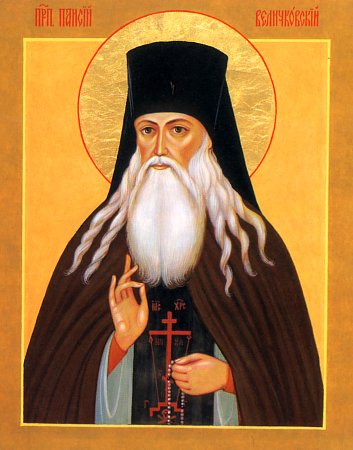
Born Peter Ivanovich Velichkovsky on 21 December 1722, he came of a clerical line: his great-grandfather, grandfather, father and elder brother had all been archpriests of the city of Poltava. He lost his father at the age of four and was raised by his mother, Irina (Juliana in monastic life).
From the age of twelve Peter studied at the Kiev Theological Academy. At seventeen he left it for the Lyubech monastery, founded by St Anthony of the Caves. From there he made his way to the monasteries of Moldavia and Wallachia, where he learned prayer and monastic obedience and received the rasophore with the name Parthenius.
Seeking elders versed in the writings of the holy fathers, he came to the Holy Mountain of Athos. There, at twenty-eight, he was tonsured a monk with the name Paisius. Disciples began to gather around him. Not counting himself worthy to teach others, he received the brethren on one condition: that the teaching of the holy fathers of the Church stand in place of a human master. At thirty-six he was ordained to the priesthood.
After seventeen years on Athos the elder Paisius returned to Moldavia and settled with his brethren first in the deserted monastery of Dragomirna, then in the secluded mountain monastery of Secu. As the brotherhood grew, he was obliged to move his community to the wealthy monastery of Neamt, where, as at Dragomirna and Secu, he introduced the cenobitic rule, demanding of the brethren complete non-possession and the cutting off of self-will. Abba Paisius taught the brotherhood repentance and the Jesus Prayer — "Lord Jesus Christ, Son of God, have mercy on me, a sinner." The monks confessed their thoughts daily to a spiritual father and laboured at copying the books of the fathers. Under his direction Neamt became the largest monastery of the Orthodox Church, housing a thousand monks. Paisius was raised to the rank of archimandrite.
He translated many patristic writings and lives of the saints from Greek into Slavonic, and compiled the Slavonic Philokalia, a collection of great consequence for the development of Russian spiritual culture. He revived within monasticism the saving practice of eldership and urged the love of spiritual learning.
The elder Paisius died on 15 November 1794 and was buried at Neamt. He was glorified as a saint at the Local Council of the Russian Orthodox Church in 1988.
His influence reached deep into Russian asceticism of the late eighteenth and nineteenth centuries. Seraphim of Sarov received his blessing to depart for Sarov from the recluse Dositheus of the Kitaev hermitage, who was spiritually bound to Paisius's monastery and sent his own disciples there; the Philokalia was Seraphim's constant companion. The history of eldership at Optina hermitage is likewise bound up with Paisius's legacy: the first Optina elders — Leo, Macarius and Moses — were direct disciples of Paisius's disciples, and their own disciple was St Ambrose of Optina.