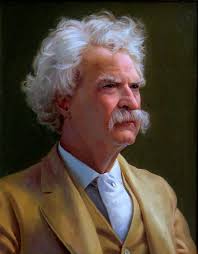
Mark Twain was a great American writer, journalist, and public figure. His work spans many genres — realism, romanticism, humor, satire, philosophical fantasy, journalism — and in all of them he holds unwaveringly to the position of a humanist and a democrat.
Samuel Langhorne Clemens was born on November 30, 1835, in the small town of Florida, Missouri; he later joked that by being born he had increased its population by one percent. He was the third of the four surviving children of John and Jane Clemens. While Sam was still a boy the family moved, in search of a better life, to the town of Hannibal, also in Missouri — the town, and its inhabitants, that Twain would later put into his famous books, above all “The Adventures of Tom Sawyer.” His father died of pneumonia in 1847, leaving many debts. The eldest son, Orion, soon began publishing a newspaper, and Sam contributed what he could as a typesetter and, occasionally, as a writer. Some of the paper’s liveliest and most controversial articles came from the pen of the younger brother — usually when Orion was away. Sam also traveled now and then to St. Louis and New York.
But it was the call of the Mississippi that finally drew Clemens to a career as a steamboat pilot — a profession he admitted he would have followed all his life, had the Civil War not put an end to private steamboat traffic in 1861. Forced to look for other work, and after a brief acquaintance with the militia, Clemens left the war behind in July 1861 and went west. His brother Orion had been offered the post of secretary to the governor of Nevada, and the two spent two weeks crossing the prairies by stagecoach to Virginia City, the mining town where Nevada’s silver was dug. The experience of the American West formed Twain as a writer and became the basis of his second book. In Nevada, hoping to strike it rich, Sam Clemens became a miner and set about digging for silver, living for long stretches in camps with the other prospectors — a way of life he would later describe in his books. Success eluded him; he had to abandon mining and take a job at the Territorial Enterprise, the local newspaper, where he first used the pseudonym “Mark Twain.” In 1864 he moved to San Francisco, where he began writing for several papers at once.
His first literary success came in 1865: the humorous story “The Celebrated Jumping Frog of Calaveras County” was reprinted across the country and hailed as “the finest piece of humorous literature yet produced in America.” In the spring of 1866 the Sacramento Union sent Twain to Hawaii, with instructions to write letters about his adventures along the way. The letters were such a resounding success that Colonel John McComb, publisher of the Alta California, proposed a lecture tour of the state. The lectures were an instant sensation, and Twain crisscrossed California, entertaining the public at a dollar a head. His first triumph as a writer came from yet another journey: in 1867 he persuaded Colonel McComb to sponsor a voyage to Europe and the Middle East. In June he set out for Europe as a correspondent; in August he visited Odessa, Yalta, and Sevastopol as well. The letters he wrote on the road were dispatched to the paper and printed, and they became the foundation of “The Innocents Abroad.” Published in 1869 and sold by subscription, the book was an enormous success; to the very end of his life many knew Twain chiefly as its author. Over his writing career he traveled through Europe, Asia, Africa, and even Australia.
In 1870, at the peak of the success of “The Innocents Abroad,” Twain married Olivia Langdon and moved to Buffalo, New York, and from there to Hartford, Connecticut. In this period he lectured frequently in the United States and England. He then turned to sharp satire, castigating American society and its politicians — a note especially audible in “Life on the Mississippi,” written in 1883. Twain’s greatest contribution to American and world literature is held to be the novel “Adventures of Huckleberry Finn”; many consider it the finest literary work ever produced in the United States. “The Adventures of Tom Sawyer,” “A Connecticut Yankee in King Arthur’s Court,” and the documentary sketches of “Life on the Mississippi” are also much loved. Twain began his career with humorous verses and ended it with grim, almost brutal chronicles of human vanity, hypocrisy, and even murder.
There were attempts in the United States to ban “Adventures of Huckleberry Finn” for its naturalistic descriptions and for language offensive to African Americans. Twain was an opponent of racism and imperialism, and in his rejection of racism went far beyond his contemporaries; yet his books do contain elements that today can be read as racist — many terms in common use in Twain’s day now sound like racial slurs. Twain himself regarded censorship with irony. When a public library in Massachusetts decided in 1885 to remove “Huckleberry Finn” from its shelves, he wrote to his publisher: they have excluded Huck from the library as “trash suitable only for the slums,” and on that account we shall undoubtedly sell another twenty-five thousand copies. From time to time various of his works were banned by American censors, mostly on account of the writer’s outspoken civic and social positions. Some pieces that might have offended religious feeling Twain withheld from print at his family’s request; “The Mysterious Stranger,” for instance, remained unpublished until 1916. Perhaps his most controversial work was a humorous lecture delivered at a club in Paris and published as “Some Thoughts on the Science of Onanism,” its central idea being that if one must risk one’s life on the sexual front, one should not masturbate too much. The essay appeared only in 1943, in a limited edition of fifty copies. Several other antireligious pieces stayed unprinted until the 1940s.
Twain was a superb speaker. He helped to create and popularize American literature as such, with its characteristic themes and vivid, unconventional language. Once famous, he devoted much time to seeking out young literary talent and helping it break through, using his influence and the publishing company he had acquired. He was fascinated by science and its problems, and was a close friend of Nikola Tesla; the two spent many hours together in Tesla’s laboratory. Into “A Connecticut Yankee in King Arthur’s Court” he introduced time travel, by which many modern technologies turn up in the England of King Arthur; the technical details in the novel show how well Twain knew the science of his day. His two other best-known passions were billiards and pipe smoking; visitors to his house sometimes said the tobacco smoke in his study hung so thick that the host himself could hardly be made out.
Twain’s successes slowly faded. Before his death in 1910 he outlived three of his four children, and his beloved wife Olivia died as well. In his last years he was deeply depressed, yet he could still joke: in answer to a mistaken obituary in the New York Journal he produced his famous line, “The reports of my death are greatly exaggerated.” His finances, too, had faltered: his publishing company went bankrupt; he sank a great deal of money into a new model of typesetting machine that never went into production; plagiarists stole the rights to several of his books. In 1893 Twain was introduced to the oil magnate Henry Rogers, a director of Standard Oil. Rogers helped him reorganize his finances to advantage, and the two became close friends. Twain was often a guest at the Rogers house; they drank and played poker together, and Twain became almost one of the family. Rogers’s sudden death in 1909 shook him deeply. Though Twain publicly thanked Rogers many times for saving him from financial ruin, it became clear that the friendship had benefited both men. Twain, it seems, did much to soften the temper of the magnate whose nickname had been “Hell-Hound Rogers”: after his death, Rogers’s papers showed that friendship with the famous writer had turned a ruthless miser into a genuine benefactor and patron. In the years of that friendship Rogers began actively supporting education, organizing educational programs, particularly for African Americans and for gifted people with disabilities.
Twain himself died of angina on April 21, 1910. A year before his death he had said: I came in with Halley’s Comet in 1835; it is coming again next year, and I expect to go out with it. And so it happened.