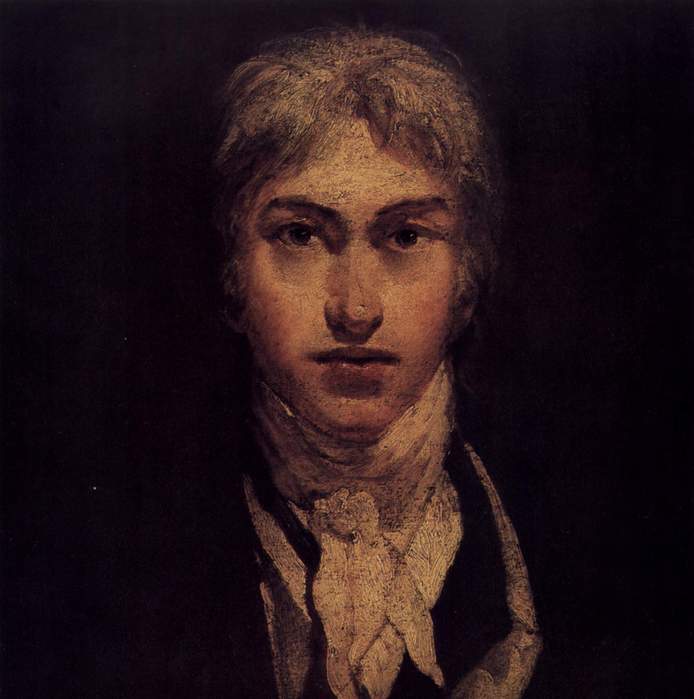
Joseph Mallord William Turner (23 April 1775, Covent Garden, London – 19 December 1851, Chelsea) was a British painter celebrated for his images of the elements — water above all — and a forerunner of the Impressionists. The early Turner gave colour free rein on his canvases and made light the true protagonist of his pictures; the late Turner anticipated the coming of abstract painting.
The hallmarks of his art: radiant colour, a preference for waterscapes over dry land and for the raging elements over calm, colour promoted to the leading role. Setting to work on a picture, Turner painted first what was elemental, ungovernable, in flux; only afterwards did forms and boundaries emerge and the elements take on outline.
Among his famous paintings: The Burning of the Houses of Parliament, 16 October 1834; Ulysses Deriding Polyphemus; The Fighting Temeraire; Snow Storm: Hannibal and His Army Crossing the Alps; Rain, Steam and Speed – The Great Western Railway.
Legend has it that Turner's last words were: "The Sun is God." A beautiful story, and one that can be neither confirmed nor refuted. But does it much matter what William Turner said on his deathbed, when his whole life bore witness that the sun was indeed his deity?
Painter of the elements
Without Turner there would have been no Impressionism, and everything in the history of painting would have gone differently. But then no "what if" is possible. Sun, air, water, and fire were the deities to whose service Turner gave his life. He also achieved no small success in topographical painting.
He was fourteen when one of his watercolours was shown at the Royal Academy and he was granted free admission there. By then the young Turner had studied under the architect Thomas Hardwick and the watercolourist Thomas Malton. He would later remark that, given the choice again, he would have preferred architecture to painting.
The Academy's president in those years was Sir Joshua Reynolds, whom Turner held in the deepest reverence. A frequent guest at the president's house, he lingered over originals by Rubens, Poussin, Rembrandt. In old age he even let slip that his happiest days had perhaps been those spent in Reynolds's company.
As a boy he would disappear for whole days along the Thames, which he went on painting all his life. Recognition came early, and he opened a gallery of his own before he was thirty. It was his idée fixe: that all his pictures should be gathered in one place.
Turner's one unquestioned authority and god in painting was Claude Lorrain — the first to set a blazing sun, Turner's chief deity, upon his canvases. The story goes that when Turner first saw Claude's pictures he burst into tears from sheer emotion and declared that no one could ever equal them. Yet it was he who came to stand beside his idol, a worthy successor in the praise of the sun.
He began with watercolours; engravings followed, then book illustrations, and at last oils. He was extraordinarily revolutionary for his time and, even so, sought after and acclaimed. His themes were the elements, streaming light, sun, water, fire — sometimes calm, sometimes turbulent and unruly, but always giving off radiance and warmth. There is a well-known story that during a storm he asked to be lashed to the mast so as to watch the hurricane from within. It may not be true; but his utter self-abandon in everything that touched painting, and his boundless devotion to the forces of nature, make it entirely plausible.
Family and private life
Turner's mother ended her days in an asylum. Any mention of her sent the painter into a rage — not only for the painful memory of what he and his father had endured, but for the fear that bad heredity might tell on him too. And indeed, the more caustic critics were known to accuse him of madness.
With his father, by contrast, he was warm and close. Old Turner was a barber, and once his son gained independence he lived with him most of the time, becoming his chief assistant and a passionate admirer of his work. In biographies of Turner the father's death, in 1829, is usually marked out as an event in its own right — which is telling enough.
The story of Turner's private life is a murky one, though the principal figures are known. In the late '70s he became friendly with the family of the composer John Danby, and after Danby's death with his widow — so friendly that before long they were living together. Sarah Danby bore him two daughters. He was not a good father, though the children are named in his will. Sarah's niece, Hannah Danby, entered his service at twenty-three and kept his house; their relations, in all likelihood, did not stop at housekeeping. Hannah remained deeply devoted to Turner all her life. By the accounts of those who knew her she was slightly unhinged, and grew more eccentric with age; she suffered from some skin disease that left her whole face and body covered in a crust.
Turner's last love was again a widow, Sophia Booth, from whom he rented a room for several years on his visits to Margate. By her account he never contributed financially to their life together. The neighbours knew him as a Mr. Booth, a clerk of the courts. Toward the end Turner left Hannah the house with its gallery and moved in with Sophia Booth. One day Hannah, wrapped from head to foot, brought herself to come to the house where Turner — by then gravely ill — was living with Sophia; she stood in silence, and went away. It was in Mrs. Booth's arms that the failing painter died, in his seventy-sixth year. Even bedridden, she recalled, he would often call for drawing things and make sketches in his notebooks.
A difficult temper
Most of his contemporaries agree that Turner's temper was unfriendly and abrupt, and that one did well not to get too close: he was either silent, or blunt and caustic. Yet amid the chorus of complaint other voices can be heard. Once, staying with one of his rich patrons and collectors, he was asked by someone in the household why he never painted a self-portrait. "What is the use of painting so insignificant a figure as myself?" Turner answered. "It might harm my drawings. People would say — could a little fellow like that have painted them?" Rudeness is often armour for shyness and diffidence; perhaps that was true, in some measure, of Turner as well. He was short, of sturdy, squat build, with a coarse face like a bulldog's, hands forever chapped, fingers smeared with paint. No London dandy hid behind the academician's mask: he was likened to a sailor, a peasant, a cabman. He himself admitted he was no aristocrat but a labourer, and named hard daily toil as his "secret": "I know of no genius but the genius of hard work."
When Turner painted, he worked himself into a frenzy. Walter Fawkes, a rich collector who bought his pictures with relish, recalled that he would begin by flooding the paper with thin colour until it was soaked through. He often worked on several pictures at once — while one dried he took up the next, then another, then returned to the first. When a sheet had dried he would fall, as if in a transport, to tearing, scraping, and rubbing the paper, in movements that seemed chaotic, without any system; and little by little the image would appear. His method was the opposite of the classical approach, with its strict predetermination of form and ground. Turner first summoned up the fluid, elemental space in which he worked, and out of it, under the strokes of his brush — and often of his fingers — came light, colour, radiance, sun, water, fire. Painters would sometimes make their final corrections to pictures already hung in the Academy; in Turner's hands this was a wild spectacle — he might rub in paint with spit, touch up with a finger, and the fury with which he went at a picture made onlookers fear for the canvas itself.
Turner was also an excellent man of business who knew how to handle money. There survives the story of Walter Scott's attempt to enlist him to illustrate the Provincial Antiquities of Scotland. "Turner's palm," Scott told his publisher, "is as itchy as his fingers are ingenious, and he will do nothing without cash, and anything for it, take my word. He is almost the only man of genius I know who is so shabby in these matters." Turner was grasping about money — yet after his death it came out that for many years he had taken no rent from a penniless lodger in a house he owned.
With colleagues he was scarcely more tactful, and after his election as academician in 1802 many began to accuse him of arrogance and hauteur. All the same, his colleagues prized his comments exceedingly: at a glance he could say exactly what a work needed correcting, and it always proved the right call. Difficult character notwithstanding, his work won recognition both at the Academy and in the houses of rich collectors. The painter Benjamin West called Turner the greatest painter of the age and acknowledged his merits in a most elegant formula: "Rembrandt would have liked to paint like that!.. If he could."
Teaching, on the other hand, was his weak point. As Professor of Perspective at the Royal Academy he spoke dully and confusedly — though the students loved his lectures and came all the same. The real interest began when, abandoning the lecture, he set about showing what painting was, and what it meant to make a picture.
John Ruskin, son of a rich wine merchant, met Turner when the painter was sixty-five and he himself twenty-one. Ruskin became the most militant admirer of Turner's art and a fierce champion of his reputation. Art historians regard him ambivalently — there is a view that Ruskin was a rather vulgar rich dandy. But whoever he was, it is largely thanks to his efforts that Turner's last wish was carried out: that his pictures be gathered, so far as possible, and shown in one place. Since 1949 that place has been the Tate Gallery in London, the official home of Turner's work.
Travels
The Thames was his passion, his love, the chief subject of his whole life. As a young man he built a boat and drifted down the river, greedily storing up subjects for future pictures. Indeed he travelled with a single aim — to fill himself with impressions, to find new themes and new colours.
In his youth he roamed the mountains of Wales; later came the centre, north, and south of England. From the 1800s he travelled in Europe: France, not yet an artistic mecca; Switzerland; Scotland; Germany… Italy! That was where he longed to be — to see Rome, Turin, Milan, Verona, to make sketch after sketch, drawing after drawing. But above all, Venice. To Turner, so finely attuned to the play of light, the movement of water, the glint of sun, Venice must have seemed paradise. What did he feel, finding himself there for the first time? He would return to that paradise more than once. In his Venetian scenes he seems to have set the sun itself behind the canvas, and it is its rays that make the pictures so radiant. That sun he would never lose again.