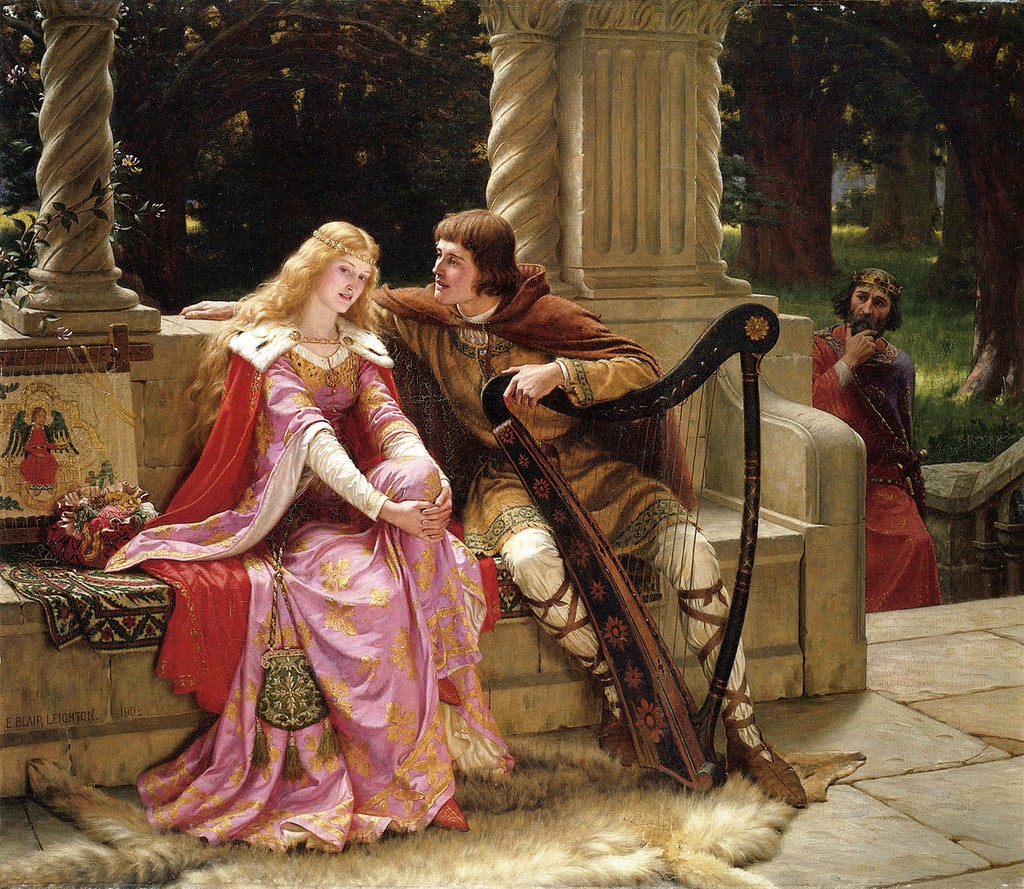
The queen, wife of Meliadus, king of Loonois, was delivered of a boy and died almost at once, with barely time to kiss her son and give him the name Tristan — from the French for "sorrowful" — for he had been born in sorrow. The king entrusted the infant to Gouvernal and himself soon married again. The boy grew up strong and handsome as Lancelot, but his stepmother conceived a dislike for him, and Gouvernal, fearing for his charge's life, carried him off to Gaul, to the court of King Faramon. There Tristan received the upbringing proper to a knight, and at twelve years old he set out for Cornwall, to serve his uncle King Mark.
Cornwall in those days was forced to pay Ireland a grievous yearly tribute: a hundred maidens, a hundred youths and a hundred thoroughbred horses. When the mighty Morholt, brother of the Irish queen, arrived once more to collect it from Mark, the young Tristan, to general astonishment, challenged him to single combat. King Mark knighted Tristan and appointed the Isle of Saint Samson as the field. Meeting in the charge, Tristan and Morholt wounded each other with their lances; Morholt's lance was poisoned, but before the venom could do its work Tristan struck his opponent a blow of such force that it split his helmet, and a shard of Tristan's sword lodged in Morholt's skull. The Irishman fled and soon died, and Cornwall was freed of its tribute.
Tristan suffered terribly from his wound, and no one could help him, until a lady advised him to seek his cure in other lands. He took her counsel and set out alone, without companions, in a small boat; for two weeks the sea carried it where it would, and at last cast it on the Irish shore beneath a castle where lived King Anguin and the queen who was Morholt's sister. Concealing his true name and calling himself Tantris, Tristan asked whether there was a skilled physician in the castle; the king replied that his daughter, Iseult the Fair, was deeply versed in the healing art. While Iseult nursed the wounded knight, he had time to observe that she was very beautiful.
When Tristan had recovered, a terrible serpent appeared in Anguin's kingdom, daily spreading havoc and ruin around the castle. To whoever slew it the king promised half his realm and his daughter Iseult in marriage. Tristan killed the serpent, and the wedding day had already been fixed, when one of the Irish knights announced that Tristan's sword bore a notch exactly matching the piece of steel drawn from the skull of the dead Morholt. Learning who had so nearly become her kinsman, the queen would have cut Tristan down with his own sword, but the noble youth claimed the right to stand before the king's judgment. The king did not have him executed, but ordered him to leave the country at once. In Cornwall King Mark raised Tristan high, making him captain and steward of his castle and domains — and before long came to hate him. He pondered a long while how to rid himself of Tristan, and at last announced that he had a mind to marry. The valiant Tristan publicly promised to fetch the bride; and when the king declared that his chosen one was Iseult of Ireland, Tristan could not take back his word and had to sail for Ireland and certain death. The ship carrying Tristan, Gouvernal and forty knights was caught in a storm and driven ashore by King Arthur's castle. King Anguin chanced to be in those parts as well, and Tristan went out in his stead against the giant Bloamor and defeated him. Anguin forgave Tristan the death of Morholt and took him back to Ireland, promising to grant him any request. Tristan asked the king for Iseult — not for himself, but for his uncle and lord, King Mark.
King Anguin granted it; Iseult was fitted out for the voyage, and the queen gave her daughter's maid Brangien a flask of love potion, to be drunk by Mark and Iseult when they mounted the marriage bed. On the way back the day grew hot, and Tristan called for cold wine for himself and Iseult. By an oversight the youth and the maiden were served the flask with the potion; they drank of it, and at once their hearts beat to another measure. From that hour they could think of nothing but each other.
King Mark was struck to the heart by Iseult's beauty, and the wedding was celebrated the moment the bride reached Cornwall. So that the king should not discover Iseult's fault, Gouvernal and Brangien contrived that he should pass the first night with Brangien, who was a virgin. When King Mark entered the bedchamber, Iseult blew out the candles, explaining it as an old Irish custom, and in the darkness yielded her place to the maid. The king was well content.
Time passed, and Mark's hatred of his nephew boiled up anew, for the glances Tristan and the queen exchanged left no doubt that both were filled with an irresistible mutual longing. Mark set a trusted servant named Audret to watch the queen, but it was long before Audret learned that Tristan and Iseult met alone in the garden. He told his master, and the king, taking his bow, hid in the crown of a laurel tree to see for himself. But the lovers noticed the watcher in time and held a conversation designed for his ears: Tristan wondered aloud why Mark so hated him, who loved his king so devotedly and revered the queen so sincerely, and asked Iseult whether there was any way to overcome that hatred.
The king was taken in by the lovers' ruse; Audret fell into disgrace as a slanderer, and Tristan was restored to honour. Audret, however, did not abandon his design of delivering Tristan into the king's hands. One day he strewed sharpened scythe blades about the queen's bedchamber, and Tristan, in the dark, cut himself on them without noticing. Iseult felt the sheets grow wet and sticky with blood, understood everything, sent her lover away, and then deliberately wounded her own leg and cried out that an attempt had been made on her life. The guilty party could only be Audret or Tristan; and Tristan insisted so hotly on a trial by combat to prove his innocence that the king dropped the inquiry, fearing to lose so faithful a servant as Audret.
Another time Audret gathered twenty knights who bore Tristan a grudge and hid them in the chamber next to the bedchamber; but Tristan, forewarned by Brangien, fell upon his enemies without armour, sword in hand. They fled in disgrace, yet Audret had partly gained his end: Mark shut Iseult up in a high tower which no man could enter. The separation from his beloved caused Tristan such suffering that he sickened and nearly died; but the devoted Brangien, dressing him in women's clothes, brought the youth to Iseult after all. For three days Tristan and Iseult delighted in their love, until Audret learned of everything and sent fifty knights to the tower, who seized Tristan as he slept.
The furious Mark ordered Tristan sent to the stake and Iseult given to the lepers. But on the way to the place of execution Tristan managed to break free of his guards, and Gouvernal rescued Iseult from the lepers. Reunited, the lovers found refuge in the Castle of the Wise Maiden in the forest of Morois. Their untroubled life did not last: King Mark discovered where they were hiding, and in Tristan's absence descended on the castle and carried Iseult off by force; Tristan could not come to her aid, for that very day he had been treacherously wounded by a poisoned arrow. Brangien told him that only the daughter of King Hoel, Iseult of the White Hands, could heal such a wound. Tristan travelled to Brittany, and there the king's daughter, who found the young man much to her liking, did indeed cure him. Hardly had Tristan recovered when Hoel's castle was besieged by a certain Count Agrippa with a great army. Leading a sortie, Tristan routed Hoel's enemies, and the king resolved to reward him with his daughter's hand.
The wedding was held. But when the couple lay down together, Tristan suddenly remembered the other Iseult, the Fair, and went no further than embraces and kisses. Knowing nothing of other delights, the young bride was perfectly happy. Queen Iseult, however, on learning of Tristan's marriage, nearly died of grief. Nor could he long endure the separation from his beloved. In the guise of a madman Tristan came to Cornwall and, having amused Mark with his talk, was kept at the castle. There he found a way to reveal himself to Iseult, and for two whole months the lovers met whenever the king happened to be away. When the time came to part, Iseult wept bitterly, foreboding that she was never to see Tristan again. In time Tristan was wounded once more, and once more the physicians could not help him. Feeling himself grow worse and worse, he sent for Iseult, ordering the shipman to sail under white sails if Iseult was aboard, and under black if she was not.
By cunning the shipman contrived to spirit Iseult away from Mark, and was already bringing his ship into harbour under white sails when the other Iseult, who had learned what the colours meant, hurried to Tristan and told him the sails were black. It was more than Tristan could bear, and his heart broke, and his soul departed.
Coming ashore and finding her beloved dead, Iseult embraced the lifeless body and died herself. By Tristan's own wish, his body and Iseult's were carried to Cornwall. Before his end he had tied to his sword a letter to King Mark telling of the love potion drunk unwittingly. Reading it, the king grieved that he had not known sooner, for then he would never have persecuted the lovers, powerless as they were against their passion.
At King Mark's command Tristan and Iseult were buried in a single chapel. Soon a beautiful thorn bush rose from Tristan's grave and, arching over the chapel, rooted itself in Iseult's. Three times the king ordered the bush cut down, and each time it stood there again the next day, as beautiful as before.