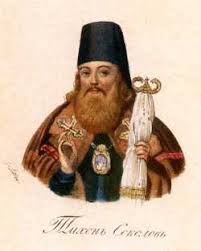
St Tikhon — Timofey, in the world — was born in 1724 into the family of the poorest church reader of the village of Korotsk, in the Valday district, and lost his father soon after his birth. His childhood and boyhood passed in dreadful poverty: at times he had to work a whole day for the villagers of his native place for a crust of bread. He barely escaped conscription as a soldier, and entered the Novgorod seminary, where he later became an instructor. Certain particular circumstances — a miraculous deliverance from mortal danger, and certain visions — inclined him toward the monastic life. In 1758 he was tonsured a monk with the name Tikhon. The following year he was appointed rector of the Tver seminary, where he lectured on moral theology — and lectured, moreover, in Russian rather than in Latin, as had been the custom before him. Besides the students, many outsiders came to hear him.
In 1761, in his thirty-seventh year, the hieromonk Tikhon was chosen bishop by a manifest sign from above. For about two years he was vicar in Novgorod, and for about four (1763–1767) he governed the see of Voronezh in his own right. Throughout his episcopate he preached tirelessly and urged the priests under him to do the same. In Voronezh a festival in honour of Yarilo, kept up since pagan times, was attended by every sort of riot. One day the bishop appeared unannounced in the public square at the very height of the revels and began to rebuke the rioters. His words told so deeply that the festival was never held again.
Meanwhile his strenuous labours had broken St Tikhon's health. He asked to be released from his office, and spent the last sixteen years of his life (1767–1783) in retirement at the Zadonsk monastery. All his time, apart from four or five hours of rest, was given to prayer, to the reading of the word of God, to works of charity and the writing of edifying books. Every day he came to church. At home he would often fall to his knees and, bathed in tears like the worst of sinners, cry out: "Lord, spare me. Lord, have mercy!" Without fail he read several chapters of Scripture daily — the prophet Isaiah above all — and never travelled without a small Psalter. The whole of his pension of four hundred rubles went to charity, and to the same purpose went everything he received as gifts from acquaintances. Often, in a simple monk's habit, he would set off for the nearest town, Yelets, and visit the inmates of the local prison; he comforted them, moved them toward repentance, and then gave them alms. He was himself utterly without acquisitiveness, living amid the simplest and poorest furnishings. Sitting down to his meagre table, he would often think of the poor who had not even such food as his, and begin to reproach himself with having laboured little, by his own reckoning, for the Church — and bitter tears would run from his eyes. Hot-tempered and quick by nature, he was astonishingly meek and forgiving: he would bow to the ground before his cell-attendant, begging pardon for some word that had seemed offensive, and always strove to repay with good whenever anyone did him an injury. Once, in the house of a friend, he fell into conversation with a nobleman of Voltairean views and refuted the scoffer so mildly yet so thoroughly on every point that the proud man lost command of himself and struck the bishop on the cheek. St Tikhon threw himself at the man's feet and began to beg forgiveness for having provoked him. This humility so worked upon the insolent offender that he returned to the Orthodox faith and afterwards became a good Christian.
St Tikhon possessed the gifts of prophecy and the working of wonders, and read the thoughts of those who spoke with him. In 1778, the year of the future emperor Alexander I's birth, he foretold many events of that reign — in particular, that Russia would be saved and the invader (Napoleon) would perish. "The Lord God in many cases heard him," his cell-attendant wrote. The saint loved above all to converse with the simple folk, comforting them in their hard lot and helping those who had been ruined. Children from the monastery settlement used to visit him; he taught them prayer, and after the talk would give them money. St Tikhon's blessed death came on August 13, 1783. Sixty-three years later his incorrupt relics were uncovered, and in 1861 he was numbered among the saints. Of his written works, especial favour has always attended a collection of short reflections, rich in examples drawn from life, entitled A Spiritual Treasury Gathered from the World.
The fuller account of his life may begin with a general observation: in describing the lives of the saints of one's own land, there is comfort and encouragement for the heart in the appearing of God's saints upon Russian soil — clear proof that the grace of God has not run dry for us either, but ever supplies what is lacking in feeble human nature. And what a triumph for the Orthodox Church, glorified in her faithful sons! The Lord has crowned them with crowns of incorruption in witness to their labours and to the right confession of that Church which remains to this day the pillar and ground of the truth.
St Tikhon's origins were of the humblest. His father, Savely Kirillov, was a church reader in the Novgorod province, in the village of Korotsk of the Valday district, and left behind him a widow with five young children. The future saint was born in 1724 and named Timofey. Losing his father in infancy, he remained in the care of his mother Domnika and his elder brother Evfimy. "As far back as I can remember myself," St Tikhon recalled in later life, "there were in our mother's house (my father I do not remember) four of us brothers and two sisters; the eldest brother served in the reader's office, the middle brother had been taken for a soldier, and we younger ones all lived in great poverty..." In such a state Timofey could scarcely hope for schooling enough even to fill a sexton's place. A certain rich, childless coachman of the post took a liking to Timofey and wished to adopt him, asking Domnika for the boy again and again and promising to bring him up as his own son. St Tikhon remembered it thus: "My mother, though she refused him — she could not bear to give me up — was driven at last by sheer want of bread to let me go... I remember well how she took me by the hand and led me to the coachman's. My eldest brother was not at home at the time; when he returned he asked our sister, 'Where is mother?' She answered, 'She has taken Tisha to the coachman.' My brother overtook her, knelt down before her and said: 'Give him to the coachman, and a coachman he will be. I would sooner go begging with my sack than give my brother away... I will try to have him taught his letters; then he can be taken on at some church as a reader or a sexton.' And mother turned back home." So the mysterious Providence of God guided the future great ascetic from his very boyhood. A brother's love saved Tikhon; the same love prepared in him a worthy servant of the Church. Yet, remaining in his parents' house, he continued to languish under the weight of bitter poverty, living on black bread alone, and sparingly at that. "When there was nothing to eat at home," he told his cell-attendant in the last years of his life, remembering his childhood, "I would go and harrow a whole day for some rich ploughman, only so that he would feed me." So Timofey laboured, living at home until he was fourteen.
In 1737 two decrees of the empress Anna Ioannovna were issued, sternly ordering a census of the church servitors' sons, the "surplus" — especially those not at school — to be taken for military service. In the Novgorod diocese, which then had no bishop, these decrees were executed with particular zeal.
Timofey's mother, in her extreme penury after the recent crop failure, could find no means of keeping her son at a church school; yet she brought him to Novgorod to be examined by the authorities, hoping still to save him from the army. Her hopes were nearly disappointed: Timofey had already been marked down for exclusion from the clerical estate and assignment to a military school when his elder brother, then serving as a reader at one of the Novgorod churches, took pity on him once more. Despite his own great poverty he resolved to take the boy upon his charge, and prevailed on the authorities to place him in the church school. On December 11, 1738, Timofey was enrolled in the Novgorod diocesan Slavonic school at the bishop's house.
In 1740, through the efforts of the new bishop of Novgorod, Amvrosy, the Slavonic school was transformed into a theological seminary. Out of the school's thousand pupils Timofey, as one of the ablest, was transferred to the newly opened seminary and taken onto the state's maintenance. The seminary authorities gave him a new surname — Sokolovsky. Of his seminary years St Tikhon later recalled: "I continued my studies at public expense and suffered great want for lack of the necessities of life; and this is how it was: when I received the state ration of bread, I would keep half of it to live on and sell the other half; with the money I bought a candle, and with it I would sit on the stove and read my book. My companions, sons of rich fathers, would sometimes find the worn-out soles of my bast shoes and wave them at me in mockery, chanting, 'We magnify thee.'" To these same men it later fell to swing the censer before Bishop Tikhon in earnest.
The youth, always at the head of his contemporaries, moved successfully up through the classes. He spent nearly fourteen years at the seminary: two years on grammar, and four each on rhetoric, philosophy and theology — the length of the course being due to the shortage of teachers in the newly founded school.
In 1754 Timofey completed the seminary. One scholar has characterized his years there thus: "At a time of universal infatuation with scholasticism, when in the very seminary that reared the saint scholastic learning lorded it over everything, when between word and deed, between thought and reality, there was almost nothing in common — when men spoke of many things, and very well, but did little or nothing — the saint of Zadonsk was a man wholly free of these defects and contradictions." Timofey was appointed instructor, first in Greek, then in rhetoric and philosophy. The young teacher, remarkable for his warmth of heart, modesty and devout life, was loved and respected by all — the students, the seminary authorities and the Novgorod hierarchs alike.
In that period of his life the future saint turned mind and heart ever more toward God, studying His wondrous ways and yearning for monasticism and the contemplation of divine things. The Providence of God was preparing in him a valiant ascetic and lamp of the Russian Church, and, guarding him from dangers, gave plain signs of his high calling.
By God's mercy St Tikhon acquired a special power of spiritual sight. One May night Timofey stepped out of his cell and saw the heavens opened and a wondrous light. Soon after this vision he finally resolved to become a monk.
On April 16, 1758 — Lazarus Saturday — Timofey Sokolovsky was tonsured with the name Tikhon. After the tonsure he was summoned to Petersburg, where Dimitry (Sechenov), bishop of Novgorod, ordained him hierodeacon, and in the summer of the same year hieromonk. That year too he began to teach philosophy and was made prefect of the seminary, though he did not long remain in the post. Afanasy (Volkhovsky), bishop of Tver, who knew Father Tikhon's gifts and devout life well, petitioned for his transfer to his own diocese. By decree of the Most Holy Synod of August 26, 1759, the hieromonk Tikhon passed under the Tver archbishop, who raised him to the rank of archimandrite and made him superior of the Zheltikov monastery. In the same year archimandrite Tikhon was appointed rector of the Tver seminary and superior of the Otroch monastery, sitting at the same time in the diocesan consistory and lecturing on theology in the seminary.
So swiftly did Tikhon advance along the spiritual path, like a lamp that could not stay hidden under a bushel. His inner worth was already known to many, and the higher degree of the episcopate awaited him. He spent two years as rector, and the lessons in theology he composed for the students of his seminary became the foundation of his remarkable book on true Christianity, for the edification of the whole Russian Church — for he was steeped through and through in the spirit of Holy Scripture and of the writings of the fathers. In his deep humility Tikhon never imagined he might attain the episcopal dignity; but the Providence of God pointed him out, mysteriously, to the chief pastors of the Russian Church.
One Pascha, at the Divine Liturgy, during the Cherubic Hymn, he approached the hierarch — who was removing particles at the table of oblation — along with the other priests, and to his customary petition, "Remember me, holy master," Archbishop Afanasy, forgetting himself, replied: "May the Lord God remember thy episcopate in His Kingdom." The humble archimandrite was thrown into confusion, but the archpastor said with a smile: "God grant you to become a bishop." On that very day, in Petersburg, Metropolitan Dimitry, first member of the Synod, was choosing a vicar for Novgorod together with Epifany, bishop of Smolensk. The names of seven candidates had already been written down, the choice to be settled by lot, when the bishop of Smolensk asked that the name of the Tver rector be added; the metropolitan observed that he was still young, but ordered the name entered. Three times the lot was cast, and three times it fell on Tikhon. "It is plainly God's will," said Dimitry. "Though I had meant to appoint him elsewhere — as archimandrite of the Lavra of St Sergius."
On May 13, 1761, archimandrite Tikhon was consecrated bishop of Kexholm and Ladoga, vicar of the Novgorod diocese, with the government of the Khutyn monastery. Thus in his thirty-seventh year, seven years after finishing the seminary course and three after taking monastic vows, Tikhon was clothed by the will of God with the episcopal dignity.
The people of Novgorod received with love a pastor reared in their own midst, whom they had long learned to respect for his monastic life. Many of the companions who had once laughed at his bast shoes were by then priests and deacons in Novgorod. They came before their bishop in great embarrassment, expecting reproaches; but Bishop Tikhon met them gently — as Joseph once met his brothers in Egypt — with a word of peace: "Fear not; I am God's." Smiling, he reminded them of their school days: "You used to wave shoe-soles at me; now you will wave censers" — and, seeing their confusion, added, "I say it to you in jest." Tikhon's sister, who lived in Novgorod, watched her brother's solemn reception and dared not present herself; but he himself invited her the next day, and together they wept over the bitter years of their childhood in utter poverty. "You, my dear, will never weary me," Tikhon told her, "for I honour you as my elder sister." She lived scarcely a month under her brother's roof: it was he who sang her funeral.
The saint's time in Novgorod was to be short — little more than a year. On February 3, 1763, after the death of Ioanniky (Pavlutsky), bishop of Voronezh and Yelets, he received a new appointment, to the see of Voronezh.
The diocese of Voronezh — which took in, besides the Voronezh province, certain towns of the Tambov, Oryol and Kursk provinces, together with the Land of the Don Host — stood then in need of thoroughgoing reform. Up to eight hundred churches and more than eight hundred thousand souls made up St Tikhon's vast flock; yet it was stripped of all material means, for at that very time the church properties had been confiscated and the salaries provided under the new establishments were not yet being paid. In vain did St Tikhon write to the civil and church authorities, setting out the difficulty of his position, the decay of clerical education, the ruin of the church buildings themselves and the wretched state of his cathedral.
A still greater affliction of the Voronezh country was the schism. From the end of the seventeenth century the broad steppes of the Don had become a convenient and favoured refuge for Old Believers and sectarians fleeing the government's persecution. It was no light task for St Tikhon to contend with the disorders of church life; his good intentions met obstacles from individuals and from every kind of authority alike, so that he had to seek his help from above, and in the strength of his own spirit, in the abounding grace of his pastoral zeal.
At the same time the saint set about the building of material churches and the renewal of those not made with hands, which constitute the Church of the living God (2 Corinthians 6:16), giving special attention to the development and right ordering of clerical schooling. Since his cathedral was falling into utter decrepitude, in the very next year after his arrival he began, on alms alone, to build a new stone cathedral of the Archangel, which he had the consolation of completing during his tenure. In place of a seminary he found at the bishop's house, on meagre funding, only a poor school of Slavonic letters, the old levies on church properties having been abolished under the new establishments. He supported this school as far as he could from his own means, founded others in the towns, and, as soon as the first modest stipend was received, immediately assembled a full seminary in Voronezh (1765), bringing teachers of divinity from Kiev and Kharkov, so that within a short time it reached a flourishing state. And how could it be otherwise, when the pastor himself cared for it without ceasing, knowing that it would serve the moral strengthening of the flock entrusted to him? He often visited the classes and acquainted himself with the students' characters, working on them by his personal presence far more than through deputies. He pointed out the best order to follow in the education of the young, marked out edifying passages from spiritual writers, and himself instructed the students by word of mouth; the most distinguished among them he encouraged with presents — a book, or clothing — and sometimes with money, or by taking them onto full state maintenance. Beyond this, he established for the seminarians an open teaching of the Law of God in the cathedral church on Sundays.
The saint felt keenly that the moral improvement of his flock required, before all else, worthy pastors to guide it directly; and clerical education was decisive, too, in the struggle with schism and sectarianism. His first care, therefore, was the founding of schools both for the poor children of the clergy and for the clergy themselves. Soon after his arrival he wrote for the clergy a special little book, The Duty of the Priest concerning the Seven Holy Mysteries, and sent it round all the monasteries and parishes for free distribution to the priests. This little book was a kind of small catechism, setting out in questions and answers the teaching on each of the sacraments, with an earnest charge to celebrate them with reverence. The following year he enlarged this catechism with a fuller instruction, On the Mystery of Repentance, to guide inexperienced priests at confession — how to speak with those who wish to open their souls to them. Not content with that, a year later he wrote a Circular Epistle to the clergy of his flock, urging upon the priests a modest and sober life, brotherly love among themselves and love toward their parishioners, and reminding them in the words of the Gospel of the high duty of their calling. To spiritual offices the saint strove to appoint worthy men, and he particularly required every clergyman to own a New Testament and read it daily. At the same time he drew up a rule for the diocesan boards, with an exhortation to keep justice and their oath. Nothing, in short, was forgotten by the careful archpastor for the instruction of those set on spiritual watch.
St Tikhon was close to the people both by his lowly origin and by his early upbringing, and so he had an especial love for people of simple station and knew how to draw near them with a sincere word that reached every heart. Measuring the spiritual need of the people, the good pastor composed four little books: A Brief Exhortation for the Constant Remembrance of Death; Notes from Holy Scripture for the Rousing of Sinners from the Sleep of Sin; An Instruction on the Mutual Duties of Parents and Children; and Flesh and Spirit — Their Mutual Struggle in Man. The saint ordered the priests to read these little books to the people in place of church sermons.
In the Voronezh country ancient pagan rites still lingered. The saint's spirit was stirred to indignation above all by the "annual festival" in honour of the pagan deity Yarilo, and by the wild folly and drunkenness of Shrovetide.
In his writings from the Voronezh years we read: "The souls of many are in an evil state... enfeebled, fallen sick, in need of medicine and a healing plaster"; "of Christian faith and Christian life not even the traces are to be seen"; "insolence, evil-doing, violence, spite and other iniquities of wicked and pernicious men multiply more and more"; "many, especially in the present age, put off repentance now to sickness, now to old age, now to death... a grievous sin, and truly a delusion of the devil — the mark of utter carelessness about salvation, and of the sleep of sin."
Against all this St Tikhon took the most resolute measures. Once he appeared in person at the festival of Yarilo. At the sight of the bishop before them, some "fled the square of the games for shame"; others, "stung in conscience," fell silently at his feet; still others, "in the heat of their repentance, begged forgiveness." The booths of the games and the fair were torn down in the saint's presence.
The next day the archpastor summoned to his residence all the priests of the city and its leading citizens, and in a sermon of rebuke laid before them all the disorders of the late festival, imploring them to abandon it for ever. On the following Sunday he appointed a general assembly in the cathedral, and there again delivered a powerful discourse against the pagan feast. Having first shown how lawless it was and how unworthy of Christians, he reminded the Orthodox that they were enrolled in the army of Christ and had renounced Satan and his angels at Holy Baptism, yet, forgetting their high calling, fell to rioting and passed from lawless games even to manslaughter, in the devil's service — for this observance had been established in the days of paganism. Then he turned to the priests, who are set as watchmen over the house of God, and reminded them of their strict accountability should they, through negligence, allow the ruin of Christian souls. Nor did he fear to speak a strong word to the civil authorities present in the cathedral, that they should firmly do their duty in watching over the good order of the people. And the fathers of families and the elder citizens he exhorted from the pulpit not to remain indifferent to such a disgrace, but to keep their children and dependants from taking part in devilish rites, lest occasion be given to the enemies of Orthodoxy to mock the Holy Church and to defame the very city where so blasphemous a festival was held — whose unworthy name ought to be blotted from the people's memory.
This discourse, alive with simplicity of heart and pastoral zeal, had an astonishing success: sobbing in the church drowned the preacher's voice; all repented with contrition of heart; and, to the everlasting credit of the good pastor, the pagan custom was abandoned in Voronezh for ever. It was a triumph of Christianity and of love, worthy of the first ages of the preaching of God's word. Tikhon humbly gave thanks to God for the success granted him. By the simplicity and force of his preaching St Tikhon also brought back into Orthodoxy not one thousand of the Old Believers. "His influence upon the schismatics was great," a historian notes. "Even the most obstinate among them, who never returned to the bosom of Orthodoxy, undoubtedly revered him."
St Tikhon was tireless in action; not a free minute passed with him in vain, and he took everything all too closely to his loving heart. Caring for pastors and flock, he did not forget the seemliness of God's house — the repair and good order of the churches, the vessels, the sacred plate and the holy icons. He missed no festal service, and never left his flock without instruction. In his sermons he took the field above all against love of money and the many forms of extortion, against immoral amusements, against luxury, miserliness and want of love for one's neighbour; these vices and their like he exposed boldly, in all their nakedness and deformity.
It happened, though, that the meek pastor had to endure censure for his devout zeal, for the seed of God's word did not everywhere find welcoming soil. The weaker sort sometimes disliked his laying special fasts upon the townsfolk in times of common calamity; but fear of offending him compelled obedience, for men already saw in him, living, a saint of God, and said among themselves: "One dare not disobey — he will complain to God." And indeed there were cases when the Lord visibly punished the disobedient. Once Tikhon was travelling to a landowner's funeral through the village of Khlevnoe on the Moscow road. The rude inhabitants there delayed him a long while, refusing horses on the pretext that they had none, when in fact they were exceedingly rich in them. Soon afterwards nearly all their horses died, so that they fell into utter poverty and felt their guilt in having offended a man of God. Some years later, when Tikhon was already living in retirement at Zadonsk, they came to beg his absolution, complaining that the meek bishop had, as they thought, cursed them. Tikhon lay ill and could not receive them, but bade them be told that he had never dreamed of cursing them: it was God who had punished them for disrespect toward their pastor.
The unbroken labours and cares from which St Tikhon never had rest, together with the vexations and constant obstacles met in carrying out his good designs, gravely undermined his health. He grieved that he could no longer toil with his former tirelessness for the Church of God; and in 1767 he was obliged to give up the government of the diocese and withdraw into retirement. He was assigned a pension and allowed to live where he chose.
His public service on the Voronezh see had been brief — four years and seven months — yet even in so short a span he left a fruitful mark on spiritual enlightenment, on the good order of the church, and on missionary work. After leaving office St Tikhon lived more than fifteen years in retirement in the monasteries of the Voronezh diocese: until 1769 in the Tolshevo monastery of the Transfiguration, and thereafter at Zadonsk.
The solitary Tolshevo monastery, forty versts from Voronezh, had drawn the saint by its deep stillness amid dense forests. He hoped that fresh air and quiet, with country labours, would restore his strength; but the marshy situation proved bad for his health. For more than a year he hesitated, and at last, in Great Lent of the following year, 1769, resolved to change his abode, choosing for his peaceful refuge the monastery of Zadonsk, favourable in climate, where he settled for good in a small stone house built against the bell-tower at the very gates.
Settled in that monastery, St Tikhon became a great teacher of the Christian life. In those years he wrote his finest spiritual works, in which with deep wisdom he unfolded the ideal of true monasticism — the Rule of Monastic Life and the Counsels to Those Turned from the Vain World — and that ideal he embodied in his own living. He kept the ordinances of the Church strictly, and attended the services of God's house with zeal, almost daily, often singing and reading on the kliros himself; in time, out of humility, he gave up all part in the celebration and stood in the sanctuary, reverently signing himself with the cross. His favourite occupation in his cell was reading the lives of the saints and the works of the fathers. The Psalter he knew by heart, and on the road he would commonly read or sing psalms. By his life the saint taught all around him how one must live in order to be saved; his asceticism, and a goodness that seemed not of this earth, confirmed men in the sense of the high worth of the Christian faith.
As his strength returned, the saint began to suffer heartfelt distress over his seeming idleness, as active men will who suddenly find themselves at liberty. Abundance of time weighed on his soul exactly as the want of it once had in his pastoral labours. It seemed to him that he was altogether useless to society, yet drew a pension for past service; he reproached himself even for having accepted, if only for a short time, the episcopal office, counting himself unworthy of it. Such dark thoughts troubled his heart, and he often spoke of them to those near him, and wrote of them to the first member of the Holy Synod, Metropolitan Gavriil, who knew and esteemed him. Thinking to set him at rest, the metropolitan offered him the government of the Iversky monastery at Valday, near his birthplace. Tikhon could not decide, wrestling with the thought of changing yet again the place he had chosen for his rest; then, submitting himself wholly to God's will, he said firmly: "Though I die, I will not leave this place!" — and from that moment he grew calmer. He was further quieted by the word of a simple elder, taken as a secret sign of God's Providence. There was at Zadonsk a certain Aaron, whom he revered for his strict life. One day the saint's cell-attendant, meeting the monk at the holy gates, remarked that the bishop was firmly minded to leave Zadonsk for the Novgorod diocese. Aaron replied: "The Mother of God does not bid him leave this place." When the cell-attendant repeated the elder's words, St Tikhon answered humbly, "Then I shall not go," and tore up the petition he had already prepared. Having put away every thought of removal from Zadonsk, he resolved to give himself wholly to the service of his neighbours, that he might be useful to the Church, though no longer upon a bishop's throne.
The saint loved to talk with everyone about the soul's salvation. He would gather children round him and teach them to pray; he entered into conversation with peasants, teaching love of labour and the fear of God, and shared the sorrows of the unfortunate. Sometimes he drove out to acquaintances — oftenest when they least expected him, but stood in need of his counsel. Beggars flocked to him in crowds, and he gave alms to all, on returning from church or on his porch through his cell-attendants; at no hour did he refuse any of the poor. He would often fall into talk with the monastery brethren, with novices and simple pilgrims, admitting each to his blessing, and doing what he could to conceal his high rank from them, that they might open their souls to him more freely; for this reason he met them in the courtyard or at his porch in a plain monk's habit, asked after their needs and labours, and had a word of edification for each. Besides these spoken conversations he kept up a devout correspondence, setting down his thoughts in letters. When some neighbouring peasant suffered from crop failure or fire, the good pastor gave him what help in money he could, borrowing it himself from benefactors. If a pilgrim fell ill on the road, he took him into his house and kept him till he recovered, and to others he sent food or medicine at home; not one of the monastery brethren who fell sick was left without his care. Nor was his help for the simple only: he did not refuse orphans of gentle birth either. Enjoying universal respect, he interceded in the courts for the oppressed and gave letters of petition under his own hand, which had their kindly effect. From all this one may judge how deeply the whole surrounding population was attached to him.
The child-loving pastor had compassion, too, on those imprisoned for debt or for crime, and visited them often. The prisoners received him as a father; he would sit down among them warmly, as in a family circle, ask each about his offence, and strive to waken repentance in him, or to instil the patience to bear his lot.
To St Tikhon the women's monastery of the Sign in Yelets owes its rebirth. In 1769 a great fire destroyed the convent, and all the nuns were transferred to Voronezh. One novice alone resolved, with the saint's blessing, to settle on the ashes of the former convent, for he had foretold that by the prayers of the departed eldresses the community would rise again. The novice found there a poor old woman who had made herself a cell out of a stone cellar, and little by little a few sisters gathered round them. With help from the saint and from one of the pious citizens of Yelets a small wooden church was built in the name of the Sign of the Mother of God, and a community formed beside it, which was in time raised to the rank of a convent.
With the years St Tikhon increased his ascetic labours. He lived in the plainest fashion: he slept on straw, covering himself with a sheepskin coat. His table was of the scantiest; yet even there he would say, as if reproaching himself with luxury: "Glory be to God — see what good food I have; while my brethren — one sits in prison, another eats his bread without salt. Woe is me, wretched man." His dress was of the simplest, for he wished to be a monk and ascetic in the full sense of the word. He never went to the bath-house, and did not like to be waited on, save only when he was ill. His humility went so far that at the mockery which was not seldom flung after him he paid no heed, seeming not to hear it, and would say afterwards: "It is pleasing to God that even the servants laugh at me — and I deserve it for my sins." Often in such cases he said: "Forgiveness is better than revenge." All his life the saint "endured with joy affronts, sorrows and wrongs, mindful that there is no crown without victory, no victory without struggle, no struggle without battle, and no battle without enemies" (canon, sixth ode).
In moments of temptation he would shut himself in his cell and, prostrate on the ground, implore the Lord with weeping to deliver him from the evil one. The greater part of the night he spent in vigil and prayer, allowing himself some four hours of rest toward dawn and about an hour after dinner. Then he would walk out into the monastery garden, withdrawing into the thick of the trees, and there too he loved to sink into the contemplation of God. The fruit of his meditations on nature and on men were the works he completed in retirement: A Spiritual Treasury Gathered from the World (1770) and On True Christianity (1776).
By the labours of self-denial and love the saint's soul rose to the contemplation of heavenly things and to the foreseeing of what was to come. He foretold much concerning the destinies of Russia — speaking, in particular, of Russia's victory in the war of 1812. More than once the saint was seen in spiritual rapture, his face changed and shining, but he forbade any speaking of it.
For three years before his end the saint prayed every day, with tears, in the words: "Tell me, O Lord, my end, and the number of my days." And one day at morning twilight he heard a quiet voice: "On the Lord's day shall be the end of thy life." This he confided to his closest friend, Father Mitrofan. The blessed peace of soul that comes after struggle already dwelt then in the holy ascetic.
At the feast of the Nativity of Christ in 1779 the saint was in church at the Divine Liturgy for the last time. On January 29, 1782, he drew up his spiritual testament, in which, having given glory to God for all His mercies toward him, he professed, in the words of the apostle Paul, his hope in God's mercy beyond the bounds of this earthly life. His death the saint foreknew and foretold three days beforehand, allowing all his acquaintances to come to him on that day for their farewells. On August 13, 1783 — "on the Lord's day" — at a quarter to seven in the morning, the saint's soul was parted from his body. "His death was so peaceful that he seemed to fall asleep." So, in his fifty-ninth year, ended the toilsome life of St Tikhon of Zadonsk.
Up to the very day of the burial a multitude of country folk and townspeople from Yelets and Voronezh kept coming to the monastery, asking for panikhidas over the departed, so that there were not hieromonks enough for the services and the help of the neighbouring priests was needed. After the funeral, which could be held only on August 20, the body of the blessed Tikhon was carried by the hands of priests to a vault specially prepared for it beneath the altar of the monastery's principal church.
The saint's memory was devoutly kept at Zadonsk, not only by those who had known him in life but by those who had merely heard of him or read his edifying works. Panikhidas were served over his tomb without ceasing, and soon after his blessed death began the signs and healings that bore witness to his heavenly glory.
On August 12, 1861, St Tikhon was numbered among the saints of the Russian Church. On the following day, at Zadonsk, before an immense concourse of pilgrims from every corner of Russia, his relics were solemnly uncovered by Isidore (Nikolsky), Metropolitan of St Petersburg and Ladoga, with a great company of hierarchs and clergy. On the saint's feast day a cathedral liturgy was celebrated, followed by a procession with the holy relics not only round the cathedral but round the whole monastery of Zadonsk where he had rested from his labours. It was a sight to move the heart. The whole monastery courtyard, every roof, the wall and the high bell-tower were studded with people, who had sat there since early morning, holding on to one another, simply to keep their places; even the monastery trees were covered with onlookers. The people threw down kerchiefs and lengths of cloth all along the path of the procession; linens and towels flew through the air over the heads of the walkers, till they lay more than an arshin deep (about 28 inches) along the road where the procession passed. Some fifty thousand arshins of linen were gathered and distributed to the poor — that St Tikhon, on the day of his glorification as in his lifetime, might clothe the destitute. So the lamp was set upon the lampstand, "that it may give light unto all that are in the house." His feast was appointed for August 13/26.
After the Revolution the monastery shared the fate of so many holy places in Russia. On January 28, 1919, a special commission carried out an "inspection" of St Tikhon's relics. Soon, however, the saint's remains were returned to the same silver shrine from which a blasphemous hand had torn them. Until the spring of 1922 the returned relics were in the keeping of the monks of the Zadonsk Bogoroditsky monastery; then their custodians became the Renovationist schismatics, who with the help of the persecutors of religion had seized the holy monastery; and in 1932 the relics of St Tikhon left Zadonsk altogether. The holy treasure was handed over to an anti-religious museum set up in the former Grand Ducal church of Yelets, and passed from there to the Oryol regional museum, in whose storerooms it lay until the Second World War. During the fighting that reduced Oryol to ruins, believers managed to rescue and preserve the relics; later, with the coming of peace, they were openly displayed in the Epiphany cathedral of Oryol — this was in 1947. But during the new anti-religious campaign under Khrushchev the relics of the wonderworker of Zadonsk found themselves once more in the storerooms of the local museum. Only in 1988 was the venerated wonder-working treasure given over to the diocese of Oryol. There, in the cathedral of Oryol, the relics remained until 1991, when, by the care of Mefody, Metropolitan of Voronezh and Lipetsk, they were solemnly returned to the place from which godless power had once torn them — beneath the vaults of the Vladimir cathedral of the Zadonsk Nativity-of-the-Theotokos monastery. This took place on the saint's feast day, August 13/26, 1991. Since then the relics of the wonderworker of Zadonsk have rested undisturbed in the Vladimir cathedral, pouring out their unfailing grace on all who come to the saint for help with a heart full of sincere faith.