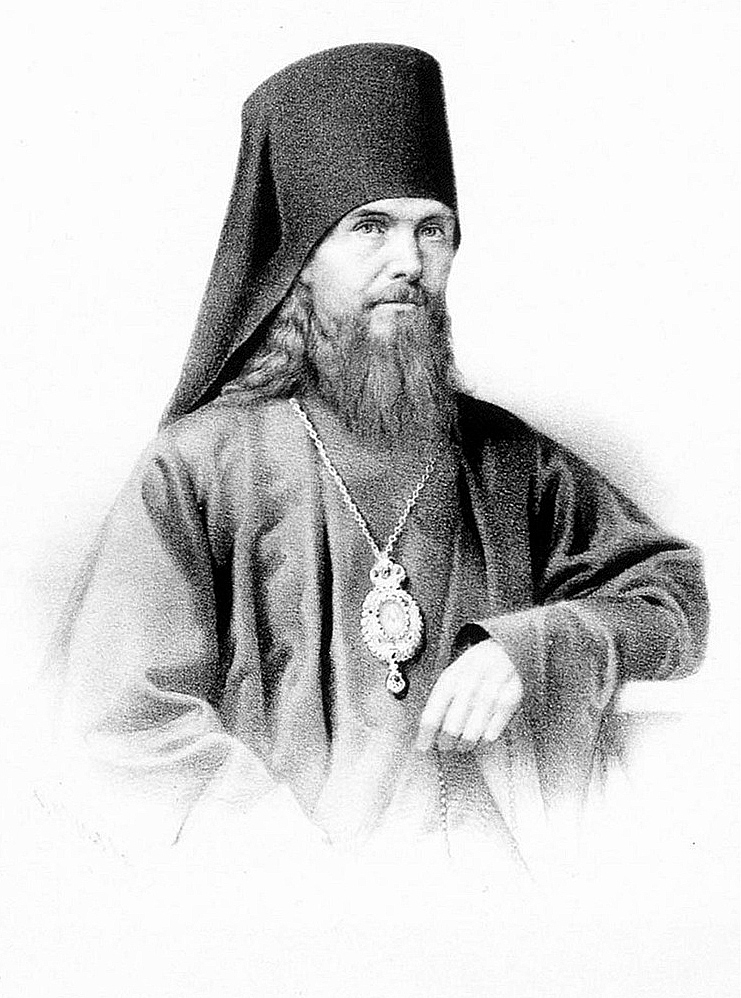
Saint Theophan the Recluse (Georgy Vasilyevich Govorov in the world, 1815–1894) was a Russian bishop, theologian, and spiritual writer — one of the most influential guides of Orthodox piety in the nineteenth century. He was canonized in 1988.
Born into the family of a village priest in Oryol province, he passed through the Livny church school, the Oryol seminary, and the Kiev Theological Academy, finishing first in his class everywhere. He took monastic vows at twenty-six and was an archimandrite by thirty-two. His path began conventionally enough, up the academic ladder: he taught at the St. Petersburg Theological Academy and served with the Russian ecclesiastical mission in Jerusalem and at the Russian embassy in Constantinople. There, in the East, he learned Greek and copied out for his own use the Philokalia, the collection of ascetic treatises by the holy fathers.
In 1859 Theophan became bishop of Tambov, then of Vladimir — a beloved hierarch, energetic, quiet, merciful. And then, in 1866, at fifty-one, at the height of his career, he asked the Synod to release him from the governance of his diocese. He withdrew to the Vysha Dormition Hermitage in Tambov province and spent there the last twenty-eight years of his life, almost all of them in complete seclusion.
His was a seclusion of a peculiar kind — no gloomy flight from the world. From a cell he did not leave for years on end, he carried on an enormous correspondence, a thousand letters a year: to students, townswomen, officers, peasants, priests, teachers, the sick — answering each vividly, concretely, without formulas. Out of this grew his great spiritual school, a practical teaching on prayer, on the thoughts of the mind, on how to live as a Christian in the world. From these letters his famous books were assembled.
His principal works: The Path to Salvation (1868), a systematic account of the Christian way — conversion, purification, growth; What the Spiritual Life Is and How to Attune Oneself to It, answers to a young woman of fashionable society, and one of the most widely read of Orthodox books; An Outline of Christian Moral Teaching (1891), his chief theological work; a five-volume translation of the Philokalia, a foundational labor that gave the Russian reader a key to the ancient monastic experience; and a series of long commentaries on the epistles of the Apostle Paul.
He died on January 6, 1894, as he greeted the feast of the Theophany. He was seventy-nine. In his last letter, written a few days before his death, he said: "One must live for the Lord, and give everything to the Mother of God."