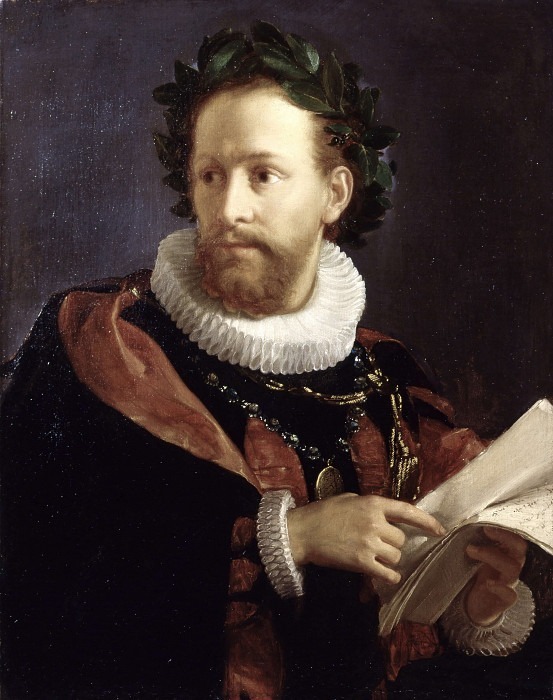
Torquato Tasso was born in 1544 in Sorrento, into an aristocratic family. His mother, Porzia de' Rossi, was Neapolitan by origin; his father, Bernardo Tasso, was away at the time of his son's birth, serving as secretary to Ferrante Sanseverino, Prince of Salerno. Bernardo returned to Sorrento in January 1545 and that summer moved to Salerno, where Torquato spent his early childhood. Bernardo was then sent into exile, and from 1550 lived with his family in Naples.
Torquato was educated at a Jesuit college, where he acquired a brilliant command of Latin, Greek and rhetoric. In 1554 Bernardo obtained leave to live in Rome; his wife's parents forbade her to follow him, and Torquato travelled to his father alone. In 1556 Porzia died suddenly, in circumstances that were never made clear.
Bernardo soon sent the boy to his own parents in Bergamo while he himself took service at Urbino, with Guidobaldo of Urbino. Within a few months his son joined him there, and Torquato applied himself diligently to the ancient writers, above all Virgil and Homer. His companion in play was the young Francesco Maria II della Rovere.
In the spring of 1559 Bernardo went to Venice to oversee the publication of his poem Amadigi, and his son followed. It was then that Torquato composed his first verses — some of them appeared in a collective anthology of 1561 — and conceived the poem Rinaldo, the portrait of an ideal knight driven by ambition and by love for his lady. The material was drawn from the classical authors, with direct borrowings from Virgil and Livy. In his leisure hours Torquato studied Plato and Aristotle closely, worked on Dante and wrote commentaries on the Divine Comedy.
In 1560 his father sent him to Padua to read law, a profession that might have secured his livelihood; at the university, however, Tasso gave himself far more to poetry and philosophy than to jurisprudence. Sperone Speroni left an especially deep mark on his intellectual formation. In 1562 Rinaldo was published in Venice. In 1563 and early 1564 Torquato continued his studies in Bologna, but was forced to leave the city over satires aimed at fellow students and professors.
At the invitation of the young prince Scipione Gonzaga, Torquato returned to Padua, where he resumed his studies and was elected to the Accademia degli Eterei, within whose walls he gave readings of his own verse. In Mantua in the summer of 1564 he fell in love with Laura Peperara and dedicated a series of poems to her. He finished university in the summer of 1565 and, at the invitation of Cardinal Luigi d'Este, brother of the Duke of Ferrara, came to Ferrara. He was graciously received at the court of Duke Alfonso II: his learning and poetic gift lent the court a new lustre. At first Tasso was dazzled and enchanted by the Ferrarese court. He was prized above all by its ladies, foremost among them Marfisa d'Este and the duke's sisters, Lucrezia and Eleonora. At court he came to know noted men of letters, including Guarini and Pigna.
In October 1570 Tasso accompanied Cardinal Luigi d'Este to France, where he met Pierre de Ronsard; by March of the following year, however, his patron's financial difficulties obliged him to leave Paris. On his return he spent only a short time in Ferrara; from January 1572 he drew a salary at the duke's court without performing any defined duties, and accompanied the duke on journeys to Rome, Pesaro and Venice.
In 1573 Tasso wrote the pastoral drama Aminta, one of his most celebrated works. The Jerusalem Delivered was completed in April 1575, after which he visited Rome for the jubilee year. Throughout 1576 he laboured assiduously, at times agonisingly, over the perfection of the poem. That April, at Easter, he visited Modena; in September came a public altercation with a certain Ercole Fucci, in which the poet took a heavy blow to the head from a stick. He returned to Modena, where he composed verses in honour of the local poetess Tarquinia Molza, and came back to Ferrara in January 1577.
By the mid-1570s ever clearer signs of a persecution mania were showing themselves: a morbid suspiciousness shading into obsessive fears, which broke out one June day in 1577 in a fit of madness — before the eyes of Lucrezia d'Este he attacked a servant with a knife. Placed under arrest in the ducal palace, he escaped on the night of 27 July, disguised in borrowed clothes, and made his way down the length of Italy to his sister in Sorrento, where at first, trusting not even her, he passed himself off as another man. Even there, once assured of Cornelia's devotion, he did not stay long, and the next year and a half was spent shuttling between Rome, Mantua, Venice, Pesaro and Turin, until in February 1579 he found himself once more in Ferrara, on the eve of the duke's marriage to Margherita Gonzaga. At the height of the wedding festivities, on 11 March — his thirty-fifth birthday — madness seized him again; he turned on the courtiers with threats and was sent not even to prison but to a hospital, where he was chained as a raving madman.
In the hospital of Sant'Anna the poet spent, in the end, seven years, though the conditions of his confinement were not uniformly harsh. At times he was taken out into the country, and it appears he was occasionally permitted to walk in the street — which makes entirely plausible a meeting between Tasso and Michel de Montaigne, who was in Ferrara in November 1580. The Essays do indeed mention the pitiable state of the great Italian poet; in his travel journal, however, Montaigne passes over this (hypothetical!) encounter in silence. In July 1586 Tasso's friend Vincenzo Gonzaga took the poet to Mantua, where he could work in relative peace, but a fresh attack of the illness soon followed. In October 1587 Tasso fled the hospital, made his way through Bologna to Rome, and in March 1588 arrived in Naples, settling in the monastery of the Olivetans.
In November 1588 Tasso went again to Rome, where he lived under the protection of Scipione Gonzaga until August 1589; expelled on account of his erratic behaviour, he returned to the monastery. In 1590 and 1591 he lived by turns in Florence, Rome and Mantua. In January 1592, at the invitation of Matteo di Capua, Prince of Conca, he went to Naples.
In his final years the poet produced a new version of his principal work, the Jerusalem Conquered, a poem fashioned to the ideological requirements of the Counter-Reformation. In the judgement of one scholar, its rhetoric and religious pathos grew heavier; the poem became more monumental and more ponderous, and the balance of styles that had distinguished the Jerusalem Delivered was lost. In November 1594 he received an invitation from the pope to come to Rome and be crowned, as a great poet, on the Capitoline hill. He arrived utterly ill, and in April 1595 found refuge on the Janiculum, in the monastery of Sant'Onofrio, whose air, it seemed to him, was more healing. There, on 25 April 1595, never having lived to see his coronation, Torquato Tasso died. The great poet is buried in Trastevere, in the church of Sant'Onofrio al Gianicolo.