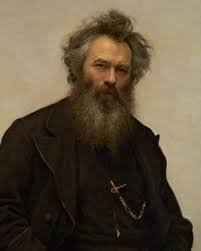
Ivan Ivanovich Shishkin (13 [25] January 1832, Yelabuga, Vyatka Province — 8 [20] March 1898, St Petersburg) was a celebrated Russian landscape painter, a master of the realist depiction of the forest. He studied under Apollon Mokritsky at the Moscow School of Painting, Sculpture and Architecture, and under Sokrat Vorobyov at the Imperial Academy of Arts. One of the founders and an active member of the Society for Travelling Art Exhibitions — the Peredvizhniki, or Wanderers — he showed paintings at every one of their exhibitions until his death.
The hallmarks of Shishkin’s art: precision of drawing down to the smallest detail, a fidelity so exact that one could study the structure of plants from his canvases, and an epic breadth. He was scrupulous about accuracy — sometimes to the point of being faulted for it. It is generally held that Shishkin the colourist yields to Shishkin the draughtsman. His landscapes are realistic through and through; his attitude to nature was not the romantic rapture of a man intoxicated by beauty but a calm, deliberate study.
His famous paintings: Morning in a Pine Forest, Rye, View in the Environs of Düsseldorf, View on the Island of Valaam: The Kukko Locality, In the Wild North, The Mast-Tree Grove, Forest Wilderness.
Whenever Shishkin lost the people he loved, lost his inspiration, and sank into deep despondency, the meaning of life was given back to him, again and again, by Yelabuga — his native town in Vyatka Province. His father was for many years its mayor, wrote a History of the Town of Yelabuga, and naturally hoped that his son would carry on the family’s merchant business and bring glory to his home town. The second wish came true: Shishkin’s paintings sang both the beauty of his small homeland and the endless forests of the large one.
The failed clerk who found his path
For commerce the young man proved categorically unfit and unwilling — as for anything else but painting. So that no one should doubt it, after four years at the Kazan gymnasium he simply left, announcing to his family that he had no wish to “become a clerk.” This delighted no one, least of all his mother. But his father, seeing that the boy was firm and in earnest, sent him to the Moscow School of Painting and Sculpture. Apollon Mokritsky became his first teacher, and it was Mokritsky who instilled in him a reverence for drawing and for the strict correspondence between the forms on the canvas and the forms in the world. Shishkin recognized the direction of his gift almost at the start: landscape, landscape, and a little more landscape. Nothing stood higher for him than the chance to paint nature: “The landscape painter is the true artist; he feels more deeply, more purely… Nature is always new and always ready to give from the inexhaustible store of gifts we call life. What can be better than nature!” His paintings are a weighty argument that little indeed can be.
He kept his tie to his teacher for many years. Even while studying under Sokrat Vorobyov at the Academy of Arts — the logical next step — he often turned to his first mentor. Mokritsky, saddened at parting with a pupil whose strength of talent he keenly felt, predicted that everyone would soon know Shishkin’s paintings, “if he works at the Academy with the same love.”
Petersburg and the Academy of Arts
Shishkin’s first impression of Petersburg was anything but rapturous: “a cold, stiff city; here I remembered Yelabuga with sadness.” Yet this cold city was to be his home from then on. At the Academy he studied, evidently, with the same love that had struck his first teacher — witness his successes there and the medals his paintings won.
In the summers he often went to Valaam, painting its stern nature with complete absorption. The famous canvases painted in the open air there first made people speak of him, out loud, as a major and original Russian talent. For View on the Island of Valaam: The Kukko Locality the Academy awarded him the Great Gold Medal and the right to a funded journey to Europe. He lived abroad from 1862 to 1865, mainly in Germany and Switzerland, with visits to Belgium, Bohemia, France, and Holland. In Düsseldorf, before his paintings became famous, he won renown for his virtuoso drawings, which were given an exhibition at the Düsseldorf Museum; View in the Environs of Düsseldorf earned him the title of academician. Homesick, he came back to Russia before his term of funding had run out.
Shishkin and the Wanderers
He returned, fell hungrily upon the native landscapes, and plunged into the passions then seething in the art world — and these were no small passions: the famous Revolt of the Fourteen under Ivan Kramskoi, the refusal of gifted young artists to obey the dead letter of academicism, the demand that painting be filled with life, the Artel of Artists, to which Shishkin drew close, and then the Society for Travelling Art Exhibitions, of which he became a founder. To the Wanderers’ ideas he stayed faithful to the end of his life.
Kramskoi said that Shishkin was “the only man among us who knows nature in a scholarly way.” And indeed his pictures reproduce a landscape in detail while showing the viewer far more than the most detailed photograph could. For Forest Wilderness he received, in 1873, the title of professor of landscape painting.
Private life and irreparable losses
Joy in his private life was meted out to Shishkin sparingly. In 1868 he married Yevgenia, sister of the painter Fyodor Vasilyev. They lived in perfect harmony, simply and warmly, the house often full of guests. Often, but not for long. From 1872 a black streak began, thick with the deaths of those closest to him. His father, whom he dearly loved, died; then his small son Vladimir. Consumption, then incurable, carried off his wife’s brother Fyodor, whom Shishkin had befriended and looked after; the next year the disease took his wife too — Zhenya, as he called her. A year after that his son Konstantin was gone. Shishkin was left with his daughter Lidia — and a boundless grief. “The world went dark; everything lost its colour, as in a black-and-white engraving. My native Yelabuga brought me back to life,” he recalled. The landscapes of the country of his birth put the brush back into his hand; only in his paintings did Shishkin find refuge from despair.
Olga Lagoda was among the first thirty women admitted to the Academy of Arts as auditors; later she worked in Shishkin’s studio. The artist fell in love with his pupil, and in 1880 she became his wife. Once again happiness proved short-lived. A year later Olga bore a daughter, Ksenia, and a year after that she died of peritonitis. The girl was taken in and raised by Olga’s sister.
The longest love of his life
Shishkin’s muse, it seems, was jealous. At any rate, the facts known to his biographers say that he never again tried to give part of his life to a woman; from then on his paintings were his sole passion. He travelled widely across the Russian expanses, and many famous canvases came out of those journeys. For two years he headed the landscape studio at the Academy. Besides painting he made solid progress in printmaking, working in etching with the mixture known as aqua regia, and belonged to the Society of Russian Aquafortists.
In the artist’s defence
One often meets a would-be avant-garde, supposedly modern attitude to Shishkin: an outdated landscapist, stuck in his forests, out of step with the spirit of the times, and so on and so forth. We disagree. Those with eyes will see that his paintings of the 1890s, for instance, show a heightened interest in light and air — and not merely an interest but a magnificent command of it. Take the famous Rain in an Oak Forest. To paint not fog, not the moment before or after rain, but the rain itself — and so convincingly: the downpour subsiding, the transparent haze in the air, glints of sun on the ripples of a great puddle. This is no flirtation with Impressionism; truth and realism still stand above all. What we have is far more than a brilliant photograph — it is a painting by Shishkin. Does he still seem insufficiently modern? Shishkin knew perfectly well how to change without betraying his principles.