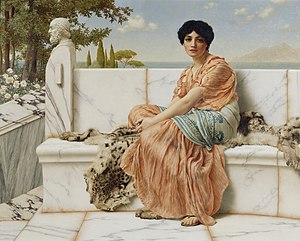
Sappho — Sappho of Mytilene, as she was later known — was a poet and musician of ancient Greece, a maker of monodic melic verse, the sung lyric, and one of the canonical Nine Lyric Poets.
What we know of her life is scant and contradictory. She was born on the island of Lesbos, in Mytilene. Her father, Scamandronymus, was a "new" aristocrat: a man of noble family who engaged in trade. Her mother was named Cleis; besides Sappho there were three sons. A feeling for word and rhythm showed itself early, and it seems that from a young age she was already writing hymns for the chorus that performed at the Thermian panegyris, the chief religious festival of Mytilene, dedicated to Artemis Thermia, an ancient goddess and mistress of the springs of Lesbos. Alongside choral hymns she wrote odes, hymns, elegies, festive songs and drinking songs.
In the middle of the seventh century BC the monarchy at Mytilene was abolished, its place taken by the oligarchy of the royal Penthilid clan. The Penthilids soon fell to a conspiracy, and the leading aristocratic families began a struggle for primacy. In 618 BC power in the city was seized by a certain Melanchrus, whom the ancient authors call the first tyrant of Mytilene. Before long Melanchrus was overthrown and killed by the combined efforts of the poet Alcaeus, his brothers, and Pittacus, a future tyrant of the city. The tyranny then passed to Myrsilus, whose policy was directed against certain members of the old Mytilenean nobility, and many aristocrats — Sappho's family among them — were forced to flee (between 618 and 612 BC). Sappho lived in exile at Syracuse, in Sicily, until the death of Myrsilus (between 595 and 579 BC), when she was able to return home.
She lived in Mytilene, which is why she came to be called Sappho of Mytilene. Legend has it that Alcaeus fell in love with her at this time.
There is another legend about the poet: that she fell in love with a sailor named Phaon, who scorned women and cared only for the sea. Every day he sailed out in his boat, and Sappho, the story goes, would wait upon a rock for his return. One day Phaon did not come back, and she threw herself into the water. The legend is a weaving-together of the myth of Phaon, a sea deity of Lesbos who once ferried Aphrodite and received from her a salve that made every woman who saw him fall in love with him. That myth entwined itself gracefully with the figure of the famous poet, and so the legend arose.
Sappho married Cercylas, a wealthy man of Andros, and bore a daughter — named Cleis, after Sappho's mother — to whom she dedicated a cycle of poems. Neither husband nor child lived long.
Women on Lesbos, and in Aeolis generally, enjoyed a freer social standing than elsewhere in the Greek world. Their social activity here met almost no restrictions; part of a family's property, for instance, could pass down the female line; and alongside the male hetaireiai the island preserved thiasoi, comparable fellowships of women. Sappho led such a thiasos — a cult association devoted to Artemis and also to Aphrodite. Among its tasks was the preparation of girls of good family for marriage, a premarital service to Artemis meant to secure the girl a successful childbirth in time to come. Within the program of the thiasos Sappho taught the girls music, dance and the making of verses.
Antiquity produced no shortage of tales about the poet's relations with her chosen ones and companions. The tradition began with the writers of Attic comedy — the names survive of seven comic playwrights who took episodes from Sappho's life as plots for their plays. Understanding her poetry imperfectly, and judging the cultivated Aeolian woman of the early sixth century BC by the standards of their own Athenian world, they misconstrued much of what was reported of her life.