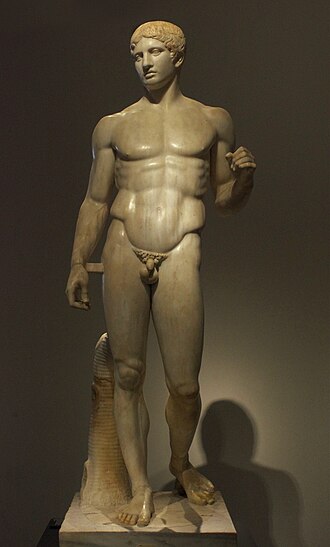
Polyclitus, born at Argos, was among the most celebrated sculptors of ancient Greece. He worked in the fifth century BC, the age in which Greek art and culture reached their height, and he was a consummate master whose works still inspire artists and art historians the world over.
His most famous work is the Doryphoros, the Spear-Bearer, which became the standard of male beauty and a model for sculptors of every age that followed: a perfectly proportioned human body built on mathematically calculated ratios — a breakthrough in the art of its time. Another celebrated work, the Diadumenos — a youth binding a victor's ribbon about his head — likewise displays that perfection of proportion and the harmony of the human frame.
Polyclitus was a theorist as well as a gifted practitioner. His treatise, the Canon, set out his ideas on the mathematically measured proportions of the human body; it became the foundation of all later artistic theory and is studied by art historians and artists to this day. His key contribution to culture lies in this understanding of harmony and proportion, which opened the way to new forms and styles in sculpture and in the other arts.
For all his immense contribution, his life was not without hardship. He lived in an era of great change and conflict, and his work was not always understood or valued by his contemporaries. Yet his passion for his art and his conviction in his own ideas allowed him to create works that fascinate people still. There is an intriguing paradox in him, too: he was theorist and practitioner at once, and so could make works that were at the same time beautiful and rigorously reasoned.
Polyclitus matters today because his ideas about harmony and proportion remain alive, inspiring artists and designers alike. Works such as the Doryphoros and the Diadumenos stand as models of perfection and beauty and continue to fascinate people the world over; and his theoretical legacy — the notion of a mathematically measured human form — is still studied and applied across many fields of art and design.