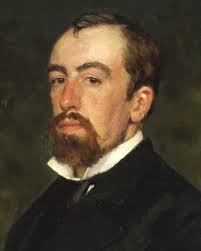
Vasily Dmitrievich Polenov (May 20 [June 1], 1844, St Petersburg – July 18, 1927, Borok estate, Tula province) was an outstanding Russian landscape painter, a master of historical and genre painting, and a teacher at the Moscow School of Painting, Sculpture and Architecture. A pupil of Pavel Chistyakov, he was in turn the teacher of Isaac Levitan and Konstantin Korovin — and, besides, a gifted stage designer and an organiser of people’s theatres.
What distinguishes Polenov’s art is bright, clean colour, and an abundance of sunlight and air quite uncharacteristic of Russian painting in the second half of the nineteenth century. He is regarded as the creator of the so-called “intimate landscape” — the lyrical landscape, the landscape of mood — and he was the first in Russian painting to present the plein-air study as an independent work of art in its own right. He took a lively interest in questions of painterly technique, in the chemistry of pigments and their interaction, conducting experiments aimed at the long-term preservation of the paint layer — thanks to which most of his pictures have survived in remarkably good condition.
His best-known paintings include Moscow Courtyard, The Overgrown Pond, Grandmother’s Garden, The Village of Turgenevo, and Christ and the Woman Taken in Adultery.
In 1871 something unheard-of happened at the Imperial Academy of Arts: the large gold medal was awarded to five competitors at once — Polenov, Repin, Makarov, Zelensky and Urlaub. Uproar and scandal followed. It emerged that Grand Duke Vladimir Alexandrovich, who had taken the Academy under his wing, simply had not grasped that the whole point of a competition is to choose one winner — the best.
The Grand Duke flatly refused to reverse his ill-considered decision: taking one’s words back was no business for royalty. All five received the right to a funded period of study abroad. But at the ceremonial dinner Vladimir Alexandrovich came over with congratulations only to Polenov’s father. “How touching!” gushed the more excitable ladies. “The Grand Duke thanks the father for the son’s picture!” A certain Madame Brock pronounced on the superiority of The Raising of Jairus’s Daughter, Polenov’s competition piece: “How plain it is that it was painted by a young man from a good family!” Even Polenov’s twin sister Vera joined in this loftily aristocratic talk: “I did not care for the others — they all smell of Russian painters (no offence intended), even the much-praised Repin.”
Kramskoy, a commoner from Ostrogozhsk, spoke dismissively to Repin, a soldier’s son from Chuguev, about the Petersburg-born hereditary aristocrat: “That fine gentleman.” The critic Vladimir Stasov, who had little liking for Polenov’s pictures, curiously argued to the painter that his very “cast of soul was un-Russian,” and that rather than return to Moscow he would do better to settle somewhere in Paris or Berlin — that, supposedly, would suit him more.
Polenov’s whole biography refutes these absurd prejudices. He did, of course, bring back magnificent studies from Palestine, and the pictures he painted in Normandy and Greece, in Egypt and Lebanon, are fine things. But his best, his defining and most famous works are precisely his Russian views — the “intimate” landscapes painted in old Moscow and in all the places where he lived for long stretches: his parents’ estate of Imochentsy on the little river Oyat, Savva Mamontov’s legendary Abramtsevo, and his own estate on the Oka near Tarusa, named with the colourful local word “Borok.”
“For some reason people here take me for an aristocrat,” Polenov complained in his letters. “It is some sort of misunderstanding. I feel no noble qualities in myself. I work constantly, and I love work above all things.”
A “young man from a good family” he certainly was: Polenov is that rarest of cases among Russian nineteenth-century painters for whom becoming an artist was, as the saying goes, written in the stars. His beloved maternal grandmother, Vera Nikolaevna Voeikova — “babasha,” as the grandchildren fondly called her despite her despotic temper — was the daughter of the architect Nikolai Lvov (familiar to us from Levitsky’s portraits) and a ward of the poet Gavrila Derzhavin. She loved poetry, told fairy tales, and could quote Karamzin’s History of the Russian State almost by heart. Many of Polenov’s paintings owe their existence to the impressions of family lore, peasant life and picturesque countryside gathered at the village of Olshanka, where he used to visit her.
She entertained her small grandchildren by holding competitions for the best picture — everything done properly, with medals awarded, just as at the Academy: gold to Vasya, silver to Vera, nothing at all for Alyosha and Kostya, who were indifferent to drawing, and bronze to little Lilya. Nor was grandmother Voeikova far wrong — except about the girls. The beautiful Vera, for all that she and Vasily were born on the same day and at the same hour, had no artistic gifts whatever; whereas the youngest, “Lilya” — Elena Polenova — would become Russia’s first professional woman artist.
Polenov’s father, Dmitry Vasilievich, served as a diplomat in Greece, collected classical antiquities and was a friend of Karl Bryullov, who even gave a little instruction in painting to his wife Marya Alekseevna, the artist’s mother — she painted watercolours. The children were introduced to art from infancy. When Christ Appearing to the People — the picture over which the painter Ivanov had laboured in Italy for two long decades — was brought to St Petersburg, the Polenovs took all five children to see it several times, to “commune” with it. That childhood memory proved decisive for the future artist: his well-known paintings on biblical themes took their impulse from the blazing impression the Ivanov canvas made on him as an adolescent.
His parents engaged Pavel Chistyakov to teach the boy painting. Chistyakov, later a celebrated teacher, was then a mere student. He recognised at once young Polenov’s gift for chromatic harmony, addressing him with ceremonious respect and explaining: “He is a colourist.”
Contemporaries and successors would prize Polenov above all for the clarity and purity of his colour, for that almost Impressionist surfeit of light and air so untypical of Russian art of the day. His canvases are positively brimming with both: not only the radiant Moscow Courtyard — even his Burnt Forest astonishes with the festive brightness of its greens. Before long, customers in Moscow paint shops were naively demanding: “Give us colours like the ones in Polenov’s pictures! You know — bright, sunny ones, even if they cost more!”
Polenov was not a painter-psychologist, nor an ideological painter like many of his friends among the Peredvizhniki. What interested him was the properly artistic side of the matter — the relation of colours, the harmony of the palette. At the Moscow School of Painting, Sculpture and Architecture he initiated his students — Levitan and Korovin foremost among them — into the “chemistry of paints,” the secrets of mixing them and laying them on canvas, the possibilities and effects of their mysterious interaction.
In love, however, Polenov really was an aristocrat. He was nicknamed “the knight of beauty”; ladies of his acquaintance swore that Polenov, never once observed in a casual liaison, even peeled an orange with the elegance of a prince. He first fell seriously in love when he was nearly thirty. It happened in Rome, where he frequented the artistic circles that gathered around Adrian and Emilia Prakhov and Savva and Elizaveta Morozov. There he first saw the eighteen-year-old Marusya Obolenskaya, a Russian girl studying operatic singing in Italy. The feeling that flared up in him was so strong that it robbed him of speech — they called him “the enamoured ascetic” — and he never brought himself to declare himself to Marusya. Then the irreparable happened: she died as the result of a medical error. Weakened by illness, Obolenskaya was mistakenly given a smallpox vaccination that proved fatal. Later, the death of his twin sister Vera would lead to the sombre painting The Sick Girl, in which viewers would discern the features both of the girl the artist had loved and of his beloved sister.
His second love overtook him more suddenly still: in a railway compartment he met a charming woman. Her name, it turned out, was also Maria — Maria Klimentova — and, miracle of miracles, she was an opera singer, exactly what Marusya Obolenskaya might have become. Struck by the coincidence, Polenov fell ardently, passionately in love. Klimentova did not return his feeling, but neither did she plainly refuse him, now drawing the artist closer, now pushing him away. This operatic diva would later conduct a similar intrigue — founded not on love but on idle feminine vanity — with the writer Chekhov. As for Polenov, returning from another journey abroad he learned with bitterness that Maria Klimentova had abruptly — no, not died, like Marusya Obolenskaya, but rushed into marriage with some lawyer, taken to drink out of dissatisfaction, and acquired a taste for cards.
Consolation he sought, as always, with his friend Savva Mamontov at his estate of Abramtsevo. Only there did his soul find rest, given over to creative work. Many of his well-known pictures were painted at the Abramtsevo plein-air sessions; there he made stage sets for the estate’s theatricals and composed music for them, and with Vasnetsov and Repin devised the design and decoration of the famous Abramtsevo church — the “fairy-tale” Church of the Saviour Not Made by Hands. Polenov did not at first understand, and then for a long time could not believe, that a relation of the Mamontovs, Natasha Yakunchikova, was sighing over him. Fourteen years his junior, she embroidered church banners after his designs and loved him ardently and in silence. When the church — the cherished project of everyone at Abramtsevo — was at last completed, the first couple to be married in it were Natalia Yakunchikova and Vasily Polenov.
Natalia Vasilievna would prove one of the most devoted wives any Russian artist ever had: her husband’s art and pictures became the meaning of her life. Six children were born to the Polenovs. They acquired the Borok estate near Tarusa — where Polenov painted his celebrated views of the Oka — built schools and a church, paid out of their own pocket for the teachers in the neighbouring villages of Byokhovo and Stakhovo, and created a remarkable people’s theatre and a “diorama” of Polenov’s pictures, a kind of round-the-world voyage for peasants who had never travelled beyond their native village — doing everything in their power, in short, so that the hard and at times hopeless life of the Russian countryside might become at least a little as radiant, luminous and colourful as Vasily Polenov’s best paintings.