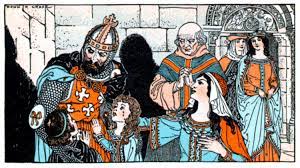
Ruy Díaz de Vivar, called the Cid, slandered by his enemies, lost the favour of his lord, King Alfonso of Castile, and was sent by him into exile. The Cid was given nine days to quit Castilian soil; once they had passed, the king's men had the right to kill him.
Gathering his vassals and kinsmen — sixty warriors in all — the Cid rode first to Burgos; but however the townspeople loved the bold baron, fear of Alfonso kept them from giving him shelter. Only the brave Martín Antolínez sent the men of Vivar bread and wine, and afterwards joined the Cid's company himself.
Even a small company must be fed, and the Cid had no money. So he resorted to a ruse: he had two chests made, bound in leather, fitted with stout locks — and filled with sand. With these chests, which supposedly held gold the Cid had plundered, he sent Antolínez to the Burgos moneylenders Judah and Rachel, asking them to take the chests in pledge and furnish the company with ready coin. The Jews believed Antolínez and counted out a full six hundred marks.
His wife, Doña Jimena, and his two daughters the Cid entrusted to Abbot Don Sancho, superior of the monastery of San Pedro; then, having prayed and taken tender leave of his family, he set out. Word had meanwhile spread through Castile that the Cid was bound for Moorish lands, and many bold warriors, hungry for adventure and easy spoils, hastened after him. At the bridge over the Arlanzón a full hundred and fifteen knights joined his band; the Cid greeted them joyfully and promised that feats and untold riches would fall to their share.
On the exiles' path lay the Moorish town of Castejón. The Cid's kinsman Alvar Fáñez Minaya proposed that his lord take the town while he himself plundered the countryside. By a daring raid the Cid took Castejón, and soon Minaya arrived there with his booty. The spoils were so great that at the division each horseman received a hundred marks, each foot soldier fifty. The captives were sold cheap to the neighbouring towns, so as not to be burdened with keeping them. The Cid liked Castejón, but he could not stay long: the local Moors were tributaries of King Alfonso, who sooner or later would have besieged the town, and the townsmen would have fared badly, for the fortress had no water.
His next camp the Cid pitched near the town of Alcocer, and from it he raided the surrounding villages. The town itself was well fortified, and to take it the Cid turned to a stratagem. He made a show of striking camp and retreating. The men of Alcocer rushed out in pursuit, leaving the town undefended — whereupon the Cid wheeled his knights about, crushed the pursuers and burst into Alcocer.
In terror of the Cid, the people of the nearby towns begged help of King Tamin of Valencia, who sent three thousand Saracens to do battle with Alcocer. After biding his time the Cid led his company out beyond the walls and in a fierce fight put the enemy to flight. Having thanked the Lord for the victory, the Christians set about dividing the untold riches taken in the infidels' camp.
The booty was beyond anything yet seen. The Cid summoned Alvar Minaya and bade him ride to Castile, to present Alfonso with thirty horses in rich harness and to tell of the exiles' famous victories. The king accepted the Cid's gift, but told Minaya that the time to pardon his vassal had not yet come; he did, however, give leave to all who wished to join the Cid's company with impunity.
The Cid meanwhile sold Alcocer to the Moors for three thousand marks and moved on, plundering the surrounding districts and laying them under tribute. When his company ravaged one of the domains of Count Raymond of Barcelona, the count marched against him with a great host of Christians and Moors. The Cid's men once more had the upper hand, and the Cid, overcoming Raymond himself in single combat, took him prisoner. In his magnanimity he released the captive without ransom, taking from him only the precious sword Colada.
Three years the Cid passed in ceaseless raids. Not a man remained in his company who could not call himself rich — yet it was not enough for him. The Cid conceived the conquest of Valencia itself. He drew a tight ring about the city and pressed the siege for nine months; in the tenth the Valencians could hold out no longer and surrendered. The Cid's share — he took a fifth of all booty — came in Valencia to thirty thousand marks.
The king of Seville, enraged that Valencia, pride of the infidels, was in Christian hands, sent an army of thirty thousand Saracens against the Cid; it too was routed by the Castilians, who now numbered thirty-six hundred. In the tents of the fleeing Saracens the Cid's men took three times the spoils of Valencia itself. Grown rich, some of the knights began to think of returning home, but the Cid issued a wise decree: whoever left the city without his leave forfeited everything he had gained on campaign.
Summoning Alvar Minaya once more, the Cid again sent him to King Alfonso in Castile, this time with a hundred horses. In exchange for the gift he asked his sovereign's leave for Doña Jimena and his daughters, Elvira and Sol, to follow him to Valencia, where the Cid now ruled wisely and had even founded a diocese under Bishop Jerome. When Minaya appeared before the king with the rich gift, Alfonso graciously agreed to release the ladies and promised that his own knights would escort them to the border of Castile. Pleased at having discharged his lord's errand with honour, Minaya went to the monastery of San Pedro, where he gladdened Doña Jimena and the daughters with news of their coming reunion with husband and father, and paid Abbot Don Sancho generously for his pains. As for Judah and Rachel — who, despite the prohibition, had peeped into the chests the Cid had left them, found sand inside, and were now bitterly lamenting their ruin — the Cid's envoy promised to make good their loss in full.
The infantes of Carrión, sons of the Cid's old enemy Count Don García, were tempted by the untold wealth of the lord of Valencia. Though the infantes held that the Díaz family was no match for them, counts of ancient line, they nonetheless resolved to ask for the Cid's daughters in marriage. Minaya promised to convey their suit to his lord.
At the Castilian border the ladies were met by a detachment of Christians from Valencia and two hundred Moors led by Abengalbón, lord of Molina and friend of the Cid. With great honour they conducted the ladies to Valencia, to the Cid, who had not been so glad and merry in a long while as at the reunion with his family.
Meanwhile Yusuf, king of Morocco, gathered fifty thousand brave warriors, crossed the sea and landed not far from Valencia. To the alarmed women, who watched from the roof of the alcázar as the African Moors pitched their vast camp, the Cid said that the Lord never forgot him — and was now sending into his hands a dowry for his daughters.
Bishop Jerome said mass, put on armour, and charged the Moors in the front rank of the Christians. In the savage fight the Cid, as ever, prevailed, winning along with fresh glory yet another rich booty. The sumptuous tent of King Yusuf he set aside as a gift for Alfonso. Bishop Jerome so distinguished himself in this battle that the Cid gave the good cleric half of the fifth that was due to himself.
From his own share the Cid added two hundred horses to the tent and sent them to Alfonso in gratitude for letting his wife and daughters leave Castile. Alfonso received the gifts most graciously and declared that the hour of his reconciliation with the Cid was near. At this the infantes of Carrión, Diego and Fernando, pressed the king to arrange their betrothal to the daughters of the Cid Díaz. Returning to Valencia, Minaya told the Cid of the king's proposal to meet him for reconciliation on the banks of the Tagus, and of Alfonso's request that he give his daughters in marriage to the infantes of Carrión. The Cid accepted his sovereign's will. Meeting Alfonso at the appointed place, the Cid would have prostrated himself, but the king demanded that he rise at once, for it did not befit so glorious a warrior to kiss the feet even of the greatest of Christian princes. Then King Alfonso solemnly proclaimed the hero's pardon before all and declared the infantes betrothed to his daughters. The Cid thanked the king and invited everyone to Valencia for the wedding, promising that no guest would leave the feast without rich presents. For two weeks the guests passed the time in feasting and games of arms; in the third they asked leave to go home.
Two years passed in peace and merriment. The sons-in-law lived with the Cid in the alcázar of Valencia, knowing no troubles and surrounded by honour. But one day misfortune struck: a lion broke loose from the menagerie. The knights of the court rushed at once to the Cid, who was asleep at the time and could not defend himself. The infantes, however, disgraced themselves in their fright: Fernando crawled under a bench, while Diego hid in the palace wine-press, smearing himself with filth from head to foot. The Cid, rising from his couch, went out unarmed against the lion, seized it by the mane and returned it to its cage. After this episode the Cid's knights began to mock the infantes openly.
Some time later a Moroccan host again appeared near Valencia. Just then Diego and Fernando had a mind to return to Castile with their wives, but the Cid forestalled their intention by inviting them to ride out into the field next day and fight the Saracens. Refuse they could not; in the battle they showed themselves cowards — of which, luckily for them, their father-in-law did not learn. In that battle the Cid performed many feats, and at its end, on his Babieca, once the horse of the king of Valencia, he galloped after King Búcar, meaning to offer him peace and friendship; but the Moroccan, trusting to his own horse, refused. The Cid overtook him and clove him in two with Colada. From the dead Búcar he took the sword called Tizona, no less precious than Colada. Amid the joyful festivities that followed the victory, the sons-in-law came to the Cid and asked leave to go home. The Cid let them go, giving Colada to one and Tizona to the other, and untold treasures besides. But the ungrateful men of Carrión were plotting evil: greedy for gold, they had not forgotten that by birth their wives were far beneath them and therefore unworthy to be ladies of Carrión. After a night's halt in a forest the infantes ordered their retinue to ride ahead, saying they wished to be left alone to take their pleasure with their wives. Left alone with Doña Elvira and Doña Sol, the treacherous infantes told them they would be abandoned there, food for beasts and shame for men. However the noble ladies appealed to the villains' mercy, they stripped them, beat them half to death, and rode on as if nothing had happened. By good fortune the Cid's nephew Félez Muñoz was among the infantes' companions. Anxious for his cousins' fate, he turned back to the halting place and found them lying there senseless.
Back within the bounds of Castile, the infantes boasted shamelessly of the insult they had dealt the glorious Cid. The king, learning what had happened, grieved with all his soul. When the sad news reached Valencia, the enraged Cid sent an envoy to Alfonso. The envoy delivered the Cid's message: since it was the king who had betrothed Doña Elvira and Doña Sol to the unworthy men of Carrión, it now fell to him to summon the cortes to judge between the Cid and those who had wronged him.
King Alfonso acknowledged the justice of the Cid's demand, and soon the counts, barons and other nobles he had summoned assembled in Toledo. Much as the infantes dreaded meeting the Cid face to face, they were obliged to appear at the cortes. With them was their father, the sly and treacherous Count García.
The Cid laid the case before the assembly and — to the joy of the men of Carrión — demanded only the return of his priceless swords. Relieved, the infantes handed Colada and Tizona to Alfonso. But the judges had already found the brothers guilty, and the Cid then demanded the return of the riches he had bestowed on his unworthy sons-in-law. Willy-nilly the men of Carrión had to satisfy this demand too. Vain, though, was their hope that with his goods restored the Cid would be appeased. At his request Pedro Bermúdez, Martín Antolínez and Muño Gustioz stepped forward and demanded that the men of Carrión wash away in blood, in single combat with them, the dishonour done to the Cid's daughters. This the infantes feared above all else, but no excuses availed them. A combat was appointed in due form. The noble Don Pedro all but killed Fernando, who owned himself beaten; Don Martín had scarcely closed with Diego before the latter fled the lists in terror; the third champion of Carrión, Asur González, wounded, yielded to Don Muño. So the judgment of God marked out the righteous and punished the guilty.
Meanwhile envoys had come to Alfonso from Aragon and Navarre, asking the daughters of the hero Cid in marriage for the infantes of those kingdoms. The second marriages of the Cid's daughters proved incomparably happier. The kings of Spain honour to this day the memory of the Cid, their great forefather.