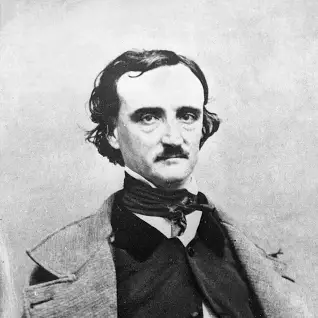
Childhood
Edgar Allan Poe (1809–1849) was born in Boston to a family of actors. His father abandoned the household when Edgar was a year old; his mother died of tuberculosis before the boy turned three.
He was taken in by a wealthy Richmond merchant. When Edgar was six the family moved to Britain, where he completed primary school.
In 1820, pressed by financial troubles and the foster mother's illness, the family hurried back to Richmond. It was there that literature first took hold of him. Over five years of schooling he read the Greek and Roman classics in the original, with a marked preference for poetry, and began writing verse of his own.
University and military service
In 1825 Poe's foster father came into an enormous inheritance — $750,000 — and the family's life changed abruptly once again. In 1826 the nineteen-year-old entered the University of Virginia at Charlottesville, taking on two courses of study at once: classical philology and modern languages.
Despite doing well, he had to leave after his first year. Young Poe had acquired a taste for wine and cards, and when his stepfather refused to cover the gambling debts, he turned him out of the house. In Richmond in 1827 Poe met the publisher Calvin Thomas, who brought out his first collection, Tamerlane and Other Poems, in an edition of fifty copies. In the preface Poe claimed that most of the poems had been written before he turned fourteen — an exaggeration.
That same year Poe was obliged to sign a five-year enlistment and became a private in the United States Army, giving a false name — Edgar A. Perry — and adding four years to his age. Sullivan's Island in Charleston harbor, the exotic post where he served, would later furnish the setting of "The Gold-Bug."
Staff duty was light, and the young soldier found time to write new work and polish the old. Within two years the service had begun to weigh on him, and in 1829 he secured an early discharge — helped, as it happened, by tragedy: his foster mother had fallen gravely ill. Though he loved her, he did not arrive even in time for her funeral.
Early work
In 1829 in Baltimore, where Edgar was nursing his brother through tuberculosis, the collection Al Aaraaf, Tamerlane and Minor Poems appeared. In 1830 he entered West Point as a cadet. He kept at his writing, preparing a third collection for the press, and though his standing was good he resolved to leave the academy; he was discharged in 1831.
He moved to New York and published that third volume, Poems, which gathered new lyrics and longer poems along with an essay on the nature of poetry and on national literature.
Desperately short of money, he entered several tales in a prose competition whose winner would take $100. Methodical as ever, he first read up on the theory of short fiction. He did not win.
Nor did he despair. He kept writing, and to the next competition submitted six tales and a poem. His "MS. Found in a Bottle" took the prize — $50 — and for the first time his talent had won recognition.
In 1834 his foster father died without mentioning him in the will. Knowing how badly off Poe was, his friend and patron, the writer John Kennedy, recommended him to the Southern Literary Messenger. Poe began contributing, then became assistant editor and moved to Richmond, staying with the magazine until 1837 — printing stories and criticism and handling the practical side of the operation.
The love of his life
Poe's depressions and drinking bouts were bound up with a passion: he had fallen in love with his thirteen-year-old cousin Virginia, whom he married at twenty-five. After leaving the magazine he moved with his wife and mother-in-law to New York.
The economic crisis of 1837 left him without work. Yet it was then that he wrote some of his finest tales, and his first novel, Arthur Gordon Pym (1838), appeared. It sold poorly.
In 1838 the family moved to Philadelphia. Poe worked at one publication after another for a pittance and took whatever came his way — he even co-wrote a book on seashells.
A master and innovator
In 1839 came Tales of the Grotesque and Arabesque, twenty-five stories in all. The reviews were good; the sales were not.
From 1840 Poe dreamed of a magazine of his own, but instead became editor of Graham's Magazine, owned by the businessman George Graham, printing a story in every issue.
In 1841, with "The Murders in the Rue Morgue," he founded the detective genre.
In 1842 Virginia fell ill with tuberculosis, and Poe lost his post. To this period belong his darkest tales, detective stories among them. In 1843 his debts drove him into bankruptcy.
Before long he found a partner willing to help launch the long-planned magazine, named The Stylus. Its first issue carried "The Gold-Bug," which in 1844 won a prize for the best story. In 1843 Poe also returned to poetry, which he had left untouched for three years.
That same year the family moved to New York, where for once he had no difficulty placing his work. His famous hoax "The Balloon-Hoax," printed in the New York Sun, is held to have inaugurated the genre of science fiction.
In 1845 he published "The Raven," his perfect poem, which delighted critics and readers alike; he described its making in the essay "The Philosophy of Composition."
That year Poe was earning his living by lecturing and was part-owner of the Broadway Journal, where he appeared as a critic and published no new work. Within a year the journal had to close.
Fatal love, and death
In 1846 Poe began a series of critical sketches, "The Literati of New York City," which soured his relations with his fellow writers. Money grew short again. The family moved to a suburb of New York, where Virginia died in 1847. Poe himself then fell ill; on recovering, he gradually returned to literary work, and the last piece he published was the prose poem Eureka.
In 1849, after an engagement had collapsed over the groom's "unreliability," Poe worked hard — writing stories and poems, giving lectures.
In Richmond he met again the sweetheart of his youth, by then a wealthy widow, and began preparing for a wedding. He set out for New York to settle his affairs, but died in a Baltimore hospital, taken there by a friend who had found him in a wretched state, in someone else's dirty clothes, his valise gone. His last words were "Lord, help my poor soul."
Legacy
It would be hard to name a writer more industrious than Poe. In his lifetime he produced a great number of poems long and short, tales and novellas, longer fiction, criticism, and writings on the theory of literature. Nothing occupied him more than the writer's craft, and he never stopped honing his own.
His poems stand in the Romantic tradition; his outlook is steeped in tragedy and pessimism. The favorite image of his verse — a dying young woman — appeared there long before he lived through the death of his wife.
The early tales parody the Romantics; the mature writer is a master of the psychological story. It was Poe who worked out the principles of the detective genre — he himself called these pieces tales of ratiocination — a genre resting on logic, with the figure of the detective at the center of the narrative. He is also counted the founder of science fiction, explaining the mysterious by way of scientific ideas.