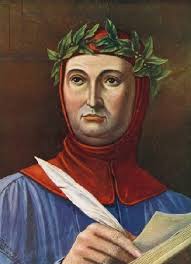
Francesco Petrarch was an Italian poet, the head of the elder generation of humanists and one of the leading figures of the Italian Proto-Renaissance.
He was born on 20 July 1304 in Arezzo, and spent most of his childhood in Florence, Tuscany, and Avignon.
His Life
The son of a Florentine lawyer, he was drawn from childhood to Roman literature; the law left him cold, though his father insisted that he pursue precisely a legal education. After a brief spell of legal study at Bologna, in 1320 Petrarch resolved to abandon the field for the classics and the religious life.
In 1326 he took minor orders and entered the service of Cardinal Colonna, whose patronage left him free to travel and to write. His interest in Latin literature and poetry deepened considerably in these years. He came to know Giovanni Boccaccio, another representative of the humanist current in letters; the two became close friends and kindred spirits.
In 1327, at Mass in Avignon, Petrarch first saw Laura de Noves. She would become the single muse and inspiration of his life; for her he would write the sonnets that entered literary history as the finest specimens of the genre, and to her he would dedicate his work to the end of his days.
Until the close of the 1330s the poet went on travelling across Europe on diplomatic missions for the Church and for Cardinal Colonna, earning the standing of a distinguished scholar and man of letters. His sonnets on an unrequited, exalted love for Laura — full of admiration and reverence before a higher ideal — won wide popularity, and in 1341 he was crowned poet laureate of Rome with a wreath of laurel. In the years that followed he travelled through France, Germany, and Spain, holding various ecclesiastical offices, studying the works of Cicero, and immersing himself in Greek history and literature.
In the course of his travels in the 1340s Petrarch fathered two children out of wedlock. In this period he also began to put his papers in order, assembling a collection of his own poems; in the end the book came to hold some four hundred of his works.
His last years were spent at the court of Francesco I da Carrara. He lived in Padua, though at times he preferred the small village of Arqua, and it was there that he died on the night of 18–19 July 1374. When he was found, a pen was still in his hand, and on the table before him lay an unfinished life of Caesar. He was buried on the spot; over the grave his son-in-law Brossano raised a monument of red marble.
His Creative Legacy
Petrarch was always drawn to classical poetry, and under the influence of that passion he forged an inimitable style of his own. His verse is rich in allegory, and he took the Italian form of versification as its foundation.
In his work Petrarch explores the bond between love and chastity; his lyric hero is moved by emotion and feeling. His writings are known throughout the world and have been translated into many languages. Among them one may single out My Secret, or the Book of Conversations on Contempt for the World; the Letter to Posterity; and the Guide to the Tomb of Our Lord Jesus Christ.
Later students of his work have observed that in his verse Petrarch fundamentally reimagined the conventions of love poetry: love for an idealized lady became a way of learning to love God rightly. There is a grace in his writing in which he surpassed his contemporaries — save, perhaps, Dante. He shows great refinement, above all in the rendering of human feeling, and he often opens with a single trope and develops it, setting the mood of the entire work to follow.