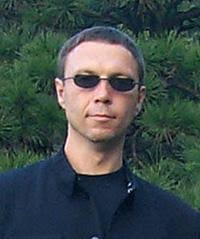
Viktor Olegovich Pelevin is a Russian writer, a postmodernist, and the winner of numerous prizes. He was born to a father who taught in the military department of the Bauman technical university and a mother who ran a section of a food store. For a time the family lived in a communal flat on Tverskoy Boulevard, later moving to a three-room apartment of their own in Severnoye Chertanovo — where, if the press is to be believed, the writer lives to this day, and where he even registered as a sole proprietor at the local branch of the Pension Fund. After finishing a school with intensive English in 1979, Pelevin entered the Moscow Power Engineering Institute, in the faculty of electrification and automation of industry and transport. On graduating he stayed at the institute, working as an engineer in the department of electric transport and pursuing full-time postgraduate study there. He wrote a dissertation on the electric drive of a city trolleybus with an asynchronous motor, though there is no record of its defence — nor, for that matter, any reliable confirmation that the Buddhist novelist-to-be served in the air force in the late eighties, as fan sites sometimes claim.
In 1989 the future winner of the Little Booker Prize, and repeated nominee for prestigious literary awards, entered the Gorky Literary Institute, only to be expelled two years later — for losing touch with the institution, as he himself put it. That same year he began working with the journal "Science and Religion," preparing material on Eastern mysticism, and served as a staff correspondent for the magazine "Face to Face." It was then that his first story appeared: by one account "The Sorcerer Ignat and the People" in "Science and Religion," by another "Old Ignat and the People" in "Chemistry and Life." His debut collection of stories came out in 1991; a year later the novel "Omon Ra" brought his first taste of popularity, but real recognition — arriving with the Little Booker itself — came two years after that, and grew exponentially. Five years later came the first Russian "Zen-Buddhist" novel, "Chapayev and the Void," which in 2001 made the shortlist of the celebrated Dublin literary award and won Pelevin an international reputation. In 1999 he presented the "nostalgic and sarcastic" novel "Generation P" and settled definitively into his status as the voice of a generation, a cult writer of the present day. The books that followed would be nominated again and again for the Big Book, the NOS, the National Bestseller and other major prizes.
So little is known of the writer's private life — practically nothing — that in recent years it has more than once been suggested that Viktor Pelevin is a project rather than a person, that perhaps he does not exist at all, or, in Dmitry Bykov's phrase, that if he does exist, it is on the astral plane. At his rare meetings with journalists the writer keeps up the reputation of a melancholy mystifier. He neither denies nor confirms the rumours about him. The only thing he has ever refuted is the use of consciousness-expanding substances — though he did mention a fondness for Chinese tea. He is also known to have travelled widely, chiefly in the East, where he studied spiritual practices. Viktor Pelevin has no accounts on social media, gives almost no interviews and does not appear in public. At one prize ceremony a life-size cardboard figure of the author was carried onto the stage — whether in irony at the rumours of his unreality or to keep the intrigue alive. But whatever conjectures his admirers and the journalists may put forward, Viktor Pelevin goes on delighting his readers with new books, which reliably occupy the bestseller lists and the top lines of every readers' ranking.