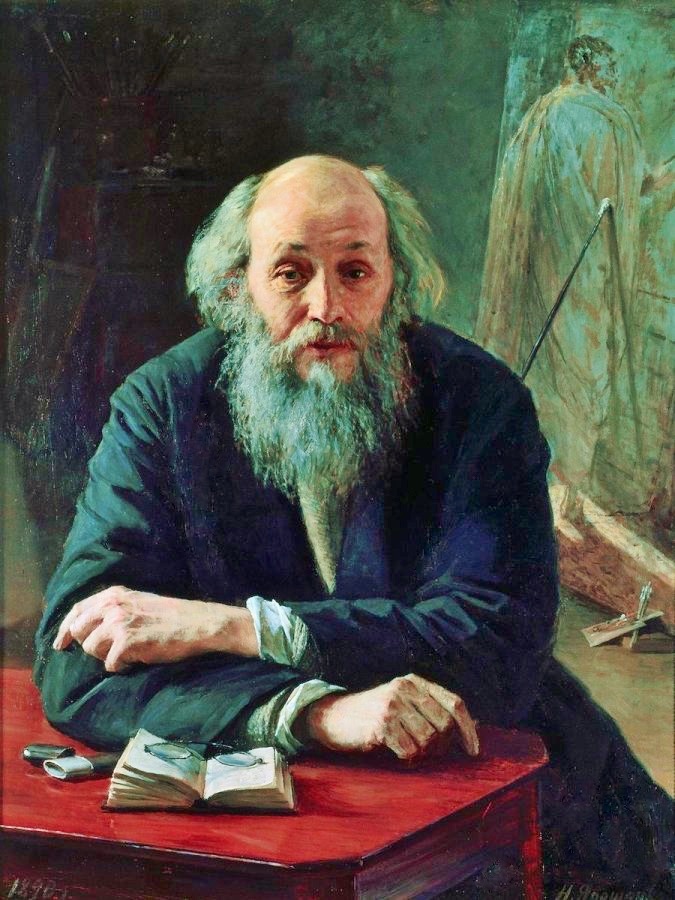
Nikolai Nikolaevich Ge (15 [27] February 1831, Voronezh – 1 [13] June 1894, the Ivanovsky farmstead, Chernigov province) was a Russian painter and draughtsman who worked in portraiture and in historical and religious painting, and one of the founders of the Society of Traveling Art Exhibitions — the Peredvizhniki.
For all Ge's closeness to the Peredvizhniki, his own artistic searching went far beyond the bounds of realist painting. Every attempt to classify his work and fit it into a movement is doomed: scholars have observed that he was always either behind the popular taste or ahead of it, remaining a solitary figure not only in Russian but in European art. His individual, expressive manner — above all in his treatment of Gospel subjects — often struck contemporaries as unskilled or careless; seen in retrospect, Ge stands as an innovator of genius. The chromatic drama of his late work anticipates Mikhail Vrubel (the two artists were, in fact, related).
His famous paintings include The Last Supper; Peter I Interrogating Tsarevich Alexei at Peterhof; Pushkin in the Village of Mikhailovskoye; and "What Is Truth?" Christ and Pilate.
If a contest were ever held among the Russian painters of the second half of the nineteenth century for the title of incorrigible idealist, Nikolai Ge would have every chance of winning — and not for want of rivals. The age itself, in Russia, belonged to those who believed that art could transform reality and that their personal efforts could change their neighbor's life, and all of Russia's, for the better. Yet even against that background Ge stands out for a particular inner honesty, a kindness without moralizing, a generosity of spirit without sanctimony, a love of neighbor without preconditions. "I was building a stove for a poor family on my farmstead," he confessed, "and that time was the most joyful of my life. And who ever invented the notion that muzhiks and peasant women — simple folk generally — are coarse and ignorant? It is not merely a lie; I suspect it is a malicious lie. I have never met such delicacy and fineness anywhere..."
His exotic surname the artist owed to his great-grandfather, a French nobleman, Matieu de Gay, who fled to Russia in terror of the French Revolution. Ge, a man of thoroughly liberal convictions, would later joke: what folly, to run away from so good a cause.
Ge's father bore the entirely Russian name and patronymic Nikolai Osipovich and had even fought against Napoleon's army in 1812. His mother Ge never knew: she died of cholera when Nikolai was three months old. The father remarried and had little time for his sons — he was a busy man, strong-willed, successful, and rather hard — so Nikolai and his two elder brothers were raised by their grandmother and by "nanny Natasha." Biographers hold that this feminine upbringing formed Ge's compassionate, responsive character — and also an acute sense of the injustice going on around him.
In Ge's memoirs there are piercing stories: how his beloved nanny hid from him, when he was only just old enough to understand, the terrible marks of a beating — the master had ordered a punishment; or how he and his nanny stood at the window watching soldiers march smartly on the parade ground while past the ranks was carried yet another soldier, flogged to death.
Ge was then sent to the gymnasium in Kyiv. And there, too, what he remembered most vividly were the cruelties and humiliations the supervisor inflicted on the boys. "He struck with a square ruler," Ge recalls, "and once broke it on someone's head. He tore at ears — the curl of the ear would split in a crack that stayed covered with a permanent scab..."
His practical father insisted that Nikolai enroll in the mathematics department of the university in Kyiv. After a year there, Ge transferred to the same discipline in St. Petersburg. He was so delighted by the move that he covered the walls of the Kyiv apartment with drawings. Yet it was not ambition that drove him to the imperial capital. His motive for choosing Petersburg, Ge later explained thus: "I strained to get here from the provinces in order to see that astonishing man — Bryullov."
It was youthful idealism in its purest form: a mathematics student from a family of Ukrainian landowners of modest means appoints the painter Bryullov his idol, and for his sake resolves to change the course of his life. "I arrived, I saw the 'Pompeii' — I cannot look at it enough!" was how Ge reported his first impressions of the capital. A year later he abandoned mathematics and entered the Academy of Arts. "Art won out," he explained.
But he never got to study under "the magnificent Karl": Bryullov died in 1852, when Ge was going on twenty-one. Bryullov's favorite models, though — Taras from Yaroslavl province and Vasily from Vologda — went on posing for the Academy's students and entertaining them with tales from the life of Karl Pavlovich.
The Academy's system of instruction in Ge's day could hardly be called perfect. One professor assigned the same subject for months on end — the Flood. A second, Professor Markov, maintained with a straight face that the chief virtue of history painting is that it is boring. A third, Professor Utkin, made a point of correcting students' drawings in French pencil, which could not be erased, thereby ruining for good not only the drawing (sound on the whole, if inexact in details) but any creative enthusiasm as well.
Ge, however, possessed the happy and rare capacity to see the good side of everything. Even the Academy's walls at first filled him with rapture: "Dear building! How much joy, truth, simplicity, intelligence, genius has lived here!" As for the paintings of Bryullov, whom he worshipped: "For months, nearly a year, I could see nothing else: the 'Pompeii' eclipsed everything!" The whole of early Ge, from his Academy years, is Bryullov lovingly sung over again.
The idealist Ge lived in poverty. Painting to commission he could not do — he was certain it harmed art. And to spend on himself the small sums his father sent was immoral, when there were so many in need all around. The critic Stasov claims there was a time when Ge was so threadbare that of respectable clothing his wardrobe retained "only a dress-coat suit and an overcoat," and in this attire he went not only to his studies but to the shop and the bathhouse. Ge shared lodgings with his friend the sculptor Parmen Zabello and two other art students, none of whom could boast financial well-being. It turned out that the only owner of a tailcoat was Ge — and without a tailcoat in those days one was not admitted to the Hermitage, the place where an Academy student received his most important lessons. Of all the flat's inhabitants, only one made it to the museum: whoever managed to put on the tailcoat first. And since it was also Ge's only decent clothing, this, in Stasov's words, "put Nikolai Nikolaevich in the position of a man under arrest."
Did this weigh on Ge? Oh no! To fuss over one's personal comfort was petty egoism — and Ge was devouring his adored Herzen and Belinsky and dreaming of a more just ordering of society.
At about this time Nikolai Ge fell in love — and fell in love, as it were, by proxy. His friend Parmen regularly received letters from his sister Anna, and Ge took to reading them: the friends kept no secrets from each other. The unknown young woman staggered Ge's imagination by the elevation of her thoughts and her good sense. Soon Ge entered into correspondence with her himself, and within a few months resolved that he would marry no one but her. She would be twenty-four, and Ge twenty-five, when they wed in the Chernigov village of Monastyrishche, to spend the whole of their lives together. As a wedding present Ge gave his bride the essay "On the Occasion of a Drama" by Alexander Herzen — his and Anna's favorite writer.
Hardly settled into married life, the Ges dashed off to Rome: Nikolai Nikolaevich had lately won the Academy's gold medal and with it the right to a funded residency in Italy. And what did Ge expect from "abroad"? Freedom, it turns out: "If I were asked, why are you going? I might perhaps answer: to pursue art; but that would be the outward answer, not the true one. To myself I would answer: I cannot remain here. Where there is breadth, where there is freedom — there I want to be. Six years of gymnasium, two years as a student, seven years of the Academy — enough; it can be borne no longer."
In Italy two sons were born to the Ges: Nikolai in 1857 in Rome, and Pyotr in 1859 in the town of Frascati. Ge later exchanged Rome for the cheaper Florence, traveled a good deal, tried himself in landscape, painted the marbles of Carrara and the sunsets of Livorno — but for a long time he could not find his own path in art, and began to understand that at the Academy "they taught trifles and nonsense." The moment came when Ge felt he had nothing to say in painting. Day by day his resolve hardened to go back to Russia and declare to the Academy's authorities that he had brought nothing and painted nothing, having become convinced of his utter lack of talent. Had the idealist's disillusionment prevailed then, we should hardly now be speaking of the remarkable artist Nikolai Nikolaevich Ge.
What happened next may without embarrassment be called a revelation. Not an especially religious man, but a deeply read one, Ge took up the Gospel to reread — and suddenly saw everything it tells with extraordinary reality. Saw it as a picture. "And suddenly I saw there the sorrow of the Savior, losing forever a disciple — a man. Near him lay John: he had understood everything, but could not believe such a rupture possible; I saw Peter, who had leapt to his feet, because he too had understood everything and was filled with indignation — he is a hot-blooded man; and I saw, at last, Judas: he will certainly leave. Here, I understood, is what is dearer to me than my own life; here is He in whose word not I alone but all the nations will drown. There it is — the picture!" A week later The Last Supper, painted by Ge in a single breath, was finished.
In Russia the picture had a resounding success. It was extolled furiously and abused just as zealously (if only because the artist had made Christ resemble Herzen, who was banned in Russia). Ge was at once given the title of professor of the Academy — bypassing the intermediate rank of academician, a case of the utmost rarity — and Emperor Alexander II expressed the wish to acquire The Last Supper.
But the artist was in no hurry to return to Petersburg for good. His family spent thirteen years in Italy in all before Ge ripened to that step. His return coincided with an event he could only welcome: the "revolt of the fourteen," the protest of fourteen young artists against the rules of the Academy, which would grow into the Peredvizhniki movement. Ge's rapprochement with them was swift; the former mathematician was made treasurer of the traveling exhibitions. At the very first of them his painting Peter I Interrogating Tsarevich Alexei produced a decisive sensation.
Yet the master's subsequent works on historical themes — among them the masterpiece so familiar to us all from school textbooks, Pushkin in Mikhailovskoye — the public did not accept. Ge himself understood that such painting did not quite answer his calling. But then what did? The master kept speaking of some high ideal, and met no understanding. To the surprise of many he abandoned all his affairs in the capital, sold off his property, and bought the derelict farmstead of Ivanovskoye in Chernigov province, a good ten versts from the nearest railway station. There the artist and his family would live for very nearly eighteen years — until his death.
Ivanovskoye became for Ge roughly what Yasnaya Polyana was for Tolstoy: a proving ground for a new, more moral life. Tolstoy occupied a special place in the artist's biography; a tender friendship bound them. Following Tolstoy, Ge renounced hired labor, gave up smoking, became a vegetarian. Where the artist had once been famous for a hearty appetite and a passion for roast beef, he now deliberately ate what he did not like — millet porridge, for instance. Tolstoy disliked oil painting — and for a time Ge took to working in pencil (his illustrations to Tolstoy's "What Men Live By" were done that way). Ge threw himself into farming, showing guests his new threshing machines, his apiary, his oat fields with childlike delight. He mastered the stove-builder's trade, laid stoves for the peasants, and urged an artist of his acquaintance to wash the floor for a poor family at least once in her life — for his sake.
And painting? In time Ge returned to it. The great theme of his late work would be the last days of the life of Christ, and its aim — to shake his contemporaries out of their indifference: "I will shake all their brains with the suffering of Christ." But his new manner scandalized the public. Had a law against "offending the feelings of believers" existed then, Ge might well have been convicted under it. What was not written about him! That the master had "squandered his talent and works with its remnants." That his pictures were "a lie admitting no justification" and a caricature; that he had presented Christ as "all but a ferocious conspirator and an implacable savage"; and — the crowning touch — that these works were "painted not for the Russian people." His canvases were removed from exhibitions; reproductions of them were forbidden; Pavel Tretyakov, outraged to the depths of his soul, refused to buy them. "I am tired of defending your pictures, Nikolai Nikolaevich," Kramskoy told him.
The sixty-three-year-old artist died suddenly: he returned from town to the farmstead, abruptly felt unwell, and that same evening was gone. Only the twentieth century would be able to grasp it: inside the realist and Peredvizhnik there had been hidden an elemental expressionist, and his late works were not a failure but a breakthrough — the grand breakthrough of a nineteenth-century artist toward the anguished aesthetic of the century to come.