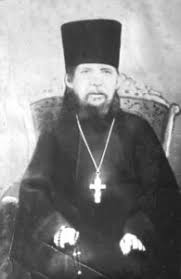
The last elder of Optina to be chosen by the council of the brethren was St. Nektary, a disciple of the elders Anatoly (Zertsalov) and Ambrose (Grenkov). Fifty years he spent in the skete of the Optina Hermitage, twenty of them in seclusion. Of his life — bound up as it was with the persecution of the Church and the hounding of monasticism — less is known than of his celebrated predecessors.
St. Nektary (in the world, Nikolai Vasilyevich Tikhonov) was born in 1853 in the town of Yelets in Oryol province, into the poor family of Vasily and Elena Tikhonov. His father, a mill worker, died when the boy was only seven; before his end he blessed his son with an icon of St. Nicholas, entrusting the child to the saint's care. The elder never parted with that icon all his life.
With his mother Nikolai's relations were of the warmest and most heartfelt kind; she governed by gentleness and knew how to touch his heart. But she too died early, and the boy was left a complete orphan. From the age of eleven he worked in the shop of a rich merchant; he was industrious, and by seventeen had risen to junior salesclerk.
When the young man turned twenty, the senior clerk conceived the idea of marrying him to his daughter. Living in Yelets at that time was a schema-nun of nearly a hundred years, the eldress Feoktista, a spiritual daughter of St. Tikhon of Zadonsk. The master sent the young man to her for a blessing on the marriage — and the nun blessed him instead to go to Optina, to the elder Hilarion. The master let him go, and Nikolai set out.
In 1873 he arrived at the Optina Hermitage carrying nothing in the knapsack on his back but a copy of the Gospels. He came first to the skete superior, the elder Hilarion, who sent him on to St. Ambrose. So many people were then coming to the great elder Ambrose that one might wait weeks for an audience; but Nikolai he received at once, and spoke with him for two hours. What passed between them St. Nektary never revealed to anyone; but after that conversation he remained in the skete forever, becoming the spiritual son of the elder Anatoly while going for counsel to the elder Ambrose.
His first obedience at Optina was tending the flowers; then he was appointed to serve in the sanctuary. His cell had a door opening into the church, and in it he lived for twenty years without conversing with any of the monks: he would only go to the elder or to his confessor, and back again. He liked to repeat that for a monk there are only two ways out of his cell — into the church, or into the grave.
Under the guidance of his great mentors he grew swiftly in the spirit. On 14 March 1887 he was tonsured into the mantle; on 19 January 1894 he was made hierodeacon, and four years later the bishop of Kaluga ordained him hieromonk. He was then thirty-four.
Already in those years he was healing the sick, and possessed the gifts of clairvoyance, of wonderworking, and of discernment. But in his humility he hid these high spiritual endowments beneath an outward foolishness.
In 1912 the Optina brethren elected him elder. He refused, saying: "No, fathers and brothers! I am feeble of mind and cannot bear such a burden." Only out of obedience did he consent to take up the eldership.
His foolery often carried prophecies whose meaning became clear only with the passage of time. Half a year before the revolution, for instance, the elder took to walking about with a red bow on his chest; or he would switch on an electric flashlight and pace his cell with a grave air, inspecting every corner and cupboard. After 1917 that "eccentricity" was remembered quite differently: it was precisely thus, by flashlight, that the Bolsheviks searched the monks' cells, the elder Nektary's room among them. Or he would gather up all manner of rubbish, arrange it in a little cupboard, and show it to everyone: "This is my museum." And indeed, after Optina was closed, there was a museum in the skete.
Once the elder Barsanuphius, then still a novice, was passing Father Nektary's little house. The elder stood on his porch and said: "You have exactly twenty years left to live." The prophecy was later fulfilled to the letter.
Archpriest Vasily Shustin told how the elder would sort his letters without reading them: "This one requires an answer; those are letters of thanks — they may be left unanswered."
There are recorded cases of his healing the mortally ill. One woman had a daughter with an incurable disease, given up by every doctor. The mother came to the elder for a blessing, and before she could say a word he addressed her himself: "You have come to pray for your sick daughter? She will be well." He gave her seven gingerbreads and told her the girl should eat one each day and receive communion often. The daughter took the gingerbreads with faith, communed after the seventh, and recovered. The illness never returned.
The nun Nektaria came to him with an adolescent boy who had suddenly fallen ill, his fever rising to forty degrees. The elder gave the boy an apple: "Here is your medicine." And blessing them for the road, he said: "At the stop, while the horses are being fed, let him drink some boiled water, and he will be well." So it happened: the boy drank the water and fell asleep, and woke healthy.
The elder received visitors in the little cottage of the elders before him. Sometimes he would leave books lying on the table in the reception room; visitors, while they waited, read them and found in them the answers to their questions. And St. Nektary, in his humility, would remark that they were really coming to the elder Ambrose, and that the cell itself spoke on his behalf.
He kept a cat that obeyed him with uncommon devotion, and he liked to say: "The elder Gerasim was a great elder, and so he had a lion; we are small — and we have a cat."
In appearance the elder was short and stooped, with a rounded face and a small wedge of a beard. His face seemed to have no age — now ancient and stern, now young to the point of quickness, now childlike in its purity and calm. He walked with a light, gliding step, as though barely touching the earth. Only just before his death did he move with difficulty, his legs swollen like logs and weeping fluid — the toll of long years of standing at prayer.
He was once asked whether he had to take upon himself the sufferings and sins of those who came to him, in order to relieve or console them. "There is no other way to lighten them," he answered. "And sometimes you feel as though a mountain of stones lay upon you — so much sin and pain have they brought you that you can scarcely bear it. Then grace comes and scatters that mountain of stones like a heap of dry leaves. And you can receive again."
The elder spoke often, and with love, of prayer. He taught constancy in it, and held it a good sign from the Lord when petitions went unanswered. "One must go on praying and not lose heart," he would teach. "The Lord sends His mercy when it is pleasing to Him, when it is profitable for us to receive it... Sometimes the Lord grants a petition after a year... One must take the example of Joachim and Anna. All their lives they prayed and did not despair — and what consolation the Lord sent them!"
After the monastery was closed, on Palm Sunday of 1923, St. Nektary was arrested. He was confined in the monastery's bread building, converted into a prison. The room where he was held was divided by a partition that did not reach the ceiling; on the other side sat his guards, who smoked incessantly, and the elder choked on the smoke. On Holy Thursday he was taken away to the prison in Kozelsk.
On his release the authorities demanded that Father Nektary leave the Kaluga region. He lived in the village of Kholmishchi in the Bryansk lands, in the house of a peasant related to one of his spiritual sons. The Cheka threatened this peasant with exile to Kamchatka for sheltering the elder, and in the autumn of 1927 he was burdened with an especially heavy tax.
To Kholmishchi, despite every difficulty, his spiritual children came from all ends of Russia. The holy Patriarch Tikhon sought St. Nektary's counsel through trusted intermediaries.
A seer, St. Nektary prophesied in 1917: "Russia will rise again, and will be poor in material things but rich in spirit; and in Optina there will be seven more lamps, seven pillars."
From 1927 the elder began to ail seriously, and his strength waned. Father Sergiy Mechev came to give him communion. On 29 April 1928 Father Adrian made his difficult way to Kholmishchi, and that same night St. Nektary died in his arms. Shortly before his end, asked where he should be buried, the elder pointed to the village cemetery and forbade burial beside the Church of the Protection, saying that the place would become worse than a pig pasture. So it proved: the church was demolished, and a fairground and a dance floor were set up on the cathedral square. In fulfilment of his wish he was buried in the local village cemetery, two or three versts from Kholmishchi.
In 1935 grave robbers dug up the elder's grave, hoping to find valuables. They tore off the coffin lid and stood the open coffin propped against a tree. In the morning, collective farmers coming to the cemetery saw the elder standing incorrupt — his skin like wax, his hands soft. The coffin was closed and lowered into the grave to the singing of "Holy God."
After the revival of the Optina Hermitage, on 3/16 July 1989 — the feast day of Metropolitan Philip of Moscow — the relics of St. Nektary were recovered. As the solemn procession moved through the monastery, a wondrous fragrance rose from the relics: the elder's mantle proved incorrupt, and the relics were the color of amber. In 1996 St. Nektary was numbered among the locally venerated saints of the Optina Hermitage, and in August 2000 the Jubilee Bishops' Council of the Russian Orthodox Church glorified him for veneration by the whole Church. The shrine with his relics now stands in the western part of the St. Ambrose chapel of the monastery's Cathedral of the Presentation.
As in the elder's lifetime, so after his blessed repose, everyone who turns to him with true faith receives grace-filled help. Through the prayers of St. Nektary people find their way out of the hardest circumstances of life, and miracles of healing, spiritual and bodily, are wrought. Holy father Nektary, pray to God for us!