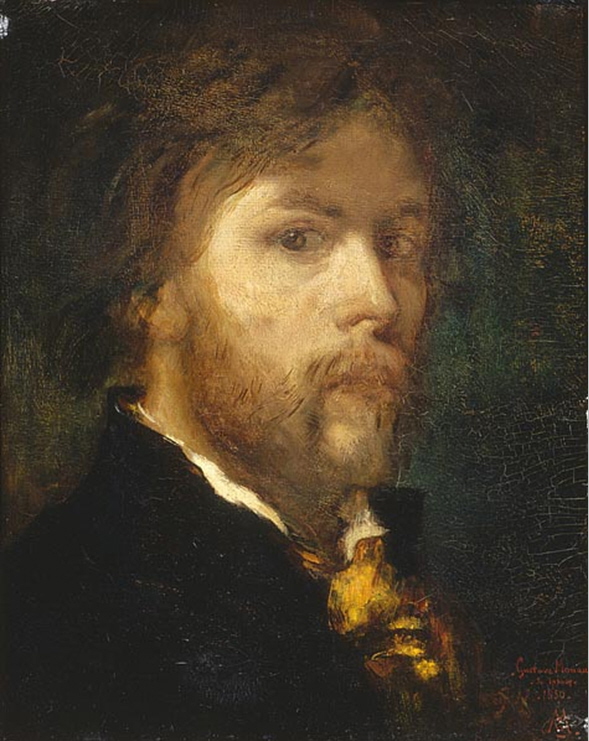
Gustave Moreau was born in Paris in 1826 into a well-to-do family: his father was an architect, his mother a musician. As a child he was often ill and spent long periods at home — where, forced apart from other children his age, he began drawing early. He received a thoroughly academic education, but put it to uses far removed from academicism.
Moreau became one of the leading painters of Symbolism — a movement that sought not the depiction of the visible world, but images of dreams, myths, and inner states. His canvases are populated with figures from antiquity and the Bible — Oedipus and the Sphinx, Salome, Prometheus — yet they are painted not as illustrations of a story, but as precious visions overloaded with ornament, in which what matters is not the narrative but its emotional cipher.
In 1888 Moreau was elected to the Académie des Beaux-Arts, and in 1892 he became a professor at the École des Beaux-Arts — and unexpectedly proved to be a teacher rare for his time. Rather than demanding that his students imitate his own manner, he taught them to see the idea concealed behind the line and to trust color as an independent language. Among his students were Albert Marquet, Georges Rouault, and Henri Matisse — the very Matisse who, a few years later, would head the group of painters whom critics would call the "Fauves" ("wild beasts").
Moreau himself, meanwhile, remained an almost hermit-like figure: he exhibited rarely, avoided publicity, and lived a secluded life in a house on the Rue de La Rochefoucauld in Paris, where his studio was also located. It was this very house that he began, already in his lifetime, to remodel into a future museum of his own works — he enlarged the studios and installed spiral staircases for viewing the paintings, which were hung in several tiers.
Moreau died in 1898 of stomach cancer. Under his will, his house and almost all of its contents — thousands of paintings, drawings, and sketches — passed to the state on condition that the exhibition be preserved intact. In 1903 the mansion opened as the Musée Gustave Moreau — a rare case of an artist himself designing the space of his own posthumous memory.
Years later, Matisse recalled Moreau's lessons as a school of freedom rather than of submission: the teacher made his students copy the old masters in the Louvre not in order to instill a ready-made style, but so that each of them might find in another's painting something that resonated with his own eye. Such an approach was a rarity within the academic system of the late nineteenth century, built above all on uniformity of method and a rigid teacher-student hierarchy.
The paradox of his fate lies in the fact that during his lifetime the broad public knew little of him, and that the truly lasting mark he left was not so much through his canvases as through a few years of teaching: what he taught a handful of students — to trust the eye more than the rule — determined the future course of twentieth-century painting.
Today, in the Paris museum that bears his name, one can see what was almost never exhibited during his lifetime — not only finished canvases, but hundreds of watercolor studies and sketches in which Moreau sought out the composition anew for each painting, over many years. This gap between the secretive, almost obsessive labor over a conception and the final, meticulously finished canvas is the key to why his students carried away from the studio not a ready-made style, but the habit of seeking their own image, one not yet found.