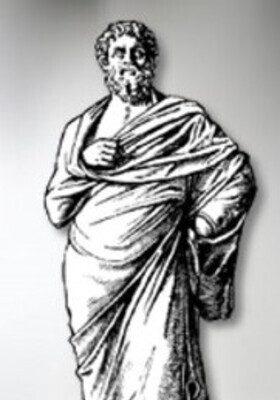
Of the author himself almost nothing is known. It has even been suggested that the very name is a scribal accident: a copyist doubling the gamma in the Greek logou ('of the tale') produced loggou, from which a nominative loggos — Longus — was constructed and taken for the writer's name. His approximate dates, the second century, rest solely on the language of his novel. To judge by the book, he lived in a wholly pagan world and came from Lesbos, the island on which the story is set — though his knowledge of the place is incomplete and inexact, for all his mention of Mytilene, its principal city.
His distances between one geographical point and another are likewise only approximate, and the winter he describes on Lesbos is so severe as to strain belief. The intellectualism and polish of his prose betray a townsman, whose ideal had become a rural life idealistically conceived, lived close to nature, with the natural sensuality of personal relations.
He is the author of the celebrated pastoral romance Daphnis and Chloe, which shows the deep influence of the shepherd idylls of Theocritus, Moschus and Bion. Unlike theirs, his work is written in prose, with regular insertions of verse arising spontaneously at the most poetic moments of the text. This joining of the poetic and the prosaic was a new device in the history of ancient Greek literature, and marks Longus as an educated man of letters, able to fuse the traditions of different genres at once innovatively and convincingly.
Like his predecessors in the idyll, Longus animates and poeticizes nature, peopling it, in the Hellenistic manner, with the traditional figures of the lesser mythology. The naturalness of the shepherd's life he depicts is joined to a poetic and remarkably candid treatment of the erotic — the sensual scenes involving the young Daphnis and Chloe, the seductress Lycaenion, and Gnathon.
The exact date and place of his death are unknown.