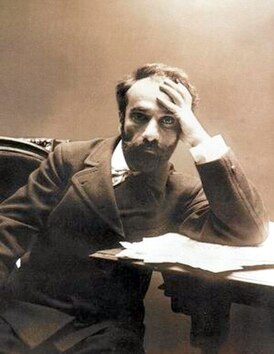
Isaac Ilyich Levitan (born 3 (16) October — or, by other accounts, 18 (30) August — 1860, in the settlement of Kibarty, today the town of Kybartai, Lithuania; died 22 July (4 August) 1900, in Moscow) was a master of the "mood landscape" and one of the creators of the national Russian landscape.
The distinctive quality of Levitan's art: his lyrical landscapes are suffused, on the one hand, with subjective human feeling (nature "grieves," "frowns," is "at peace," "rejoices," and so on), and, on the other, with a keen sense of an objective higher harmony — which is why the human figure becomes unnecessary in his landscapes, even superfluous. Depicting with great feeling and truthfulness everything dear and modest, plain and unassuming, simple and great in Russian nature, Levitan — in the words of Alexandre Benois — brought "a life-giving spirit of poetry into a stale realism."
Famous paintings by Isaac Levitan: "Autumn Day. Sokolniki," "Above Eternal Peace," "The Quiet Abode," "By the Whirlpool," "The Vladimirka Road."
...Twice he tried, and failed, to shoot himself, and once he tried to hang himself. He could burst into sobs in the middle of a conversation. Or flee at the height of an exhibition, to hide from human eyes. He would walk off without a word of warning, abandoning his studies, and go hunting in the forest for days without food; he was once put on a missing-persons list, and on his return was held under arrest for twenty-four hours, so that he would not waste the police's time again. Twice, as if in a recurring nightmare, in despair and fury, he flung down at the feet of the women he loved (first one, then the other — both had long been firmly married to men other than him, and for a time they competed for Levitan's ailing heart) a dead gull he had shot with his own hand. He suffered agonizing bouts of depression. And he died, not yet forty, of a dilation of the aorta.
But what has any of this to do with his art? What do Levitan's biography and his paintings have in common? Life and painting are parallel universes! Keep your slimy paws off the genius, you mercenary tabloid scribblers! Does any of this explain anything, or help us understand anything at all?
We dare to claim that it does. Try to trust us, and we will try to explain.
Landscapes as a reflection of Levitan's personality and life
An exceptionally delicate emotional makeup, a nervous suspiciousness and vulnerability, "raw nerves," a melancholic temperament with its heightened, intuitive perception — all of this bears directly on Levitan's brilliant ability to discern, in the plain and low-contrast Russian landscape, what no one before him had been able to see.
"These poor villages, this meager nature..." — so Tyutchev, one of Levitan's favorite poets, summed it up in the nineteenth century. "I will walk down the gloomy path, to remember the sobbing of the blizzard," wrote Rubtsov of the same reality in the twentieth. For a long time it was held that Russia had no landscape — and could have none — worthy of a painter's brush; the academy's first bursary students went to Italy for their landscapes, and Shishkin and Polenov, closer to Levitan's own time, went to Germany, Switzerland, France.
Levitan began and ended with the Russian landscape; it was his alpha and omega, and he found Russian nature neither gloomy nor meager. "The northern Great Russian landscape — submissive, joyless, with its aching note of longing and sorrow," as Levitan's contemporary, the artist Leonid Pasternak, described it — proved to the melancholy-prone Levitan not only intelligible and dear but also within his power to master. It is worth noting that even the art-historical vocabulary applied to Levitan hints at melancholy: "tremulous brushstroke," "nervous brush"...
Levitan went abroad three times, but to the brighter nature of France and Italy, and to the solemnly majestic Alps of Switzerland, he remained indifferent; he grew weary, bored, and wrote wistful letters home: "I can only imagine how lovely it is now back in our Russia — the rivers have flooded, everything is coming to life... There is no better country than Russia! Only in Russia can there be a true landscape painter." Even in the Crimea, so much more colorful than central Russia, the artist managed to grow homesick. His Crimean studies were snapped up at once from the exhibition, yet Levitan complained: "Nature here [in the Crimea — ed.] astonishes you only at first, and then it becomes dull, and you long terribly for the north... I love the north more than ever now... only now have I come to understand it."
Here, in the most unassuming of motifs, the "melancholic Barbizon painter" Levitan, by the force of his love, uncovered "the divine something poured out through nature." Piercing and quiet, modest and humble, Russian nature is transfigured in Levitan's art into the highest poetry.
What did Levitan's childhood conceal?
Despite his own susceptibility to love, and the ardent female interest he inspired in return, Isaac Levitan never officially married. The only woman to whom he once proposed — in the heat of the moment and, it seems, to his own surprise as much as hers — was Chekhov's younger sister, Maria Pavlovna. Nothing came of it. Yet, contrary to the usual course of such affairs, Levitan and Maria remained close friends for the rest of their lives. But even she admitted: "Isaac Ilyich himself never said a single word about his family or his childhood. It was as though he had had no father or mother at all. At times it even seemed to me that he wanted to forget they had ever existed. He only ever said that as a child he had known terrible hardship..."
It cost biographers some effort to reconstruct even the outline of the beginning of Levitan's life.
He was born at the western edge of the Russian Empire, near the railway station of Kibarty (now in Lithuania), into a cultured Jewish family. His grandfather was a rabbi, and his father, too, completed a rabbinical school, though he chose not to pursue Talmudic learning any further. Having taught himself German and French, Elyashiv (Ilya) Levitan worked as a railway inspector and as a translator for a French firm. They lived poorly. There were four children: the sons Avel (who would later call himself Adolf) and Isaac, and the daughters Teresa and Emma. Of the mother of the household, Basya (Bertha) Levitan, an avid reader, biographers say that instead of a hot dinner she might, with rapture and passion, retell her children the plot of some book that had gripped her.
In search of a better life, and with all the impracticality of Chekhov's future characters, Levitan's father dreamed his "To Moscow, to Moscow!" — and in the late 1860s the whole family, small children and all, did move to the old capital, but never found the prosperity it hoped for. The father taught French to the offspring of well-to-do Jewish families. Money grew catastrophically short — so short that Ilya Levitan's own children could not attend school; in the evenings he tried to make up the loss himself.
The son Avel showed some aptitude for drawing and was admitted to the Moscow School of Painting, Sculpture and Architecture. Soon the thirteen-year-old Isaac followed him there. From some memoirs it appears the father saw no particular gift in him: it was simply convenient to have the sons studying in one place and keeping together. Incidentally, in exactly the same way, following his elder brother Sergei — whom he would go on to surpass — Levitan's schoolmate Konstantin Korovin also entered the School.
The Levitans went on living in great poverty, in a tiny rented flat. Isaac had just turned fifteen when his mother died. And when he was seventeen, both Ilya and Isaac Levitan were struck down at once by typhoid fever. Alarmed, kindhearted neighbors took father and son to separate hospitals, and only Isaac was fated to return: his father died. Over the next few years Levitan would come to know the humiliation of homelessness and destitution, persecution on account of his origins, and even hunger.
But why, then, did he refuse to remember his parents?
A few years ago Mikhail Rogov, a candidate of economic sciences, tracked down and published archival records indicating that Ilya and Bertha Levitan, whose son Avel was born in 1860, could not possibly have been the parents of Isaac, who came into the world that same year — just five months before Avel. According to the birth records, Isaac Levitan was the son of Ilya's own brother, Khatskel, yet for some reason he was raised in Ilya's family and bore his uncle's patronymic. The reasons we do not know. This family secret died with the two painter brothers: Isaac ordered all his correspondence destroyed after his death, and Avel, who outlived him by thirty-three years, was monstrously secretive.
Levitan's student years dragged on for eleven full years
At first Isaac studied life drawing under the exposé-minded genre painter Vasily Perov, but by some miracle Alexei Savrasov, who taught the neighboring landscape class, recognized a kindred spirit in the fourteen-year-old boy. He all but begged to have Levitan "handed over" to him. This time Perov did not object.
As soon as spring came, Savrasov would lead his students out of the dusty classrooms into the forest, the park, or down to the river. He might arrive at the school with a sprig of pussy willow and demand that his colleagues appreciate the subtle, incomparable scent of the first greenery. From his students he demanded not copying but observation. Some thought Savrasov strange; Levitan understood him at half a word. And if the teacher asked whether the oak in his picture rustled or did not rustle, Levitan not only was unsurprised by the question but very soon began to grasp how, by painterly means, to make an oak rustle, a birch tremble, and nature as a whole live, grieve, and rejoice.
Levitan himself, alas, had more often to grieve in those years of apprenticeship. Orphaned and homeless, he sometimes went three days without a meal, grew dizzy at the smell of the white bread with which his comrades fortified themselves, and for several years wore a checked jacket and short trousers he had long outgrown. Mikhail Nesterov recounted that Levitan "was in great want; many half-fantastical tales went around the school about him... It was said that at times he had nowhere even to sleep. There were occasions when, after the evening classes, Isaac Levitan would quietly vanish and hide in the upper floor of the huge old Yushkov house, where once, in the reign of Alexander I, the Freemasons had gathered, and which later unsettled Moscow's townsfolk with 'terrible apparitions.'"
His situation improved a little when Levitan received a stipend from the Moscow governor-general. But in 1879 another blow of fate awaited him: after the attempt on the sovereign's life, Jews were expelled from Moscow. Thirteen years later, in 1892, the same thing happened again: by then a famous artist, he was once more ordered to "leave within twenty-four hours," and only a great public outcry made his return possible. Feeling himself an outcast, a stranger, was nothing new to Levitan.
Isaac Levitan would never receive the diploma of a "certified artist." His beloved teacher Savrasov appeared at the school more and more rarely; he drank and could not stop. Having finished his "graduation" painting, Levitan searched long for Savrasov through the taverns and doss-houses, and found him nearly in rags. Hung over, Savrasov chalked on the back of the canvas "Large Silver Medal" — which would have entitled Levitan to a diploma. But the school's leadership did not agree with this verdict. Perhaps Perov's growing dislike of Savrasov made itself felt, or perhaps, as Konstantin Paustovsky believed, "the talented Jewish boy irritated some of the teachers. A Jew, in their opinion, had no business touching the Russian landscape."
Even so, Levitan continued to attend the school's classes for several more years: after Savrasov, Vasily Polenov came to teach there — a splendid colorist and a highly educated man, who gave Levitan a great deal in matters of painting and used him as the model for Christ in his own canvases.
The adult life of the artist Levitan
On leaving the school, Levitan and his friend, the animal painter Alexei Stepanov, settled in cheap rooms on Tverskaya Street. Much bound them together besides painting: a joyless childhood, an early acquaintance with poverty, and a shared love of hunting. Levitan was an excellent shot at ducks and hares — and Stepanov painted them too; his first fame would come from the pictures "Elk" and "The Cranes Are Flying." Into Levitan's "In the Forest in Winter" Stepanov "moved in" a wolf. The landlords had grandly named the rooms on Tverskaya the "England" hotel. The contrast greatly amused Chekhov, who joked that all the paintings Levitan produced at the time would later be assigned to his "English period."
Money was short again, and Levitan could not bring himself to hack out swans and courting couples beneath the stars for sale. He recalled with gratitude the first hundred rubles that Pavel Tretyakov paid him for "Autumn Day. Sokolniki," but they too were quickly spent. Polenov "matched up" his talented pupils Korovin and Levitan with work painting scenery for Savva Mamontov's Private Opera. The millionaire paid generously, but Levitan was a born easel painter, not a scene painter, and for some reason he never took root at Mamontov's Abramtsevo either. Nevertheless, with the money earned from Savva, Levitan set out on his first great artistic journey — to the Crimea. Seeing the sea for the first time, he could not hold back his sobs, but he cooled toward the Crimea very quickly. He was drawn farther north: to Babkino near Moscow, where he spent three summers as a guest of the Chekhov family, to Savvina Sloboda near Zvenigorod, to the Volga.
In the early 1880s the Chekhovs were staying with the Kiselyov landowners at Babkino, while Levitan rented a little room in the neighboring hamlet of Maximovka. Chekhov grew worried that Levitan had not been seen among people for some time, and set out with his brothers to find him. At dusk they came upon Levitan lying on his bed. Startled, he snatched up a hunting rifle and aimed it at them, and the mistress of the house whispered to Chekhov that Isaac had wanted to shoot himself only recently. Suspecting the onset of a mental illness, and understanding that Levitan must not be left alone, Chekhov took him under his wing: he invited him to come and live with them at Babkino and found him work at the humor magazines to which he himself contributed. It was Chekhov, too, who first brought Levitan into the salon of Sofia Petrovna Kuvshinnikova.
"A tender eye": the whirlpools of love in Levitan's life
"Levitan's eye was so tender that the slightest falseness or inaccuracy of color was, for him, unthinkable," the artist Boris Ioganson maintained. Women read Levitan's "tender eye" differently: emotional and handsome, he was extraordinarily attractive to the opposite sex. His romances were forever stormy, attended by scandals and duels that never came off.
Chekhov's biographer Donald Rayfield, who stripped the writer's life of its prudish silences, says of Levitan too that he was a man "who had hundreds of affairs with hundreds of women." Leaving the order of magnitude to the Englishman's conscience, let us note that the longest relationship of Levitan's life was with the artist and musician Sofia Petrovna Kuvshinnikova; it lasted eight years and was described, in a diminished projection, by Chekhov in "The Grasshopper." But the famous "Grasshopper," with its foolish and vain heroine, her underappreciated doctor husband, and her lover — the mediocre artist Ryabovsky — is, for all the coincidence of circumstances, a work of fiction all the same. The real story of Levitan and Kuvshinnikova is a story about something else.
Sofia Petrovna was thirteen years older than Isaac: when they met she was thirty-nine, he twenty-six, and she was indeed married to a doctor — the police physician Dmitry Pavlovich Kuvshinnikov, known in artistic circles not only for his wife's salon, which drew celebrated writers, musicians, and painters, but also because Perov painted him as the boastful huntsman in the famous "Hunters at Rest."
Dmitry Pavlovich gave himself seriously to his work, while his wife gave herself, with equal passion, to art: she drew rather well, played the piano better still, and was forever inventing something — unusual outfits for herself, or furnishings for the home. "There was much in Kuvshinnikova that could please and captivate," Olga Knipper wrote to Anton Chekhov. "She did not stand out for her beauty, but she was unquestionably interesting, original, gifted, poetic, and refined. One can well understand why Levitan was captivated by her." "She was a woman not especially beautiful, but interesting for her talents," echoed Chekhov's brother Mikhail. "She dressed beautifully, able to sew herself an elegant costume out of scraps, and she had the happy gift of lending beauty and comfort even to the dreariest dwelling, one resembling a barn. Everything in their flat seemed luxurious and elegant, and yet instead of Turkish divans there were soap crates with mattresses laid over them under rugs. On the windows, instead of curtains, hung plain fishing nets."
Sofia Petrovna asked Levitan to give her a few lessons, and so their romance began. As soon as the warm days came — for all eight years — Levitan and Sofia Petrovna would go off to paint from nature: around Moscow, near Tver, or on the Volga. Sofia Petrovna proved, like Levitan, a passionate and self-forgetting hunter. In earlier days Isaac might vanish into the forest for a week with no company but his dog Vesta — who had attached herself to him by chance but was astonishingly devoted (it was said Levitan had taught her to count to ten and fed her regularly even when he had no dinner himself). Now he and Sofia Petrovna, dressed in men's trousers and boots, would push into the thickets, wade through the mud, lie in wait for woodcock and grouse, shoot, drag heavy game-bags of their kill — and then, with zeal and even spite, hurl the game to the ground, counting up who had bagged more that day, neither willing to yield to the other. The testimony of yet another of Chekhov's correspondents — his sister Maria Pavlovna, Levitan's would-be bride — completes the picture: "You can't imagine what is happening with S. P. [Sofia Petrovna — ed.]! Pampered by a kind and generous husband, by a carefree and secure way of life in which everything bowed to her, she is now taming her very self, patiently enduring Levitan's gloom, irritation, and sharpness, if only to instill in his restless, anxious soul a sense of harmony and reliability. She rejoices when she sees the world fill again for him with all its colors, and the canvas draws him, and he is smiling and gentle. And other people's gossip interests her little."
In Sofia Petrovna's presence Levitan sulked less and less often: she diverted him with amusing stories about mutual acquaintances, saw to it that he did not go cold or hungry while painting outdoors, and instilled in him a confidence in his enormous talent that Levitan kept losing, ready to give up. His gift matured and grew stronger. The paintings created during the years of her active part in his life brought him his first loud renown. It was she who took a liking to the Volga town of Plyos, where Levitan worked so well and where "Evening. Golden Plyos" and "The Quiet Abode" appeared. It was she who traveled with Levitan to Lake Udomlya, where he painted the majestic canvas "Above Eternal Peace." And it was the two of them together who chanced upon the Vladimir highway; while Levitan painted "The Vladimirka Road," Sofia carried the heavy canvas on a cart, "like an icon," from the house to the open air and back.
Whether she was happy with Levitan, God knows; but her love and devotion are beyond doubt. Rayfield contends that Sofia Petrovna lasted so long at the artist's side only because she willingly turned a blind eye to the romances he carried on in parallel. In Plyos, Levitan and Kuvshinnikova met the beautiful Anna Grosheva, languishing, like Katerina in "The Storm," in the patriarchal family of her Old Believer husband. Sofia Petrovna helped arrange Anna's flight to Moscow, thinking that her soul yearned for freedom — when in fact Grosheva was yearning for Levitan. One summer, staying at the estate of the landowner Panafidin, Levitan became infatuated with another beauty, Lika Mizinova, to whom Chekhov intended to propose. In his letters Levitan teased his friend that "the divine Lika" "loves not you, the fair-haired one, but me, the volcanic brunet." That summer he painted the famous picture "The Whirlpool," telling Kuvshinnikova: "Everyone has had his own whirlpool in life." And Chekhov warned Lika: "You are destined to break poor Sappho's heart."
But it was another woman who broke Sofia Petrovna's heart — one who, as it happens, had also just turned thirty-nine when she met Levitan: Anna Nikolaevna Turchaninova. That summer Levitan and Kuvshinnikova had come to paint in Tver province, and their neighbors turned out to be the family of a prominent Petersburg official named Turchaninov — three charming daughters of marriageable age and their mother, Anna Nikolaevna, unwilling to part with her youth and surpassing even her daughters in beauty.
Tatyana Shchepkina-Kupernik, who managed to reconcile Levitan and Chekhov after they had gone several years without speaking following the publication of "The Grasshopper," reports: "Sofia Petrovna's rival is beautiful. She looks like a Gypsy. She paints her lips, always goes about in white, and she smells so sweet and so strong that even the cups she drinks her tea from smell of perfume. She is dreadfully gracious to everyone — especially to Sofia Petrovna. And she praises all her studies. But her eyes are wicked. Not stern, like Sofia Petrovna's — just wicked. I keep wanting to imagine whether they are ever different, when she caresses her children or prays. But perhaps she does not pray at all?"
In the end Levitan broke with Sofia Petrovna, preferring Turchaninova. But with his new love he found neither lasting happiness nor, still less, peace. One of Anna Nikolaevna's daughters also fell in love with the artist, and her struggle with her mother for Levitan's heart was fierce, lasting until his very death. Levitan's depressions returned, and once again he shot at himself.
Isaac Levitan's last years and last paintings
Levitan's heart disease worsened. Whether it was a congenital defect or an acquired rheumatic myocarditis is disputed; that his neurasthenia made things worse is not. "Why am I alone? Why did the women in my life bring me neither peace nor happiness?" Levitan agonized. "Perhaps because even the best of them are possessive. They need all or nothing. I cannot do that. All of me can belong only to my quiet, homeless muse; everything else is vanity of vanities... And yet, understanding this, I still strive for the impossible, I dream of the unattainable..."
Meanwhile, professional successes began to follow one after another. He was admitted to the Association of Traveling Art Exhibitions, and his painting "The Quiet Abode" created, in Chekhov's word, a furor. Levitan was often abroad — drawn there not only by the need to find fresh subjects for his landscapes and to acquaint himself with new directions in art, but also by the need for treatment. He was admitted to the Munich Secession, which played an important part in the emergence of the Art Nouveau style. Abroad, he praised the German doctors and their miraculous baths, but complained of being unable to work: "And indeed, there is no nature here, but some kind of impotence!" "What do I need here, in a foreign land, at the very time when I am drawn to Russia and long so painfully to see the melting snow, a little birch?"
Two years before his death, Levitan — once denied the title of certified artist — became an academician of painting and began to teach at the Moscow School of Painting, Sculpture and Architecture, where he had once studied under Savrasov and Polenov. He proved a fine teacher himself: "Today I'm off to Petersburg, nervous as a son of a bitch — my pupils are making their debut at the Traveling exhibition. I tremble for them more than I ever did for myself! However much you despise the opinion of the majority, it's still terrifying, damn it!" Levitan grew close to the World of Art group; it seemed to him that only now was he beginning to understand something important about painting, and that he was capable of much more. "Levitan has a dilation of the aorta," Chekhov noted in his diary. "He wears clay on his chest. Superb studies and a passionate thirst for life."
Levitan died before reaching forty, in August 1900, and was buried in Moscow, at the Jewish cemetery by the Dorogomilovo gate (in 1941 his grave was moved to the Novodevichy cemetery). Legend has it that in the August when Levitan lay dying, the lilac he so loved miraculously bloomed a second time that year.