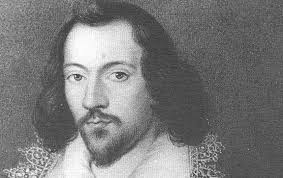
Thomas Kyd (1558, London, baptized 6 November — died 1594, buried 15 August 1594) was an English playwright. From 1565 he attended the Merchant Taylors' School; beyond that, his life can be pieced together only from fragments. It seems likely that on leaving school he followed his father into the scrivener's trade. In the 1580s he began translating plays and writing his own. Between 1587 and 1593 he was in the service of some unnamed aristocrat, and in 1591 he shared lodgings with Christopher Marlowe. Two years later that acquaintance brought him to grief: suspected of sedition and then charged with atheism, Kyd was arrested and tortured. He was released before long, but survived the ordeal by scarcely a year. With that, the biographical record is exhausted.
His literary achievement, by contrast, is considerable. Both as a translator of Tasso and Garnier and as an original dramatist he exerted a large influence on the growth of Elizabethan drama. He built his plays — still bound in great measure to the demands of narrative — on the play of passions and the collision of private interests. He did so crudely enough, it is true, often imitating Seneca's models mechanically; but for its time Kyd's work amounted to a theatrical revolution. Of his plays there survive The Spanish Tragedy (its first part only in fragments), Soliman and Perseda (whose authorship has been disputed), The Murder of John Brewen, and Arden of Faversham — attributed to Shakespeare until the middle of the nineteenth century, its true authorship established only quite recently. Kyd also wrote a tragedy called Hamlet, or Hamlet's Revenge, which underlies Shakespeare's play of the same name. The text of this so-called Ur-Hamlet has not survived — unless one accepts, with a number of modern critics, that the German tragedy Fratricide Punished (a manuscript of 1626) is a translated transcript of Kyd's play, carried to Germany by English actors on tour.
Kyd's fame rested on The Spanish Tragedy, known familiarly as Old Hieronimo. It ran through twelve editions and held the stage without interruption until the theatres were closed and the companies dispersed, founding the genre of the revenge tragedy. Several of its scenes are echoed in Shakespeare's Hamlet, and rare is the play or comedy of the Elizabethan theatre that manages without an allusion to The Spanish Tragedy or a quotation from it. Kyd also laboured over the reworking of older dramatic texts that later passed through other hands; his own is visible in Timon of Athens and in Romeo and Juliet. His style and outlook belong to the feudal order then in decay, while bourgeois influences show in his taste for realistic subjects drawn from actual criminal trials, as in The Murder of John Brewen and Arden. In that sense he is the first realist of Elizabethan drama.