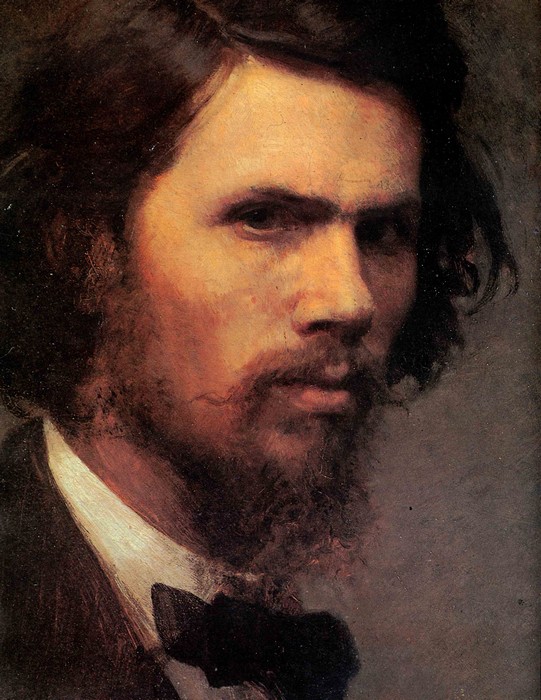
Ivan Nikolayevich Kramskoi (27 May [8 June] 1837, Ostrogozhsk, Voronezh Province — 24 March [5 April] 1887, St Petersburg) was a Russian painter — a master of the portrait and the genre scene — and an activist of art: leader of the Revolt of the Fourteen, founder of the Artel of Artists, and one of the organizers and the chief ideologue of the Society for Travelling Art Exhibitions.
The hallmarks of Kramskoi’s art: composition of plain, lucid simplicity; deep psychological penetration and flawless likeness in his portraits — a gift for finding what he himself called “the meaning of the face”; and a strict restraint of emotion in his figures, even in the most dramatic genre scenes.
His best-known paintings: The Unknown Woman, Christ in the Wilderness, Portrait of Mina Moiseyev, Inconsolable Grief, Moonlit Night, Mermaids, and portraits of Shishkin, Tolstoy, Nekrasov, and others.
Kramskoi’s life looks like an attempt to force itself into the frame of an ideology it never fit. He pointed out the way for many others — but did he find his own? One would like to answer yes; it seems Kramskoi left us no chance to.
Yes, but
To nearly every “yes” in Kramskoi’s life there is a “but” that undoes it. He fought academicism and overthrew ossified rules; he was the ideologue, inspirer, and organizer of the famous Revolt of the Fourteen, then of the Artel of Artists, later of the Society for Travelling Art Exhibitions. The “ideological content” of the man seems unambiguous. Look more closely and the contradictions multiply. He walked out of the Academy — yet was made an academician, and was offered a professorship, which he declined. He built his life on the precepts of Chernyshevsky — yet painted several excellent portraits of members of the imperial family. He saw the purpose of art in the search for the meaning of human existence, in the solving of social questions — yet by an irony of fate his most famous painting is The Unknown Woman.
It is held, not without reason, that Kramskoi’s gift showed at its fullest in the virtuoso portrait. Here too there is a “but.” The necessity of painting portraits weighed on him; he thought of them as a yoke, a bondage whose one purpose was to feed his family, and he dreamed of giving his strength to serious, “real” art.
The approaches to painting
Kramskoi began with portraits before he ever came to painting proper. Photography was just gaining ground, and no photograph went out unretouched; it was here that he took his first steps. Chance, in the person of a travelling photographer from Kharkov, got him out of the little town of Ostrogozhsk: the young man went along as retoucher and watercolourist. By then he had finished the Ostrogozhsk school with distinction and had studied drawing a little under a local icon painter.
He was twenty when he reached St Petersburg, and there he stayed. Undaunted, he went straight to the Imperial Academy of Arts, passed the examinations at the first attempt, and was enrolled. Perhaps things at the Academy were not so bad, if a penniless commoner could walk in off the street and be admitted? Still, he had to eat, and his skill with photographs served him well: Andrei Deynier, a graduate of the Academy, took him on at one of the first Russian photographic studios. Photographs that had passed through Kramskoi’s hands seemed to glow; soon he was known as the “god of retouching.” Even then the portraits would not let him go. “To paint nothing but portraits, today, tomorrow, and so on, year after year, with no way out in sight — that can crush a talent. I am weary of this position,” he would later admit. Scholars have counted some three thousand “heads.”
The Revolt of the Fourteen, the Artel of Artists, and the Travelling Exhibitions
Kramskoi taught at the Society for the Encouragement of the Arts and left behind a good name and grateful pupils; Ilya Repin spoke of him to the end of his days with immense respect and affection, and heeded his criticisms. His gifts as an organizer were superb. It was he who announced to the Council of the Academy that fourteen talented graduates refused to compete for the Great Gold Medal — a medal that meant, for the winner, six years in Italy at the institution’s full expense, with a comfortable post guaranteed to the rest. The young and ambitious would not paint a mythological subject on the set theme of “The Feast in Valhalla,” from Norse mythology. Offended that their demands were ignored, and stirred by the new democratic currents, the rebels, with Kramskoi at their head, walked out of the Academy and founded the independent Artel of Artists. It lasted eight years, though Kramskoi himself judged that its peak came in the fifth, after which decline was inexorable.
The Artel was built on the principle of the commune — the influence of Chernyshevsky’s What Is to Be Done? is plain — but in practice it collided with the ordinary frictions of daily life. Successful painters balked at paying part of their income into the common fund; communal living bred domestic quarrels, with the artists’ wives falling out first. And the fact that many members went on cooperating with the Academy in one way or another struck Kramskoi, at the time, as betrayal. He did not yet know that one day his comrades would accuse him of the same. The Artel looked less and less like the ideal community he had dreamed of; in 1870 he left it, and it soon dissolved. Taken with Myasoedov’s ideas, Kramskoi became one of the organizers of the Society for Travelling Art Exhibitions, which had an enormous influence on the course of painting in Russia.
Vera Pavlovna’s dream made flesh
Sofya Prokhorova was living with a painter named Popov, who was quite comfortably married — to somebody else. Kramskoi was twenty-two when they met; here too one catches the echo of Chernyshevsky and of Vera Pavlovna. Popov soon went abroad with his lawful wife, and Kramskoi offered the woman his hand — a helping hand, and marriage. Sofya Prokhorova became Sofya Kramskaya. In the Artel she ran the household affairs; she was always at her husband’s side and bore him six children, four of whom died. Was Kramskoi happy? Certainly — though he confessed that “personal happiness does not fill a life.”
The sudden Unknown Woman, and the curse of the portrait
For all his democratic ideology and his talk of art with a purpose, Kramskoi’s own paintings reflected little of it — though his sincerity is not in doubt (again: yes, but). At the eleventh exhibition of the Wanderers, Repin showed his Religious Procession, an encyclopedia of Russian reality; Makovsky painted the urban poor in The Rendezvous and The Reprimand; Surikov painted the disgraced Menshikov in exile. And Kramskoi? How did this sumptuous lady find her way in here at all?
Had Kramskoi not stood at the origin of the Artel and the Travelling Exhibitions, had his democratic views not been common knowledge, had there been no scandalous marriage to a “fallen woman” — would the picture have had any chance of hanging at a travelling exhibition? Even with his credentials, it raised a storm among his comrades. “A cocotte in a carriage,” pronounced the critic Vladimir Stasov, and that was that. It remains Kramskoi’s greatest riddle, never to be fully solved — the very title says as much. But looking at her — and one does not want to look away from The Unknown Woman — the thought keeps returning: what would Kramskoi have painted, had there been no daily bread to earn and no ideology into whose frame he strove to force his life?
The more popular he grew, the louder his comrades’ censure. And when he was commissioned to paint members of the imperial family… He was called an apostate who had sold himself to the Academy (he had proposed exploring cooperation between the “academicians” and the Wanderers), a renegade, a traitor to his ideals wallowing in luxury. Even his beloved red stockings were held against him. The imperial portraits did raise his family to a higher standard of living. Did they let the artist himself relax for a moment? Not at all. He seemed to be running in a wheel, and all he could do was run faster. The money went, the family’s needs grew, and he saw no way to set aside enough to do what he longed for. In despair he wrote to Pavel Tretyakov: “Things have reached the point of pain, and I am ready to cry ‘Help!’ Give me a year of life, on trial. I want one year of an artist’s life, so as not to have to chase after bread. Think it over — the matter can wait, though I am already worn out.” No one granted him the year.
He died two months short of fifty, though by the end he looked a feeble old man, confessing bitterly that everyone had turned away from him and that the thing he had been born for had gone undone. He suffered from heart disease; in his “old age” — not yet fifty! — he took morphine in large doses and went on with his portrait sittings, working five and six hours without a break. Grigory Myasoedov describes it without mercy: the family had grown used to luxury, money went uncounted, the children needed ever more, and in the end Kramskoi “needs money and more money, needs to work, needs to inject morphine, needs to die…” He died with the last portrait of his life unfinished. By an irony of fate the sitter was a celebrated physician, Karl Rauchfuss. In the fifth hour of the sitting Kramskoi swayed on his feet. Soon it was over, and even the nearness of a doctor could not help.