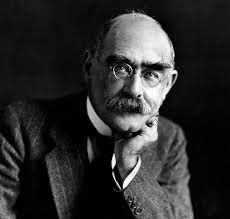
Joseph Rudyard Kipling was an English writer, poet and master of the short story. He was born in Bombay, India, to John Lockwood Kipling, a professor at the local school of art, and Alice (Macdonald) Kipling. The name Rudyard, it is thought, came from the English lake Rudyard, where his parents had met. His early years, filled with the exotic sights and sounds of India, were very happy ones. But at the age of five he was sent with his sister to England for his schooling. For six years he lived in a private boarding house whose mistress, a Madam Rosa, treated him harshly and punished him — an experience that marked him so deeply that he suffered from insomnia for the rest of his life. At twelve his parents placed him in a private school in Devon, intending that he should go on to a prestigious military academy. The headmaster, Cormell Price, was a friend of Kipling's father, and it was he who began to encourage the boy's love of literature. Poor eyesight barred Kipling from a military career, and the school granted no diplomas for entry to other universities. Impressed by the stories his son had written at school, his father found him work as a journalist on the Civil and Military Gazette, published in Lahore in British India, now Pakistan.
In October 1882 Kipling returned to India and set to work as a journalist. In his free hours he wrote short stories and verse, which the paper printed alongside his reporting. The reporter's trade taught him the many faces of colonial life. His first sales came in 1883.
In the mid-1880s Kipling began travelling through Asia and the United States as correspondent for the Allahabad Pioneer, with which he had contracted to write travel sketches. His popularity grew swiftly: in 1888 and 1889 six books of his stories appeared and brought him recognition. In 1889 he made the long journey to England, visiting Burma, China and Japan on the way; he crossed the whole of the United States and the Atlantic, and settled in London. People began to call him the literary heir of Charles Dickens. In 1890 came his first novel, The Light That Failed. The best-known poems of those years were The Ballad of East and West and The Last Rhyme of True Thomas.
In London he met a young American publisher, Wolcott Balestier, with whom he collaborated on the tale The Naulahka. In 1892 Balestier died of typhoid, and soon afterwards Kipling married his sister Caroline. During their honeymoon the bank holding Kipling's savings failed, and the couple were left with just enough money to reach Vermont, where the Balestier family lived. They stayed four years. In this period the writer turned again to children: in 1894–95 appeared the famous Jungle Book and Second Jungle Book, along with the verse collections The Seven Seas and the volume known as The White Thesis. Two children were born, Josephine and Elsie. After a quarrel with his brother-in-law, Kipling and his wife returned to England in 1896. In 1897 came the tale Captains Courageous. In 1899, during a visit to the United States, his elder daughter Josephine died of pneumonia — a devastating blow. That same year he spent several months in South Africa, where he met Cecil Rhodes, the very symbol of British imperialism. In 1901 appeared Kim, considered one of his finest novels. In Africa he began gathering material for a new children's book, published in 1902 as the Just So Stories. In that year too he bought a country house in Sussex, where he remained to the end of his life. There he wrote the famous Puck of Pook's Hill and Rewards and Fairies — tales of Old England bound together by their narrator, the elf Puck, borrowed from Shakespeare's plays. Alongside his writing Kipling now became politically active: he wrote of the looming war with Germany, supported the Conservatives and opposed feminism.
With the First World War his literary output thinned. Another blow was the death of his elder son John in the war in 1915. Kipling and his wife worked for the Red Cross in wartime. After the war he joined the War Graves Commission, and it was he who chose the biblical phrase inscribed on the memorial obelisks: “Their name liveth for evermore.” On a journey through France in 1922 he met King George V, with whom a great friendship later grew.
Kipling went on writing into the early 1930s, though success attended him less and less. From 1915 he had suffered from gastritis, later diagnosed as an ulcer. Rudyard Kipling died of a cerebral haemorrhage in London on 18 January 1936, only three days before George V. He was buried in Poets' Corner in Westminster Abbey.