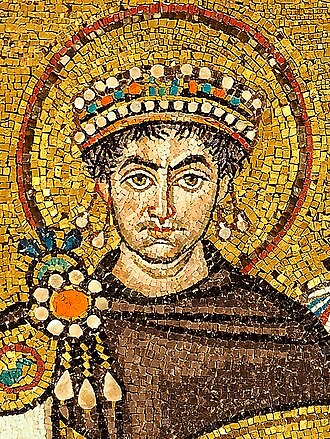
Justinian I (483–565) was the Byzantine emperor who tried to restore the Roman Empire as a single whole. He failed — but the attempt changed Europe.
His greatest legacy is the codification of Roman law (529–534). The Corpus Juris Civilis brought a millennium of Roman legal thought into a system, and that compilation became the foundation of law in most European states — down to the present day.
The campaigns of his general Belisarius won back Africa, Italy, and part of Spain; at Justinian's death the Mediterranean was very nearly one realm again. But the price was total exhaustion. The Gothic War (535–554) laid Italy waste more thoroughly than any barbarian invasion had, and three years after Justinian's death the Lombards seized the north of the country — and never left.
Hagia Sophia (537) was a manifesto in architecture and in theology alike. "Solomon, I have outdone thee," Justinian is said to have declared at its dedication. It would stand as a church for a thousand years, and then as a mosque — to this day.