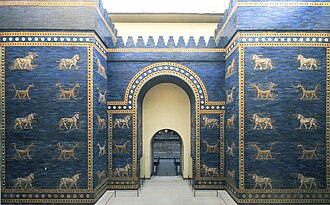
The Ishtar Gate is among the most recognizable masterpieces of ancient art: the ceremonial entrance to Babylon, built under Nebuchadnezzar II, who ruled the city in the sixth century BC. It was never merely a way into the city. It was a declaration of Babylon's grandeur and its culture. Its walls are faced with glazed brick bearing relief figures of bulls, mushhushshu dragons, and lions against a field of brilliant blue — a combination that makes the gate genuinely unlike anything else that survives from the ancient world.
The gate is itself the chief monument of Neo-Babylonian art, but it did not stand alone. It belonged to a larger architectural ensemble of temples, palaces, and other structures, and it is precisely this fusion of architecture, art, and symbolism that gives the Ishtar Gate its weight in the culture of antiquity.
The ideas behind it were rooted in Babylonian religion and myth. The animals and mythical creatures on its walls carried deep symbolic meaning, expressing the beliefs and values of the society that made them; the gate as a whole proclaimed the majesty and power of the Babylonian empire and displayed its cultural and artistic achievement. Its contribution to the culture of the ancient world was immense, and it has gone on inspiring art and architecture ever since.
Like many masterpieces, it had a difficult fate. After the fall of the Babylonian empire the gate was forgotten and fell into ruin. Only at the end of the nineteenth century was it excavated and reconstructed in the Pergamon Museum in Berlin, where it is now one of the principal attractions. That long arc of splendor, oblivion, and recovery only adds to its aura.
The Ishtar Gate matters today not only as a masterpiece of ancient art but as an emblem of shared cultural inheritance. It is a reminder that art can cross time and distance, joining people of different ages and civilizations — which is what makes it a truly enduring and universal work, one that continues to astonish.