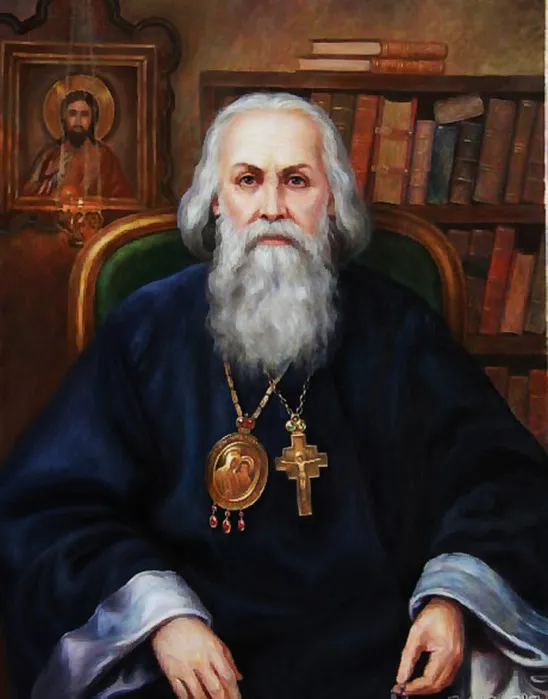
His feast day is April 30 (May 13).
Saint Ignatius Brianchaninov was born in the village of Pokrovskoye in Vologda province on 5 February 1807, into the old noble family of the Brianchaninovs, which traced its descent to Mikhail Brenko, a boyar, companion-in-arms and armor-bearer of Grand Prince Dmitry Donskoy. At baptism the future saint was given the name Dimitry.
His father, Alexander Semyonovich, a man of faith, had once been close to the court but by the time of the boy's birth had become a landowner of modest means. His mother, Sofya Afanasyevna, was an educated woman of kindly disposition who had married quite young and devoted herself to the care of her family.
Dimitry was raised from childhood in pious traditions and given a good education suited to his age. He stood out among his brothers and sisters for his gifts, showing aptitude for languages, drawing, singing and the violin. He might well have made a fine career, but something else drew him: from his youth there grew in him the desire to bind his life to the monastic calling. He prayed much and was often in church. When he confided this desire to his father, however, the elder Brianchaninov showed no sympathy and did not take it seriously.
When Dimitry turned fifteen, his father took him to St Petersburg to place him in the Main Engineering School. A patriot and a hero of the war of 1812, Alexander Semyonovich wished to see his son a military engineer, and the son did not gainsay him. Dimitry passed the entrance examinations so brilliantly that he outstripped every other candidate and was admitted straight into the second class. The year was 1822.
He studied diligently and more than once astonished his fellow students and teachers with his preparation. His successes made him known even to Grand Duke Nikolai Pavlovich, inspector-general of the Engineering Corps. In December 1824 Dimitry was commissioned as an engineer-ensign.
During his years of study he was received in aristocratic houses — his lineage, family connections, education and good breeding told, and he was besides a remarkable declaimer. He made the acquaintance of Krylov, Zhukovsky, Pushkin, Batyushkov and Glinka. Yet for all the prospects of a fine career that lay before him, they held no allure.
In this period Dimitry searched insistently for answers to the essential questions of life. Neither physics nor philosophy could supply them. He turned to the writings of the holy fathers of the Church and drew close to the monks of the Valaam metochion and the brethren of the Alexander Nevsky Lavra. His heart yearned for a place where outward glory and material comfort are counted as nothing. In the Lavra he met the elder Leonid, and with his support settled firmly on the resolve to enter a monastery. His father, learning what changes were taking place in his son's mind, was indignant and appealed to the school authorities, and Dimitry was placed under surveillance.
On completing the engineering school in 1826 he astonished many by submitting a request to resign his commission. The request was refused.
In the spring Dimitry fell ill with tuberculosis. The emperor sent doctors to him, and their verdict was disheartening: in such a state of health monastic life was out of the question. Dimitry nonetheless recovered. Instead of retirement he was offered a transfer to any of the guards regiments stationed in the milder climate of southern Russia, but he stood firm. In the end he was posted to the engineering detachment of the fortress of Dinaburg on the Western Dvina.
In November 1827, against his parents' wishes, he retired on grounds of health, and soon entered the Alexander-Svirsky monastery. There he was schooled in spiritual wisdom and performed various obediences: he labored in the bakery, at the fishing, as a driver. His spiritual guide in this period was the elder Leo. In 1828 Dimitry followed him to the Ploshchansk hermitage, and after a time moved on to the Optina hermitage. The rigors of this new life, the constant moves among them, told on his health, and at the end of 1829 he went for a while to stay with his parents, who tried in vain to talk him out of his choice.
In 1830, with the help of Stefan, Bishop of Vologda and Ustyug, Dimitry entered the Semigorodnaya hermitage; in 1831 he moved to the Glushitsky Sosnovetsky monastery. In June of that year, in the Vologda cathedral, at the age of twenty-four, he was tonsured a monk and given the name Ignatius, in honor of St Ignatius the God-bearer. On July 5 he was ordained deacon, and already on July 20 raised to the priesthood and appointed to serve at the bishop's residence. He was then sent to restore the Lopotov monastery of St Gregory of Pelshma, which had fallen into desolation. In January 1833 he was raised to the rank of hegumen.
Around this time his parents, reconciled to their son's will, restored good and trusting relations with him.
Under the strain of his labors and an unfavorable climate, Father Ignatius's health again gave way. Through friendly intercession a new post was secured for him: he was offered the office of superior of the Ugreshsky monastery. But a higher political power intervened: Emperor Nicholas I recommended that he take charge of the Trinity-Sergius hermitage near St Petersburg, and at the end of 1833 he was appointed its superior, being raised to the rank of archimandrite at the beginning of 1834. There he remained until 1857. Under his direction the hermitage was transformed, filled with monks, and won a good name. The knowledge he had acquired in the world served him, as did the respect that laymen bore him: many made him substantial donations.
From 1838 Archimandrite Ignatius also held the office of dean of the monasteries of the St Petersburg diocese.
In October 1857 Father Ignatius was consecrated bishop, and in January 1858 he arrived in Stavropol to take charge of the diocese of the Caucasus and the Black Sea. The diocese he found in dreadful neglect. Here St Ignatius met with difficulties of every kind, from insufficient funding to the hostility of the schismatics, of whom there were then not a few. Under his direction proper order was established in the services and education was set on its feet. Many people of note assisted the bishop in his work, though there were also those who treated him with ill will. In 1861 he petitioned to retire, and in August of that year was released with a pension.
In October of the same year the saint settled in the Nikolo-Babaevsky monastery. There, besides furthering the monastery's economic and liturgical life, he gave himself to solitude, worked on his writings, and received visitors in need of his pastoral care. On 16 April 1867 he celebrated the last Divine Liturgy of his earthly life. On 30 April 1867 he quietly went to God. After his death a few kopecks were found in the pocket of his cassock — the whole of his material wealth.
St Ignatius left the faithful a large body of writings of varied character. Among his published works are sermons and serious treatises, and many of his letters to private persons have come down to us. He wrote on the ascetic life (the two parts of his Ascetical Experiences), on questions of Orthodox dogmatics (On Man; On Death; on the sensory and the spiritual vision of spirits; on the angels), against heresies and schisms, and on other pressing themes of his day.