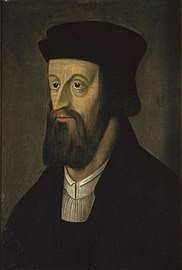
Jan Hus was born in 1369 or 1371 — the sources disagree, and the exact date is unknown.
He was educated at the University of Prague, taking his master's degree in the liberal arts in 1394. In 1401 he became dean of the theological faculty, and then, until 1403, rector of the university. In 1402 he was appointed preacher at the Bethlehem Chapel, where he saw his task as calling the Czech people to a godly life and exposing the morals of the clergy. At the university Hus had encountered the writings of John Wyclif, which influenced him deeply: unlike England, where Wyclif's works were condemned early in the fifteenth century, Prague received them with enthusiasm. Hus did not share all of Wyclif's views — he rejected, in particular, the denial of transubstantiation — and his attention fell chiefly on questions of church and politics. What he found most persuasive were Wyclif's arguments for church reform, above all the curbing of ecclesiastical power in favor of the secular. Like Wyclif, he held to predestination and set himself against a church that had claimed the right to excommunicate heretics — for only God, in the end, knows how sinful a man is, and only He appoints the righteous to salvation.
As a preacher Hus was so popular that as many as three thousand people came to hear him. In his sermons, delivered in Czech, he spoke of religion's place in everyday life — a novelty in itself — and permitted himself to criticize the church, though without setting himself against it. He thought it impossible to trust the church's official policy in everything: "If the blind lead the blind, both shall fall into the ditch." The church, naturally, answered with charges of heresy.
The papal schism, which had begun in 1378, sharpened the conflict between royal and ecclesiastical power in Bohemia; the University of Prague took the king's side. In 1409 Hus became rector once more, after the statutes were revised and the German professors and students withdrew. That same year a bull was issued against him and his preaching was banned — yet its popularity only grew. In 1412 he spoke out sharply against the sale of indulgences, and popular unrest followed; an interdict was laid upon him. Rather than expose all of Prague to the interdict, Hus left, at the king's request, for southern Bohemia, where papal decrees went unheeded, and continued his criticism of the church there. The two years that followed were a period of intense literary activity: he wrote a series of treatises, some in Czech, the most famous of them De ecclesia (On the Church). When the schism deepened, Hus kept his neutrality, believing that different currents within Christianity were permissible.
In November 1414 Hus was summoned to the Council of Constance, which was to resolve the schism. The emperor Sigismund promised him safe conduct, but did not keep his word. At the council Hus was arrested and condemned for heresy: in 1415 the council condemned Wyclif's teaching, and with it that of "his follower" Jan Hus.
On July 6, 1415, Hus was burned at the stake together with all his writings. Legend has it that at his execution he foretold the coming of a reformer whose ideas the church would not be able to destroy. His death ignited a series of conflicts known as the Hussite Wars.
The risings aimed at overthrowing Sigismund, king of the Holy Roman Empire, but the Hussite forces were defeated. Hus's followers nonetheless carried his work forward: their movement spread across Europe, and the wars it kindled lasted eleven years. And his prophecy, in the end, came true. The Protestant Reformation, led by Martin Luther, did come to pass — and, following Wyclif, Jan Hus is counted among its forerunners. In the Czech lands, the anniversary of his burning is observed each year as a day of remembrance.