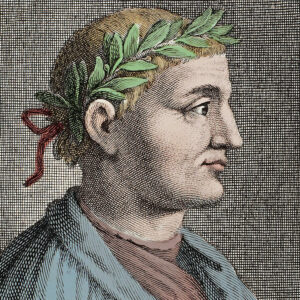
Quintus Horatius Flaccus was born on 8 December 65 BC at Venusia in southern Italy, the son of a freedman who owned a modest estate there — Venusia being a Roman military colony in the country's southeast, on the border of Lucania and Apulia. In law the children of freedmen ranked as freeborn, yet such origins still carried the mark of social inferiority, erased for good only in the next generation, and the fact left a certain imprint on Horace's outlook and his poetry. Of his mother the poet says nothing, though he mentions a nurse, Pullia.
He passed through every stage of the education customary among the Roman nobility of his day: first the school of Orbilius in Rome, where he studied Homer and the Latin Odyssey of Livius Andronicus, then the Platonic Academy at Athens, where he pursued Greek literature and philosophy. (The Academy of that era served as a kind of university, a finishing school for the young Roman aristocracy; among Horace's fellow students was Cicero's son.) In Athens he mastered Greek well enough to write verse in it.
He had gone to Athens at twenty to complete his education. At twenty-two he received the rank of military tribune, and after the murder of Caesar he took the republican side. At Philippi, where the Republic's cause was lost, Horace fled the field; when an amnesty was declared, he bought the post of a quaestor's clerk.
His verses caught the notice of Virgil and Varius Rufus, who presented the young poet to Maecenas, Augustus's closest associate, and in 38 BC Maecenas received him into his circle of friends.
In 33 BC Maecenas gave him a small farm in the Sabine hills, and Horace no longer had to worry about his daily bread. Having turned to poetry in the disillusioned years after Philippi, he took as his models two witty and caustic authors: from the Greek Archilochus he borrowed the iambus, from the Italian Lucilius the satire.
His first book of satires — he himself called them conversations — ten poems in hexameter, appeared around 35 BC. After the victory of Augustus, around 30 BC, he gathered eight more satires into a second book, joining to it seventeen short iambic pieces known as the Epodes. Then came a decisive turn in his work. In the Aeolian lyric of the early fifth century BC — poetry meant to be sung to accompaniment — in Alcaeus and Sappho, he found meters to match his now positive frame of mind, and from them he drew his inspiration as well.
Between 30 and 13 BC Horace produced four books of lyric poems, the Odes. The first book contains philosophical reflections in the spirit of Epicureanism and, in part, of Stoicism; the second is devoted to questions of poetry. A special place belongs to the letter to the Pisos on the art of poetry, known already in antiquity as the "Art of Poetry."
For the next six years Horace gave up composing lyric poems in the ancient sense of the word. Then the emperor Augustus commissioned from him a hymn for the great Secular Games; it brought the poet wide fame, and he returned to lyric once more.
The work of Horace — a remarkable master of verse, the creator of a poetry of the mind, brilliant and harmonious — stands among the summits of Roman literature, which he enriched with meters of Greek lyric that were new to it. His "Art of Poetry" became the foundation of Boileau's "Art poétique." In Russia his ode "The Monument" was translated by Mikhail Lomonosov and rendered anew by Gavrila Derzhavin, Alexander Pushkin, and Valery Bryusov; Pushkin's poem "Which of the gods has restored to me…" is a free translation of the seventh ode of Horace's second book.
Maecenas died in 8 BC, and Horace outlived him by barely two months. He died on 27 November 8 BC and was buried on the Esquiline, beside Maecenas.