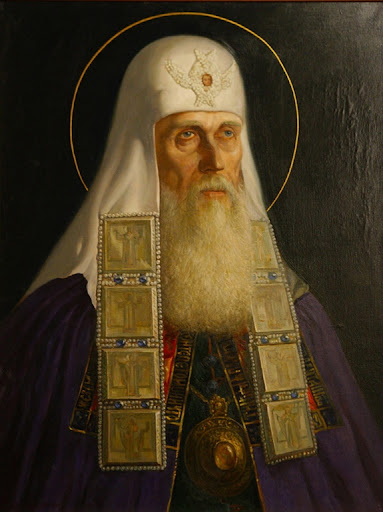
Feast days: February 17 (March 2); May 12 (25); October 5 (18), the Synaxis of the Moscow Hierarchs.
He came of the Don Cossacks. By the Patriarch's own account, he began as a priest in Kazan, at the Gostiny Dvor church of St. Nicholas (commemorated December 6 and May 9). He soon took monastic vows, and from 1582 was archimandrite of the Transfiguration Monastery in Kazan. On May 13, 1589, he was consecrated bishop, becoming the first Metropolitan of Kazan.
It was during the future Patriarch's ministry in Kazan, in 1579, that the wonder-working Kazan Icon of the Mother of God appeared and was found. While still a priest, with the blessing of Jeremiah, then Archbishop of Kazan, he carried the newly revealed icon from the place of its finding to the church of St. Nicholas. A man of unusual literary gifts, the saint himself composed in 1594 an account of the icon's appearance and of the miracles wrought through it, writing of himself with humility: "And I then... though I was stony-hearted, yet I wept and fell down before the image of the Mother of God, before the wonder-working icon and the Pre-eternal Child, Christ the Savior... And at the Archbishop's command I went with the icon, together with the other holy crosses, to the nearby church of St. Nicholas, called Tulsky..." In 1591 he gathered newly baptized Tatars into the cathedral and for several days instructed them in the Christian faith.
On January 9, 1592, St. Hermogenes wrote to Patriarch Job that no special commemoration was kept in Kazan for the Orthodox soldiers who had laid down their lives for faith and Fatherland beneath its walls, and asked that a day of remembrance be appointed for them. The Patriarch replied with a decree of February 25 directing that "for all the Orthodox soldiers killed at Kazan and within the Kazan lands, a memorial service be celebrated in Kazan and throughout the Kazan metropolitanate on the Saturday after the Protection of the Most Holy Mother of God, and that they be entered in the great synodikon read on the Sunday of Orthodoxy." Hermogenes was zealous for the faith and firm in keeping the traditions of the Church, and he labored to bring the faith of Christ to the Kazan Tatars.
In 1595, with the saint's active participation, the relics of the Kazan wonderworkers were found and uncovered: St. Gurias, first Archbishop of Kazan, and St. Barsanuphius, Bishop of Tver. Tsar Feodor Ioannovich had ordered a new stone church built in the Kazan Transfiguration Monastery on the site of the old one, where the saints lay buried. When their coffins were discovered, Hermogenes came with a council of clergy, had the coffins opened, and, seeing the incorrupt relics and vestments of the hierarchs, reported the matter to the Patriarch and the Tsar. With the blessing of His Holiness Patriarch Job (d. 1605) and at the Tsar's command, the relics of the newly revealed wonderworkers were placed in the new church. Hermogenes himself wrote the lives of Sts. Gurias and Barsanuphius, Bishops of Kazan.
For his outstanding archpastoral labors Metropolitan Hermogenes was chosen for the primatial see, and on July 3, 1606, a council of hierarchs raised him to the Patriarchal throne in the Dormition Cathedral in Moscow. Metropolitan Isidore handed the new Patriarch the staff of St. Peter, Wonderworker of Moscow (d. December 21, 1326), and the Tsar presented him with a panagia set with precious stones, a white klobuk, and a staff. Following the ancient rite, His Holiness rode in procession on a donkey around the walls of the Kremlin.
His patriarchate fell in a time of trial for the Russian state — the invasion of the impostor False Dmitry and of the Polish king Sigismund III. In this struggle Hermogenes did not stand alone: selfless Russians followed his example and came to his aid. With singular inspiration the Patriarch withstood the traitors and enemies of the Fatherland who sought to enslave the Russian people, to bring Uniatism and Catholicism into Russia, and to uproot Orthodoxy. When the impostor drew near Moscow and encamped at Tushino, Hermogenes addressed two epistles to the rebellious traitors. In one he wrote: "...You have forgotten the vows of our Orthodox faith, in which we were born, baptized, reared, and grew up; you have broken your oath upon the cross to stand unto death for the House of the Most Holy Mother of God and for the Muscovite state, and have fallen down before your false and imagined little tsar... My soul aches, my heart is sick, all my inward parts are torn, my every joint trembles; I weep and cry out with sobbing: have mercy, have mercy, brothers and children, on your own souls and on your parents, departed and living... See how our fatherland is plundered and laid waste by strangers, what desecration is visited on the holy icons and churches, how innocent blood is shed, crying out to God. Consider against whom you take up arms: is it not against God, who made you? not against your own brothers? Is it not your own Fatherland you are laying waste?... I adjure you in the name of God: abandon your undertaking while there is yet time, lest you perish utterly."
In another letter the Primate pleaded: "...For God's sake, come to your senses and turn back; gladden your parents, your wives and children, and all of us — and we shall pray to God for you..."
Soon the righteous judgment of God overtook the Brigand of Tushino as well: his end was as sorry and inglorious as his predecessor's — he was killed by his own men on December 11, 1610. But Moscow remained in danger, held by Poles and by boyar-traitors loyal to Sigismund III. The letters Hermogenes sent out to towns and villages roused the Russian people to free Moscow from its enemies and to elect a lawful Russian tsar. The Muscovites rose in revolt; the Poles answered by setting the city on fire and shutting themselves up in the Kremlin. Together with the Russian traitors they forced the holy Patriarch from his throne and imprisoned him under guard in the Chudov Monastery. On Bright Monday of 1611 the Russian militia reached Moscow and began a siege of the Kremlin that lasted several months. The besieged Poles more than once sent envoys demanding that the Patriarch order the militia to withdraw from the city, threatening him with death. He answered firmly: "Why do you threaten me? I fear God alone. If all of you, men of Lithuania, depart from the Muscovite state, I will bless the Russian militia to go from Moscow; but if you remain, I will bless all to stand against you and to die for the Orthodox faith." From his prison the Hieromartyr Hermogenes addressed a last epistle to the Russian people, blessing the war of liberation against the invaders. But the Russian commanders could not then achieve unity or concert, and so failed to take the Kremlin and free their Primate. For more than nine months he languished in harsh confinement, and on February 17, 1612, he died a martyr's death by starvation.
The liberation of Russia, for which Hermogenes had stood with such unbreakable courage, was carried through by the Russian people under his intercession. The hieromartyr's body was buried in the Chudov Monastery and in 1654 translated to the Dormition Cathedral in Moscow. His glorification among the saints took place on May 12, 1913; his memory is also kept on February 17.
Great is the national significance of St. Hermogenes, tireless champion of the purity of Orthodoxy and the unity of the Russian land. For centuries his labors for Church and country have stood as a shining example of ardent faith and love. His churchmanship was marked by an attentive and exacting care for divine worship. Under him were published the Gospel; the Monthly Menaion for September (1607), October (1609), November (1610), and the first twenty days of December; and, in 1610, the printed "Great Church Ustav." Nor did he confine himself to giving his blessing to these editions: he watched carefully over the accuracy of the texts. At his blessing the service to the holy Apostle Andrew the First-Called was translated from Greek into Russian, and the celebration of his memory was restored in the Dormition Cathedral. Under the Primate's supervision new presses were built for the printing of liturgical books, and a new printing house was erected — damaged in the fire of 1611, when the Poles set Moscow ablaze. Concerned for the good order of the services, he composed an "Instructive Epistle to All People, and Above All to Priests and Deacons, on the Correction of Church Singing," which reproves the clergy for celebrating the services contrary to the rubrics — chanting several parts of the office at once — and the laity for irreverence at worship.
The Primate's literary work is widely known. From his pen came the account of the Kazan Icon of the Mother of God and the service to that icon (1594); the letter to Patriarch Job with its account of the Kazan martyrs (1591); a collection treating questions of divine worship (1598); and the patriotic epistles and appeals to the Russian people (1606–1613), among other writings.
Contemporaries testify to a man of remarkable intellect and learning: "a sovereign of great reason and sense and of a wise mind," "exceedingly wondrous and of great discernment," "richly adorned with wisdom and accomplished in book-learning," "ever occupied with the divine words, and versed to the end in all the books of the Old Law and the New Grace, in the ordinances of the Church and the canons of the law." Hermogenes worked long in monastic libraries — above all the rich library of the Chudov Monastery in Moscow — copying out of ancient manuscripts the most valuable historical matter, which formed the basis of chronicle entries. In the seventeenth century the Voskresensk Chronicle was called the chronicle of His Holiness Patriarch Hermogenes. His writings and archpastoral letters are threaded with references to Holy Scripture and with examples drawn from history — evidence of a deep knowledge of the Word of God and wide reading in the church literature of his day.
To this learning he joined outstanding gifts as a preacher and teacher. Contemporaries describe the Primate as "a pious man," "of known pure life," "a true shepherd of Christ's flock," "an unfeigned champion of the Christian faith."
These qualities showed with particular force in the Time of Troubles, when the Russian land was visited by the calamity of inner disorder, compounded by the Polish-Lithuanian invasion. In that dark period the Primate of the Russian Church selflessly guarded the Russian state, defending by word and deed the Orthodox faith against Latinism and the unity of the Fatherland against enemies within and without. He crowned his feat of saving his homeland with a martyr's death, which passed over into grace-filled prayerful intercession in heaven for his country, before the Throne of the Holy Trinity.