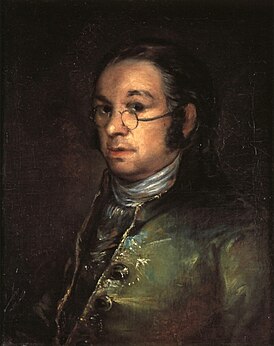
Francisco Jose de Goya y Lucientes (30 March 1746, Fuendetodos, near Zaragoza – 16 April 1828, Bordeaux) was a great Spanish painter and printmaker, one of the most striking masters of the Romantic movement in art.
Goya's art is complex and deeply contradictory. His expressive manner, his depictions of evil in its many guises, of violence, injustice, and suffering — for all the evident grotesqueness of their presentation — reflected the real experience of the best part of the Spanish national elite, unable at first to carry out the democratic reforms Spain so badly needed, and later to defend the country during the French occupation. The images in his paintings are often allegorical and archetypal: they draw on the deepest layers of popular consciousness, on folk tales and legends. His works are frequently marked by despair, disillusionment, at times perhaps even unbelief — but sometimes, too, by a keen joy in living. In his art, as in his life, he was guided by high humanist principles. Beyond painting, Goya reached unprecedented heights in the graphic arts, combining the techniques of etching and aquatint: the artist coats a metal plate with an acid-resistant varnish and scratches a drawing into the dried layer with a needle; the plate is then immersed in nitric acid, which bites into the scratched lines; these are filled with ink and printed onto paper on a special press.
Among his famous paintings: "The Naked Maja," "Charles IV of Spain and His Family," "The Third of May 1808," "The Burial of the Sardine," "Saturn Devouring His Son," "The Milkmaid of Bordeaux."
We say "Goya," and at once "The Naked Maja" rises before our eyes. He created some 500 paintings, 300 prints, and a thousand drawings, yet in the first instant it is always her people remember — half-reclining, with an inviting gaze and slightly distorted proportions. It is like Leonardo and the "Mona Lisa": impossible to separate them in the mind, and the most perceptive see in the "Mona Lisa" a self-portrait. Or like Flaubert, who declared: "Madame Bovary, c'est moi!" The bond between Goya and his Maja is of the same order, and we shall try to explain why. Maja, after all, is not a name at all. Majas were what they called girls from the lower ranks of Spanish society — cheerful, frivolous, brimming with life, hungry for music and love. The masculine form, majo, is known to us now as "macho." The pronunciation has shifted slightly, but the essence remains: inner strength, temperament, passionate drive. Goya, with his plebeian roots, his thirst for life, and his fierce character, was himself a majo. A macho. He thought like one, behaved like one, and even painted like one. In Feuchtwanger's biographical novel Goya says: "I am a majo, though now and then I read the Encyclopedie."
Origins and early years
Born on 30 March 1746, Goya was one of three sons of the owner of a small gilding workshop in the village of Fuendetodos. His mother came from a line of impoverished nobles — hidalgos, so aptly mocked by Cervantes in "Don Quixote" — while his father was a pure baturro, a commoner, who passed on to his son the knack of standing firmly on the earth and cherishing no needless illusions.
The family later moved to Zaragoza, where the thirteen-year-old Francisco was sent to study in the workshop of the painter Jose Luzan. He would spend some seven years there, excelling less in painting than in dancing the fandango, singing serenades, and street brawling. It was the conservative Luzan himself who advised Goya to try his luck in Madrid at the Academy of San Fernando, though there was no shortage of work in Zaragoza. It was whispered that the teacher simply wanted this explosive, hot-tempered troublemaker out of his sight — a young man who even in the workshop never parted with his folding navaja, the treacherous knife of the Spanish majos.
"Francho, you were born an onion, not a rose," his mother, Engracia Lucientes, would say uneasily, "and an onion you will die."
Goya's "universities"
The Academy of San Fernando turned Francisco away twice. In 1763 he received not a single vote in his favor; he despaired in the heat of the moment, then gradually cooled and tried again in 1766. That attempt also ended in failure: Goya was not strong in draughtsmanship, and in any case he resembled no one — the academicians simply could not fathom this strange, unheard-of, "deformed" style, as Ortega y Gasset would call it in the twentieth century.
Anyone else would have given up. But the master, born under the fiery sign of Aries, was devilishly stubborn and so sure of his own powers that he resolved to outwit, if not fate, then certainly the Royal Academy. Having received no stipend from it, the twenty-three-year-old Goya set off for Rome at his own expense, joining a company of matadors bound for Italy.
The bullfight, the swagger, the excited roar of the crowd — this was his element. Sociable and pugnacious, Francho adored noisy gatherings and more than once swore to dance the Aragonese jota on the backs of anyone who dared look askance at him. He took part in the corrida and performed with street acrobats. He was agile, muscular, and recklessly brave, and legends circulated about his amorous escapades, complicated by numerous duels. It was told, for instance, how Goya, having fallen in love with a novice in one of the Roman convents, spirited the girl out of the cloister. Those who knew him well had no doubt that this was exactly how it happened.
He began his conquest of Rome by climbing the dome of St. Peter's Basilica — not to take in the view of the Eternal City, but to scratch his initials at the summit. The matador and brawler from Zaragoza longed to proclaim himself at the top of his voice urbi et orbi, "to the city and the world," and never doubted for a second that Providence and Our Lady of Atocha had a great future in store for him.
Ceilings in Zaragoza, tapestries in Madrid
In 1771, having wandered through Italy and even won a prize from the Academy of Parma, Goya returned to Zaragoza. In the city of his youth he painted palaces and churches with success. His bright palette, steeped in the Italian sun, delighted the eye, and his angels — for whom street dancers had posed — adorned cathedral ceilings and enfolded Spanish hearts in an impermissibly sweet languor. Within a couple of years Francisco was earning three times as much as his former teacher.
And yet Goya was drawn to Madrid. Ambition drove him to the capital, and an old acquaintance summoned him there as well: the court painter Francisco Bayeu, whom he had met while trying, without success, to enter the Academy. Bayeu reported that King Charles III was a patron of the arts, and that interesting prospects were taking shape for Goya too.
In Madrid he began producing designs for the royal tapestry manufactory of St. Barbara. His tapestries — pileless carpets with idyllic scenes of Spanish folk life — were much to the court's taste. The gregarious Goya quickly acquired influential friends. He enjoyed the patronage of the grandee Osuna, the critic Cean Bermudez, the court reformers Floridablanca and Jovellanos, the infantes, and the king himself. Soon the next monarch ascended the throne — the weak-willed but sensitive Charles IV — and the artist's position only grew stronger. Goya charmed the new king, his clever and imperious consort Maria Luisa of Parma, and even her all-powerful favorite and future prime minister, Manuel Godoy. This is all the more astonishing given that in his portraits of royalty and their circle he flatters not in the least: Charles IV remains a milksop on the canvas, and the queen an aging voluptuary.
"So it has come about that from now on I am a court painter. It is hard to get used to the thought that my annual income will now amount to more than 15,000 reales," Goya reported to one friend. To another he wrote: "I cannot restrain myself as others perhaps restrain themselves, because here in Madrid I am much esteemed." Now Francisco could indulge his weaknesses — chocolate and partridge shooting. And he was at last avenged on the Academy of San Fernando: first elected a member, he then became its director, succeeding the deceased Bayeu.
Goya's family life
Relations between Goya and Bayeu were never simple. Francisco felt that Bayeu pressed down on him, and they quarreled often. The classically minded Bayeu lectured Goya that he ought to be more restrained in color and more careful in line, taking the Frenchman Jacques-Louis David as his model. One can imagine how such exhortations worked on the proud Francisco. In one surviving letter Goya conjures away his own anger at Bayeu: "Again and again I turn to God with the plea that He free me of the hot-tempered pride that takes hold of me."
There was another source of tension: the amorous Goya had seduced Bayeu's sister Josefa. It did not all come out at once; at the time of the hasty wedding, Josefa was pregnant. Bayeu was outraged but swallowed his feelings — Francisco had already secured a firm position at court and was far from poor.
At first Josefa was very happy; their home overflowed, and for a single ceremonial turnout — the horses and the carriage — the master paid more than his gilder father had earned in a year. Goya boasted: "In Madrid only I and Minister Godoy have one like this."
Goya and Josefa would live together for nearly forty years. She suffered from her husband's many infidelities and lived in fear as Goya, growing ever more candid and critical in his work, drew the attention of the Inquisition. By some accounts Josefa lost, living and unborn, nearly twenty children: only one son lived to maturity, Javier — a painter himself, and later a moneylender and a rogue.
In four decades of family life, Francisco painted only a single portrait of Josefa. None other, at any rate, has come down to us.
"What illness will he die of?"
Goya was forty-six when something befell him that marked the rest of his life. A mysterious illness — of which we know for certain only that it had already dogged him for years — forced him to request an official leave of a couple of months in Madrid and travel to Andalusia to recover his health.
Two months, of course, did not cure it. While Goya was staying with his friend the financier Sebastian Martinez in Cadiz, he was suddenly seized by a "foul frame of mind," followed by an attack: an agonizing roar in his head, a loss of all bearings, and soon a coma. Was it a stroke? At the end of the eighteenth century no effective treatment was known — save, perhaps, bloodletting. For a time Goya hovered between life and death, yet he survived.
Many agree that the mysterious illness may have been a complication of the syphilis he contracted in 1777, the legacy of a stormy youth; one biographer remarks: "Goya's family happiness was destroyed by a spirochete." From then on he suffered severe headaches, ringing in the ears, spells of blindness, involuntary trembling of the muscles, and paralysis of the right hand. Above all, he lost his hearing.
The other symptoms came and went; the deafness stayed forever. To the end of his life — and he would live another thirty-six years — the artist remained deaf, communicating by reading lips and passing notes.
"Now at last I know what it means to live!"
Goya had once flaunted his superb health. In his youth he would sign his letters, for a joke, "Francisco de los Taurus" — Francisco the Bull. Now he confessed to his closest friend, Martin Zapater: "I have grown old; my face is full of wrinkles; you might not even recognize me were it not for my flat nose and my sunken eyes."
The change reached his art as well: colorful high spirits gave way to the grotesque and to nightmares. It was then that the unsettling series of etchings was born — the famous "Caprichos." Ghosts and villains, witches and demons in place of full-bosomed majas, Spanish saints, and royal sitters — this was how the world now looked to a painter deprived of the power to hear it.
One thing in his life, however, did not change: women loved him as before.
The brightest star in the firmament of Madrid court life, the Duchess of Alba, Cayetana, was barely past twenty when Goya drew her for a tapestry design, and a little past thirty when he painted his first portrait of her. She was beautiful, refined, and ardent, and her pedigree could have given even the reigning Bourbons a run for their money. When a romance flared between her and Goya, he was pushing fifty — half a commoner, and completely deaf besides. But could that stop love?
In the twentieth century the Duchess of Alba's heirs would demand the exhumation of her remains and the measuring of her bones, to prove that the shamelessly bared Maja was not she, not Alba — that Goya had not painted that seductive body from her, a body fitted with a stranger's head so the Inquisition could not identify it. But whatever their purely Spanish caste pride may insist, the master's legacy preserves traces that after the death of Jose de Toledo, Cayetana's husband, the artist became her cortejo — her lover. Dozens of drawings show the duchess nude, and on one of them, in her own hand, is written: "To keep such a thing is sheer madness." In the painted portrait of Alba in black, her hand wears a ring and a signet: one inscribed "Goya," the other "Alba." And from that period a note from Francisco to a friend survives: "Now at last I know what it means to live!"
Alba teased him, threw him over, left him for men younger and nobler, then came back again, and remained the greatest and most tormenting passion of Goya's life. Their affair lasted about seven years.
Old age and joy
It seemed that in old age Goya would be left entirely alone. The Inquisition destroyed some of his friends; others were driven from the country for political reasons. In 1802 Alba died — poisoned, rumor said, with venom drawn from paint pigments — and in 1812 the grumbling, faithful Josefa was gone. Goya withdrew to the outskirts of Madrid, building the villa Quinta del Sordo, "The Deaf Man's House," and covering its walls with terrifying visions. Spain lived through the disasters of war and the French occupation, yet Francisco managed to keep his position as court painter even under French rule — something the Spaniards would long be unable to forgive him.
And when Goya turned sixty-eight, and it seemed time to take stock and mourn his losses, his life once again shimmered with color and smelled of scandal. A married beauty, Leocadia Weiss, forty years his junior, fell in love with him and left her wealthy, not-yet-old husband. Together they fled political persecution to France; two more children were born to them, a son and a daughter, while his outraged elder son Javier — the same age as Leocadia — litigated long against his father over the considerable inheritance.
The great Spanish painter died in Bordeaux at the age of eighty-two.