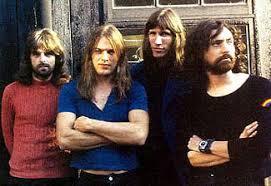
The band was founded in London in 1965 by fellow students Richard Wright, Nick Mason and Roger Waters, together with their friend from Cambridge, Syd Barrett. The name Pink Floyd is stitched together from those of two bluesmen, Pink Anderson and Floyd Council. At first the group was The Pink Floyd; after 1970 the article was dropped. Before settling on Pink Floyd the band went through a string of other names, among them The Tea Set and The Pink Floyd Sound.
The foundations had been laid back in 1963, when Mason and Waters joined a group run by Clive Metcalfe and Keith Noble; Wright soon followed, and rehearsals were held in the flat Mason and Waters shared. Bob Klose then came aboard, while Metcalfe and Noble departed. In 1963 Waters's friend Syd Barrett arrived in London and joined the band, and in 1964 it was Syd who changed the name from Tea Set to The Pink Floyd Sound, after they found themselves sharing a bill with another Tea Set. For a while Chris Dennis sang with the group; when he left, Barrett took over the vocals.
In December 1964, thanks to Wright's connections, the band got into a recording studio, and during a break laid down four songs — a cover of I'm a King Bee and three of Syd's: Lucy Leave, Butterfly and Double O Bo. In this period they were playing the Countdown Club and appearing on Ready Steady Go!. In 1965 Klose left the group. In 1966 Peter Jenner and Andrew King became the band's managers, and the experiments with its sound began.
The first professional recording came in January 1967, at Polydor; Pink Floyd then signed to EMI, and the singles appeared on that label. On 11 March came Arnold Layne / Candy and a Currant Bun, which climbed to number 20 in the chart. In August 1967 the band's first album appeared: The Piper at the Gates of Dawn, its title taken from a chapter of Kenneth Grahame's The Wind in the Willows. Most of the material was Barrett's. The record reached number 6 and is counted among the finest English psychedelic albums.
But success went to Syd Barrett's head, and after concerts were derailed in January by his drug dependence, David Gilmour joined the band. The initial plan was for Syd to go on writing songs, but nothing good came of it. He withdrew into seclusion, occasionally releasing collections of songs; in all the years that followed, Pink Floyd and Barrett met only once. The band's second album, released in 1968, carried just one of his songs.
In 1969 Pink Floyd recorded the soundtrack to the film More and the album Ummagumma, which included a live performance; it reached number 70 in the American charts and number 5 in Britain. The albums kept coming year by year. In 1970 there was Atom Heart Mother, with its twenty-minute title piece — the band's first British number one, recorded with a symphony orchestra and choir. In 1971 came Meddle, made with sixteen-track tape machines and a synthesizer. In 1972 appeared Obscured by Clouds, the soundtrack to the film La Vallee. From that album until 1987 the lyrics were written exclusively by Roger Waters, who became the band's leader; it was in this period that its most classic records were made.
In 1973 came The Dark Side of the Moon — the best-selling album in the history of rock, and the second best-selling in the world after Michael Jackson's Thriller. It is a concept record about the pressure the modern world exerts on the human psyche. The recording took nine months, and the time was unquestionably well spent: the album at last gave the band a number one in America, where it stayed on the charts for 741 weeks, 591 of them consecutive — from 1973 to 1988 — though at home it rose no higher than second place. The next album, Wish You Were Here, followed only two years later; the song Shine On You Crazy Diamond was dedicated to Syd Barrett. Remarkably, Syd himself turned up at the studio during the sessions, and at first the musicians did not recognize him.
In 1977 came Animals, its concept close to Orwell's Animal Farm. During the recording, tension began to build within the band, particularly between Wright and Waters, and the group's music was coming in for criticism from the punk movement. In 1979 another masterwork appeared: The Wall. Hugely successful, it became the band's best-selling record in America. The supporting tour was a genuine theatrical spectacle, so expensive that it very nearly bankrupted the group; Richard Wright, who took part for a fixed fee, was the only one to come out of the tour with a profit. In 1982 the album became a film, with a screenplay by Waters; during its making, relations between Gilmour and Waters grew more strained still.
In 1983 came The Final Cut. Gilmour and Waters never appeared in the studio together during the sessions, and the band did not tour behind the album; after its release the members pursued solo careers until 1986. That year Gilmour and Mason revived the band, and Wright rejoined, at first as a session musician. There followed A Momentary Lapse of Reason. In 1994 came The Division Bell, with High Hopes as its jewel; the instrumental Marooned won a Grammy. In 1995 the live album P*U*L*S*E appeared, and Nick Mason published his book Inside Out: A Personal History of Pink Floyd. On 2 July 2005 the band came together to play Live 8.
Richard Wright died in 2008. In 2012 it was announced that the band would perform at the closing ceremony of the London Olympics, but of the line-up only Nick Mason appeared. In 2014 came The Endless River, assembled from demos left over from The Division Bell; only one track was not instrumental. A video was released for Marooned, from The Division Bell. It is worth adding that the concert album Delicate Sound of Thunder was the first album ever to travel into space.
Pink Floyd's music has become a benchmark. Four of the band's albums stand in Rolling Stone's top 500. Its surviving members pursue solo projects, occasionally coming together for one-off performances — Gilmour and Waters among them.