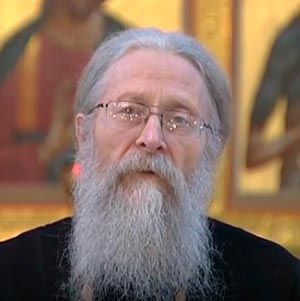
His name at birth was Heinrich Heinrichovich Fast. He was born in late December 1954 in the village of Chumakovo, Novosibirsk Region, into the Protestant German family of Heinrich and Elena Fast.
Heinrich Fast the elder, father of the future archpriest, had been arrested in 1938 on a charge of founding a counter-revolutionary organization; after ten years in the camps he was sent, as an "enemy of the people," into "perpetual exile" in Chumakovo, and Elena Fast followed her husband there. After the denunciation of Stalin's cult of personality the father was rehabilitated, and the family moved to Kazakhstan. It was there, in a devout Protestant German milieu, that the younger Heinrich spent his childhood and youth.
"I grew up in a deeply believing Protestant German family and community. One of the vivid impressions of my childhood is the little pocket New Testament I was given at ten and read hungrily, hiding away from the noisy games of the other children. From then on I loved the Word of God forever. It was then, too, at ten, that I first consciously turned to God. Later, when I was working in science, faith and science lived in me, sometimes crossing and merging, but for the most part apart — dividing my life, as it were, in two."
After school Heinrich entered the physics faculty of Karaganda University. Despite his academic success he was expelled at the end of his fourth year for his religious convictions; that same year he re-enrolled at Tomsk University, and on graduating in 1978 was kept on in the department of theoretical physics — only to be dismissed six months later for preaching the Gospel.
Alongside his studies another life was unfolding. Protestantism seemed to him too dry, and his search for truth led him to Archpriest Alexander Pivovarov, then serving in Novosibirsk, and to Ignaty Lapkin, a confessor living in Altai Krai who had already served one term for his faith and was preparing for a second. These two men, together with an intensive study of church history and the writings of the holy fathers of the Church, wrought a complete revolution in his soul, and in his fifth year he was baptized into the Orthodox Church with the name Gennady.
"Already in my senior years at university I came into contact with Holy Orthodoxy and understood that only there could my soul find salvation. A new and wondrous world opened before me — the teaching of the holy fathers, the pure spring of God's grace in the sacraments of the Church. As a fifth-year student I received holy baptism in the Orthodox Church. The old split between faith and science was gone. My soul desired and strove for one thing only: the knowledge of God and the service of Christ. And so, after my second expulsion from the university, I left this world behind and went to serve in the Russian Orthodox Church."
In 1978 he was ordained deacon, and in 1980 priest, serving in parishes across the Tuva Republic and Kemerovo Region.
In 1983, with the blessing of Archbishop Gedeon, he was sent to Yeniseysk, where he became rector of the ancient Dormition Cathedral and later dean of the Yeniseysk district of the Krasnoyarsk and Yeniseysk diocese.
In 1985–1986 came a new round of persecution from the authorities. A criminal case was opened against him on two counts: financial violations that had never taken place, and political unreliability. Seven months of investigation, searches, and interrogations might have ended badly for a "politically unreliable" priest — but then came the era of change that turned Russia's fate around.
While serving as a parish priest and raising a large family — he and his wife, Matushka Lidia, have five children — he completed the Moscow Theological Seminary and the Moscow Theological Academy by correspondence, and there, in 1995, defended a dissertation for the degree of Candidate of Theology in the department of Old Testament Scripture.
In 1987 Father Gennady became the first man in the USSR to enter the "zone" not as a prisoner of conscience but as a preacher of the truth. The colony that, to the horror of its administration, opened its gates to a priest was Corrective Labor Colony No. 16 near Uyar — the notorious "Gromadsk." He had come to visit a prisoner who had once robbed him, and after their conversations he petitioned for the man's pardon. From 1989 he visited the surrounding colonies regularly, and in the early 1990s the doors of the Yeniseysk pretrial detention center opened to him as well.
In 1991 the rectorate of the Lesosibirsk Institute of Technology allowed him to give public lectures on cosmology.
Many people came to the Orthodox faith, or were confirmed in it, through his lectures at the Orthodox lecture series of the Krasnoyarsk Regional State Universal Scientific Library — a series that has run from 1991 to the present day, two lectures a month.
In 1994 — the first in his diocese and the second in Russia — Dean Gennady Fast opened an Orthodox pro-gymnasium of Saints Cyril and Methodius in Yeniseysk. In the same deanery his protégé, the priest Andrei Yurevich, followed by opening an Orthodox gymnasium of St. John of Kronstadt in Lesosibirsk, Krasnoyarsk Krai.
He is the author of theological works and of books of historical and spiritual-educational content, some of them written with no hope whatever of publication. The fall of the atheist regime changed the fate of those books.
Since November 30, 2010, he has served as rector of the church of the Holy Equals-of-the-Apostles Constantine and Helen in Abakan.
He is married, with five children.