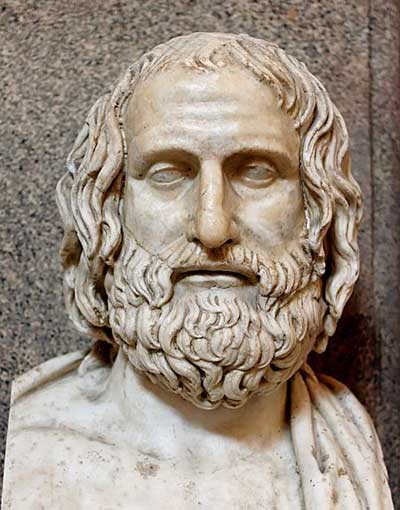
Euripides (480s – 406 BC) was an ancient Greek playwright and, alongside Aeschylus and Sophocles, one of the greatest representatives of classical Athenian tragedy.
Origins and education
Euripides was born on Salamis. His father was a wealthy and much-respected man; his mother sold vegetables. As a boy he trained seriously as a gymnast and hoped to compete at the Olympic Games, but never did; later he took up painting. He received a good education and knew Anaxagoras, Prodicus, Protagoras, and Socrates.
The tragedies
Of his more than ninety works, only nineteen tragedies have come down to us — among them Alcestis, Iphigenia in Aulis, The Bacchae, Medea, Heracles, The Cyclops, Rhesus, and The Suppliants.
Euripides' innovation was his development of the women's parts in tragedy: they surpass the male roles in strength of will and intensity of feeling. In his plays, too, slaves are no longer soulless creatures; they have characters of their own and feel as free citizens do. His work is prized for its intensely charged rendering of states of mind, its psychological insight, and the deep working-out of its scenes and monologues.