In the nineteenth century the library of Ashurbanipal, the king of Assyria who reigned in the seventh century BC, was discovered. Archaeologists unearthed some thirty thousand clay tablets covered in cuneiform, and the find opened the way to the study of the history and culture of the peoples of Mesopotamia. Today the world's museums hold around half a million such tablets. Without them we would know of Mesopotamia only from the Old Testament and the writings of ancient scholars.
The culture of the nineteenth century was a culture of diaries; through them we can see the inner world of the people who lived then. Today no one keeps a daily journal, and authors destroy the failed early drafts of their notes. Something is lost in this — the very thing with which thinking begins. We see only the final stage of their reflection.
It was in Ashurbanipal's library that the Epic of Gilgamesh was found. It had been written down around the twenty-first century BC; it was deciphered and translated into English by George Smith.
Gilgamesh is now believed to have been a historical figure. He lived roughly in the twenty-seventh to twenty-sixth centuries BC and was king of the city of Uruk. According to legend he was one-third man and two-thirds god — an echo, here, of the Bible.
In the epic Gilgamesh is a "great man": a self-assured and powerful ruler who laid claim to all the women. Many resented this, and in time he began to wear on the inhabitants of Uruk. The people of the city begged the gods to send someone who could stand up to Gilgamesh, and the gods sent Enkidu, a man of the wilderness — whom they then set about civilizing.
None of the clay tablets on which the epic is recorded describe the performance of ritual cult, but we may suppose that the priesthood played a very important role. Such a priestess may have been Gilgamesh's mother. Priestesses were intermediaries between gods and men, and Enkidu's civilizing came through his encounter with a priestess, who revealed to him the essence of civilization. The road to civilization ran through communion with the priestess, who in turn communed with the gods. The temple priestess was the key to the city and the key to the heavens where the gods dwelt. In the beliefs of the ancient peoples of Mesopotamia, a man lives in a city, eats bread, drinks beer, and consorts with the temple priestess.
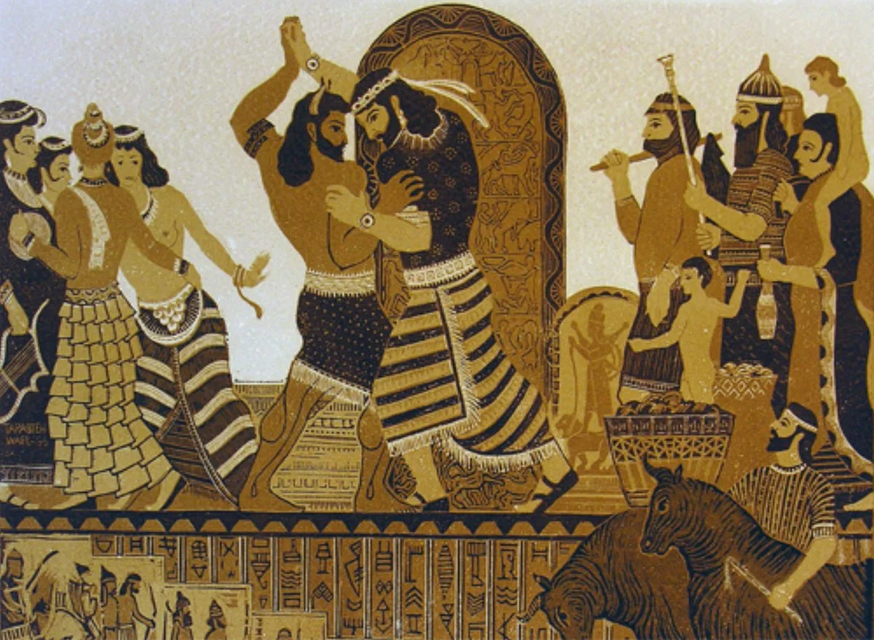
After his encounter with the priestess, Enkidu comes to Uruk, to Gilgamesh. At first they clash and wrestle; afterward they drink beer together and become the best of friends, resolving to seek adventure side by side. Before us stand a wild man and a civilized one.
Gilgamesh and Enkidu then set off for the Levant — present-day Syria, Lebanon, and Israel — to the edge of the world. This is the eastern part of the eastern Mediterranean. Here stood a cedar forest, in what is virtually modern Israel; cedar was needed for building a temple or a palace.
Cedar and the Levant appear in the Bible as well. Gilgamesh's heavenly father, by tradition, was Shamash, the sun god, and he helps our heroes. First they slay the wild beast Humbaba.
Afterward Gilgamesh and Enkidu meet the goddess Ishtar, goddess of war and of wisdom. She offers herself to Gilgamesh in marriage; he refuses. She then sends a bull, which the heroes overcome. Man sets himself against the divine: by killing the bull, the heroes defy the gods and rouse their anger. The gods decree that one of the two must die — and it falls to Enkidu. He dies, and Gilgamesh weeps over his body.
For the first time Gilgamesh understands what death is, though he had killed many before. He goes out into the steppe, clothes himself in a lion's skin, and declares that he wants to bring back his friend and to grasp what death truly is. To grant him that understanding, the gods send him to the very edge of the world, where the old man Utnapishtim lives — the survivor of the flood, who lives forever. Gilgamesh asks him: "How does one live forever?" The answer: stay awake for seven days, and then I will teach you. But Gilgamesh falls asleep — a symbol of his human nature.
Utnapishtim tells the story of the flood. The gods had warned him of it; he loaded every living thing aboard an ark and so was saved, sailing for six days. For this the gods rewarded him and his wife with immortality. Similar flood myths occur among many peoples; the story is bound up with water.
In the middle of the nineteenth century this legend reached the wider public, and it came as a shock, for something very like it stands in the Old Testament. The biblical story turned out to be one tradition among others; the myth of Noah turned out to be linked to far more ancient times.
The Sumerians believed the gods had created human beings to dig canals for them. Then people grew too noisy, and the gods sent a flood to quiet them down. In Mesopotamia parents bore children to be helpers, not to be doted on.
Gilgamesh slept through the seven days and was bitterly disappointed. But Utnapishtim told him where to find a plant that would restore his youth. Gilgamesh went after it and plucked it — and then misfortune struck: while he slept, a cunning serpent ate the plant. We meet something similar in the Bible too. After this Gilgamesh returned to Uruk. Such was the cycle of his soul, beginning in the city of Uruk and ending there.
The Epic of Gilgamesh is recorded on twelve clay tablets in all. In the last, the twelfth, Enkidu turns out to be alive, and Gilgamesh sends him to the kingdom of the dead. Enkidu returns and reports that no one should go there, for it is a wretched place — one should not try to reach the other world.
In Sumerian culture Gilgamesh became the patron of graveyards and a guide to the world beyond. The twelve tablets of the epic trace a certain cycle of the year — the natural cycle by which people lived.
Taken as a whole, the Epic of Gilgamesh is one of the first literary works of our civilization. It laid the foundations for the myths and legends that followed, and its echo can be traced, in part, in the Bible as well.