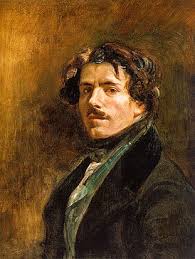
Ferdinand Victor Eugène Delacroix (26 April 1798, Paris – 13 August 1863, Paris) was a French painter whose place in the history of art is that of the most brilliant representative, and the founder, of Romanticism in painting.
What made his art distinctive: the man whose name is bound forever to the figure of a half-bare Liberty on the barricades carried out one of the great revolutions in the history of painting. Delacroix broke down the strict canons of genre that classicism enforced and began to paint scenes of contemporary life, and exotic literary subjects, in the manner the Salon reserved for Napoleon and the heroes of antiquity. Against the precise classicist line he set a rich, passionate palette, and he was the first to send the Salon pictures built of separate, visible brushstrokes. Handling and color take part in creating the mood of a canvas no less than subject and gesture do.
His famous paintings include Liberty Leading the People, The Death of Sardanapalus, Dante and Virgil in Hell, Women of Algiers, and The Massacre at Chios.
The studio is hot as a Moroccan harem, the windows shut tight, yet he asks Jenny, the housekeeper, to stoke the stove higher still. His neck is swaddled in a scarf: ever since a chill caught in his student days, his throat has ached without respite — sometimes mildly, sometimes past bearing. Then Eugène takes his cure in earnest: breathe no cold air, speak to no one. He shuts himself in the sweltering studio, alone with his strongest passion — work. Across the road, in the house facing the studio, two young men seem to have grown fast to the window. They catch Delacroix's every gesture, holding their breath and going still whenever they manage to make out the master's movements. Both dream of soon conquering Paris and winning medals at the Salon; they have rented this room for the sole purpose of watching, if only now and then, the most brilliant and revolutionary painter of a passing age at work. One of them is called Claude Monet; the other, Auguste Renoir.
By his whole life, by the record of his triumphs and failures, Delacroix gave hope to young, audacious painters. Looking at him, each could believe that painting held a genuine freedom. He won the Salon's gold medal with the very first picture he put before the public — and with his third fell out of favor for several years. Nine times he applied for a seat among the academicians who governed the fate of French art. He received the ribbon of the Legion of Honor at thirty-three and was elected to the Paris city council at fifty-three. Today the Louvre has an entire room given over to a single painter: the Delacroix room. He lived through seven political regimes, each of which flung France from one extreme to another; yet under every king and every republic, the state promptly bought his newest picture.
Napoleon
Eugène came of that French elite which rose with Napoleon. His father, Charles Delacroix, was minister of foreign affairs under the Directory and later — after Talleyrand succeeded him at the ministry — ambassador to the Batavian Republic and prefect of Marseille.
Talleyrand was a frequent guest of the Delacroix household, and from various covert signs and testimonies biographers have concluded that the true father of Eugène — the fourth and youngest child of the family — was Talleyrand himself: the schemer and manipulator, the excommunicated former bishop, the minister who serenely survived three changes of power in office. Yet Eugène never once betrayed this kinship — not in a diary, not in a letter, not by a single act. The man he always called father was incorruptibly honest, intelligent, sincere, eloquent — and died very early, when Eugène was only seven.
He grew up a nervous, emotional child. If his own recollections are to be trusted, the future painter's boyhood consisted chiefly of two occupations: surviving an endless string of accidents, and solemnly delivering to grown-ups, with great feeling, life-truths of varying importance. At the Imperial Lycée, where he was enrolled as a full boarder, mornings brought news of Napoleon's victories, long compositions in Latin and Greek, mathematics and drawing — and, prized above every other good, friendship and glory.
The Restoration
Had Delacroix's father lived to 1814, lifelong banishment from France would have awaited him, along with all who had voted for the king's execution. As it was, the family merely grew poor and lost what remained of its former honor and standing. Delacroix's mother survived the restored monarchy by only a few months; she died when Eugène was fifteen.
He went to live in his elder sister's household and acquired several useful skills: budgeting his meager funds, composing and lithographing caricatures for the capital's weeklies, carrying himself like a dandy in worn-out trousers, and slipping unseen by night into the housekeeper's bedroom. In Paris he began studying painting in Guérin's studio, keeping an eye meanwhile on a nephew at school nearby. On the endless journeys between his sister's country house and his little Paris flat he was chilled so often and so badly that the pain in his throat became chronic.
The desperate poverty of the apprentice years ended with the very first picture he showed, at the Salon of 1822. For all the colorful abuse of certain critics — "daubed with a drunken broom," "Rubens's cast-offs" — Delacroix collected both his first rapturous notices and his first two thousand francs: more than a year of his income.
The July Revolution
The young painters and poets took the Revolution of 1830 as a chance of renewal — a leap out of the whirlpool of tradition into which art, and all of France with it, was sinking ever deeper. Charles X blundered from mistake to mistake, but the muzzling of the free speech the French so coveted, and the dissolution of the Chamber of Deputies, threw the country all the way back to the good old monarchy. The revolution lasted three days and gave everyone his due. To Delacroix, out of favor under Charles, it gave inspiration: he painted the now legendary Liberty Leading the People and began to dream of Africa.
"Your journals, your cholera, your politics — all of it, alas, rather tempers the impatience with which I await my return. If you knew how pleasant it is to live under the shelter of tyranny!" So he wrote home to France as he was finishing his sweet, vivid, sweltering journey through Morocco and Algeria. The financial news, the caustic journalists busy debunking heroes and geniuses, the political adventures and quarrels — all of it struck him as petty and oppressive. For the next decade or so he would send at least one Moroccan work to every Salon; the memories would dim and the faces of the Algerian beauties fade, but what remained was a captivating, pure, saturated palette — color and light won once and for all.
Back from the East, he embarked on his longest and most impassioned journey of all, one taken without ever leaving home: for twenty years, without pause or rest, he secluded himself on scaffolding beneath the ceilings of vast halls — royal palaces, libraries, chambers of state — covering them with frescoes. Meticulous art historians have reckoned that no painter of the nineteenth century covered more walls than Delacroix. He did come down, of course. The only thing he loved more than painting and climbing scaffolds was conversation. Could scholars count friends, they would surely find that Delacroix had more of them than anyone else in his century. He could roam all night with Musset from house to house, unwilling to break off a good conversation; with Chopin he spent hours on the order in music and the order in painting. George Sand, Baudelaire, Thiers, Stendhal… It is easier to count the walls.
The Second Republic and Napoleon III
When Paris drowned in blood once more, this time to be done with kings forever, freedom looked quite different to Delacroix: "Freedom bought at the price of savage battles is not true freedom, which consists in strolling peacefully wherever one pleases, in reflecting, in dining at an hour fixed once and for all, and in a great many other things…"
During that revolution Delacroix — a painter every French government had recognized — left Paris. He had a small house at Champrosay, where, tending his vines, he found freedom of the real kind. And he knew what he was doing. Art historians have done the count: no French painter of any era lost so many works to social upheaval as Eugène Delacroix.