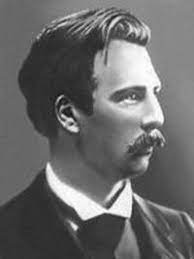
Charles Theodore Henri De Coster was born in Munich on 20 August 1827. His father, a Fleming from Ypres, was then steward to Count Charles-Mercy d'Argenteau, Archbishop of Tyre and papal nuncio in Bavaria; his mother was a Walloon, a seamstress by origin. The boy passed his earliest years amid the splendour of the archiepiscopal palace, with the count for his godfather.
In 1833 the family left Germany for home and settled in Brussels; a year later Augustin De Coster died, and his widow Anne-Marie was left to raise two children alone — Charles and his younger sister Caroline, who would become his faithful friend and, often enough, his only support. Count d'Argenteau did not at first forget his godson, and helped place him in the Jesuit college of Saint-Michel. Charles emerged from it, however, a fierce enemy of the Church and its clergy, and flatly refused to go on to the seminary as the archbishop wished. He was seventeen; he had to work and help his mother, and he took a post in one of the great Brussels banks, where he spent six years at the monotonous duties of a junior clerk.
In 1847 Charles and his friends founded a literary circle, the Society of Joyous Fellows. Young painters, journalists, poets and composers met weekly, discussed the works of the great writers and submitted their own literary efforts to the judgement of their friends. The best of these went into the handwritten Journal of the Society, De Coster's pieces among them — verse, for the most part — and some found their way into the periodical press. The Joyous Fellows staged amateur theatricals and organised excursions across Belgium, exploring a homeland that had only recently won its independence.
In 1850 De Coster resigned from the bank and entered the newly opened Brussels University in the faculty of literature and philosophy. As a student he frequented the literary circle Lothoclo, meanwhile trying to earn a living with notices, small stories and poems published under various pseudonyms in the newspapers and journals. In 1851, in his first year at the university, he met Elisa Spruyt. They were divided by age and, more gravely, by station: Elisa's father, a prominent official, would not countenance a match between his daughter and a man with neither fortune nor position in society. The two met rarely, and in secret. Their romance lasted eight years, and throughout it they wrote to each other; in 1894 Charles Potvin, a scholar of De Coster's work, collected and published his letters to his beloved.
De Coster took his degree in 1855. His diploma entitled him to teach school, but he felt no calling for pedagogy and gave himself to literature instead, though literary labour was held cheap in the Belgium of those days. From 1856 he worked closely with a new weekly, Uylenspiegel, writing political articles and pamphlets for it; the journal also published his tales and the first fragments of the Legend of Ulenspiegel. In 1857 came his first book, Flemish Legends, a collection of tales written in an archaic form of French. In 1861 he published a second collection, Brabant Tales, part of it written in modern French; some of its stories dated back to the days of the Joyous Fellows and had merely been reworked for the new edition.
In 1860 De Coster entered the State Archives, where he gathered the material he would later put to use in his epic; in 1864 he left the post so as to work unhindered on the Legend. After several years of solitary, concentrated labour and chronic poverty, the great work of his life appeared on 31 December 1867: The Legend of Ulenspiegel and Lamme Goedzak, and of Their Heroic, Joyous and Glorious Adventures in the Land of Flanders and Elsewhere. The book tells a heroic chapter of Belgian history — the Dutch revolution of the sixteenth century, the age of a people's selfless struggle against Spanish oppression and the grim despotism of the Church. Its hero, Thyl Ulenspiegel, the tireless wag and jester beloved of folk tradition, is gradually transformed into a steadfast Gueux, a fighter for his country's freedom, and at last into the eternally young spirit of Flanders, while his beloved Nele becomes the love of Flanders — the two of them beyond the reach of time.
Yet for all the enthusiasm of a small band of admirers and the praise of well-known writers, the novel brought its creator neither fame nor money. The expensive, magnificently illustrated edition, printed in a small run, sold poorly; a cheaper edition within reach of the general reader appeared only after the writer's death. In 1870 De Coster became a teacher of literature and history at the Ecole de Guerre military school, but his creditors attached his salary. He went on writing: in 1872 he published The Honeymoon, a psychological novel of contemporary life; he wrote, with a collaborator, the novel Le Mariage de Toulet, published only after his death, and the travel sketches La Zelande and La Neerlande.
Charles De Coster died of tuberculosis and diabetes on 2 May 1879, short of his fifty-second birthday. After his untimely death he was all but forgotten; more than thirty years passed before the Legend of Ulenspiegel began to be translated into the languages of the world and its author was recognised as the founder of Franco-Belgian literature.
Novels: The Legend of Ulenspiegel and Lamme Goedzak, and of Their Heroic, Joyous and Glorious Adventures in the Land of Flanders and Elsewhere / La Légende et les aventures héroïques, joyeuses et glorieuses d'Ulenspiegel et de Lamme Goedzak au Pays de Flandres et ailleurs (1867); The Honeymoon / Le Voyage de noce (1872); Le Mariage de Toulet (1879; written with Edouard Meran).
Novellas: Smetse Smee (1857); Braf le prophète (1861); Caprice de femme (1870).
Stories: Un voyage en enfer (1849); Mohammed (1850); Edouard le martyr (1851); Silhouette d'amoureux (1851); Une histoire lamentable (1852); Blanche, Claire et Candide (1856); Fantaisie. Histoire d'un ami (1856); Les pèlerins d'Haeckendover (1856); Les Frères de la bonne Trogne (1856); Celui de la nuit (1857); Humble supplique à la comète (1857); Le sire d'Halewyn (1857); Les aventures d'un coucou (1857); Christus (1861); Les deux duchesses (1861); Les fantômes (1861); Les masques (1861); Ser Huygs (1861); Les Bohémiens (1866).