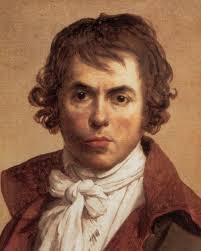
In January 1793, at a session of the Convention — France's new legislative body — the “painter of the Revolution,” Jacques-Louis David, voted for the death penalty for King Louis XVI. Three hundred and sixty deputies voted against; three hundred and sixty-one voted for. Looking at those numbers, it is impossible to shake the thought that the artist's voice proved decisive in finally burying the French monarchy. David's wife Charlotte, a convinced royalist, would never forgive him, and left him, taking their four children.
A mere nine years later, the same artist would watch with rapture as a small Corsican was crowned and anointed in Notre-Dame de Paris. Instead of the canvases that had once fired a nation to revolution, Jacques-Louis David's art would now serve to promote the empire and glorify a self-made emperor — a man with whom he fell, quite literally, in love: “What a head he has! It is so perfect it deserves comparison with the finest examples of ancient sculpture and painting... This Bonaparte is my Eros!”
David's biography offers a wide field for psychoanalytic interpretation.
He was born in Paris in 1748. His father, Maurice-Louis David, was a prosperous iron merchant who took great care over his son's education. At an expensive private boarding school, the seven-year-old Jacques-Louis studied history and ancient languages, anatomy and the rudiments of drawing. When the boy was nine, his father was killed in a duel.
His biographers say David remembered his father poorly — the mind suppressing what it could not bear. Yet he was delighted to hear from relatives that “Jacques-Louis burrs just like his father” (though such a speech defect is not hereditary). Much later, the ugly scar beside his mouth, which David himself acquired in a duel — its distortion is plainly visible in the portrait of the artist by Jerome-Martin Langlois — would please him as a reminder of his father: now they, too, had something in common.
Most important of all, David's entire subsequent life was an unceasing search for someone to take his father's place.
The orphaned boy was taken in hand by his mother's brothers. Both Jacques Buron and Jean-Francois Desmaisons were architects, and both uncles assumed he would continue the family line; they enrolled him at the Academy of St Luke. When it became clear that their nephew inclined more to painting than to architecture, his uncle Buron decided to present him to yet another distant relative — Francois Boucher, until recently the “first painter of France.”
Boucher was by then past sixty; the art of the rococo was going out of fashion, and he himself was gradually losing his sight and no longer dared take new pupils. But the legendary meeting between young David and the aging Boucher — between the new French art and the old — took place all the same. The seventeen-year-old David is said to have declared in the heat of the moment, “Antiquity will never seduce me!” — in reply to Boucher's suggestion that he study with the neoclassical painter Vien. The sly Boucher parried: “Of course, Joseph-Marie Vien's manner is a little cold. Just drop in on me now and again: I will show you how to correct his coldness with my warmth.”
Not the most gifted of artists, Vien nevertheless proved a good teacher for David, who would be lucky in his patrons all his life. In those same years Michel-Jean Sedaine took him under his wing — and Sedaine was nothing less than permanent secretary of the Royal Academy of Architecture. Seeing the young man's zeal and promise, Sedaine treated him like a son: during his student years David even lived in his house and enjoyed his support in everything.
David's great ambition then was to win the Prix de Rome, awarded by the French Academy, which carried the right to study in Italy. His first attempt failed; so did the next two. When on the third try he received a special award “for the depiction of the nude” but the grand prize went, through backstairs intrigue, to someone else, David resolved to shoot himself. Sedaine managed to burst into his room in time and found the words to persuade him that so talented a young man still had everything ahead of him.
In 1774, on his fifth attempt, Jacques-Louis David at last won the coveted prize and set off for Rome. His mentor Joseph-Marie Vien had also risen in the world: now director of the French Academy, he too was bound for Rome, on a special mission — the Italian authorities were complaining of the dissipation of the painting students, and Vien was charged with shoring up their discipline and morals. With David, admittedly, this did not quite succeed. Having gotten an Italian servant girl pregnant, Jacques-Louis flatly refused to marry her. The girl went to court. David would have landed in prison, but she agreed to a generous settlement. The money was lent to him by none other than Vien.
In truth, David had no time for family life: throughout his Italian period he perfected his craft with a maniacal passion that left room for nothing else. Raphael was his idol; Correggio and the Carracci were masters whose art he studied closely and jealously. Through the art of the Renaissance David moved toward its maternal womb — antiquity. With enormous difficulty he obtained the authorities' permission to copy images from the Hellenistic cameos and vases of the famous Hamilton collection, and he traveled to the excavations at Naples — doing everything, in short, to grasp the laws of ancient harmony in all their grandeur and primal simplicity.
Antiquity not only “seduced” David; it bore abundant fruit. He returned to Paris a different artist. His manner had grown independent and strong. Everything that had come before — timid imitation of the baroque, unconvinced echoes of the rococo — gave way to a new style, firmly grounded in the Roman classical antiquity the painter worshipped. Very soon this style of clean line and lucid composition acquired its proper name: neoclassicism.
In 1781 the master won the right to exhibit at the regular Salons in the Louvre. David showed several remarkable sketches and two paintings: Belisarius Begging Alms, on an ancient subject, and the Equestrian Portrait of Count Potocki, on a modern one. The critic Denis Diderot, that barometer of the age's taste, responded to David quite favorably. In the first picture he noted the young painter's “exceptional taste”; his review of the second was confined to a single sentence: “An excellent painting, the colors here not so dark as in the others; but is the horse's right leg not a little too tense?”
The French public, for its part, embraced David's art without reservation. Dreaming of a just republican order and of national unity, it was not deceived by the antique trappings: behind the ancient Roman subjects it saw intimations of a majestic future for France. Commissions and imitators quickly followed — and so did a wife. Charlotte Marguerite was the sister of one of his companions from the Roman years and the daughter of Monsieur Pecoul, chief building contractor to the crown, who, observing the painter's fast-rising fame, himself proposed the match. It turned out well. Within four years the master's household — far from poor, thanks to his wife's fortune — held four children: the boys Charles-Louis Jules and Eugene, and the twin girls Felicite-Amelie and Pauline-Jeanne.
Today we know David above all through the paintings of the 1790s and 1800s — The Death of Marat and the portraits of Napoleon. But the peak of his fame in his own lifetime came earlier, in 1785, when the Salon was fairly detonated by the sensational Oath of the Horatii. Three Romans of the Horatii clan prepare to fight the Curiatii brothers of Alba Longa, one of whom, by the irony of the gods, is betrothed to their sister Camilla. But public duty commands it: the Horatii must defend the honor of Rome against the Curiatii, and for its sake they stand ready to sacrifice not only the ties of kinship but their lives.
Whether consciously or not, with the Oath of the Horatii David struck the raw nerve of a French society electrified by resentment of the crown and by the presentiment of swift and decisive change. The monarchy was felt to be a vexing relic; revolutionary sentiment was, as the phrase goes, in the air. And so the Oath of the Horatii, with all its pathos of brotherhood in arms and death for the Great Fatherland, was received as a call to action.
David drew close to revolutionary circles: he held the “friend of the people” Jean-Paul Marat in boundless respect, and Maximilien Robespierre became a close friend. Without going deeply into political subtleties, the artist felt the public upheavals as a struggle for justice, and this inspired him. After the Revolution David became a member of the Convention. As leader of the opposition within the Academy — hardly surprising after his long battle for the Prix de Rome — he now gained the power to reform the artistic life of France: to turn the Academy into a democratic Commune of the Arts, and the royal Louvre into a national museum. Through David's mediation the Louvre greatly enriched its collections. And the post of director of the Louvre went to the aging rococo master Fragonard, whom the Revolution had all but thrown from the ship of modernity — the generous artist would not let him go under.
In 1793 David supported the king's execution, believing Louis XVI a traitor who had betrayed the national interest. In July of that same year the aristocrat Charlotte Corday, having talked her way into the house of the Revolution's ideologue Marat, stabbed him in his bath. The artist was in Paris that day; within two hours he was in the rue des Cordeliers, sketching from life the dead man's head and his limply hanging arm. The Death of Marat would become the foremost masterpiece of David's career — and far from the last death in his biography.
By 1794 Robespierre was dead and David was in prison. The Jacobin dictatorship had fallen; the mass terror it had unleashed turned, with grim inevitability, against the Revolution's own leading men. In prison David painted an astonishing self-portrait: a man with a glassy stare and muscles seemingly locked in spasm — in defiance of the precepts of Diderot, who had steadily scolded the master for the over-tensed musculature in his pictures — himself, awaiting a death sentence.
But David was acquitted. Charlotte Pecoul, who had left him after the king's execution, made every conceivable effort to keep her former husband from following Louis to the guillotine. Afterward they married again, and for twenty-nine years, until the artist's death in 1825, they remained together. Charlotte outlived him by only a year.
Facing the wreck of all his undertakings, David lost his bearings. He renounced his political views and abandoned his public vocation. What was there now to do, to believe in, to hope for? He painted the enormous Intervention of the Sabine Women, with its unmistakable message of reconciliation. But beneath the surface he evidently went on dreaming of something powerful, majestic, triumphant. In 1797 Napoleon made his ceremonial entry into Paris, and David witnessed the spectacle. Napoleon's Roman profile, joined to the charisma of power that radiated from him, overwhelmed the master. With the same furious energy he had so recently devoted to the cause of the Revolution, David began to serve Napoleon, who would name him first painter of the empire. “Yes, my friends, Bonaparte is my idol, and I am not ashamed to admit it” — the artist flaunted his closeness to power without embarrassment, like many who lose a father too early. And like them, he was hostage to his own inflated expectations, doomed to go on being disillusioned, and to go on losing.
In 1815 Napoleon lost the battle of Waterloo, and in 1816 the Bourbon dynasty was restored in France. Fleeing political reprisals, David escaped to Belgium. The last years of his life were given over to portraits of his former comrades of the Convention — exiles like himself — and to mythological paintings now securely forgotten. David died of a stroke and was buried in Brussels. Only his heart returned to France: it was carried to Paris and interred in plot 56 of Pere Lachaise cemetery.