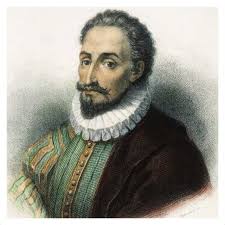
Miguel de Cervantes (born 9 October 1547 in Alcalá de Henares; died 23 April 1616 in Madrid) was a Spanish writer.
His father, Rodrigo de Cervantes, was a modest surgeon; his mother was Leonor de Cortina. Their large family lived in constant poverty, which never released the future writer through the whole of his sorrowful life. Of his early years very little is known.
Cervantes took part in military campaigns in Italy (he was in Naples), at Navarino (1572), in Tunis and Portugal, and in sea battles — Lepanto, 1571 — as well as travelling on official duty to Oran in the 1580s; he also served in Seville.
Several versions of his biography exist. The first and generally accepted one has it that "at the height of Spain's war with the Turks he entered military service under the colours. In the battle of Lepanto he was everywhere at the point of greatest danger and, fighting with truly poetic ardour, received three wounds and lost the use of an arm." There is, however, another and improbable account of his irreparable loss: that owing to his parents' poverty Cervantes received a meagre education and, finding no means of subsistence, was driven to steal — and that it was for theft that he lost his hand, after which he had to leave for Italy. This version inspires no confidence, if only because thieves in that age no longer had their hands cut off: they were sent to the galleys, where both hands were needed.
The Duke de Sessa, presumably in 1575, gave Miguel letters of recommendation (lost when he was taken captive) for His Majesty and the ministers, as the duke recorded in his testimony of 25 July 1578, in which he also asked the king to show favour and assistance to a brave soldier.
On the way back to Spain from Naples he fell into Algerian captivity, where he spent five years (1575–1580); he tried four times to escape, and only by a miracle was not executed. In captivity he was often subjected to torments of various kinds.
Rodrigo de Cervantes, in a petition of 17 March 1578, stated that his son "had been taken prisoner on the galley Sol under the command of Carrillo de Quesada," and that he "received wounds from two arquebus shots in the chest, and was maimed in the left hand, which he cannot use." The father had no means for Miguel's ransom, having earlier ransomed another son who had been on the same ship. A witness to this petition, Mateo de Santisteban, remarked that he had known Miguel for eight years, having met him when he was twenty-two or twenty-three, on the day of the battle of Lepanto. He also testified that Miguel "on the day of the battle was ill, and had a fever," and was advised to keep to his bed, but chose to take part in the fighting. For his distinction in the battle the captain rewarded him with four ducats over and above his ordinary pay.
News of Miguel's Algerian captivity came in the form of letters carried by the soldier Gabriel de Castañeda, an inhabitant of the mountain valley of Carriedo, from the village of Salazar. According to his information Miguel had been held for about two years — that is, since 1575 — by a Greek convert to Islam, the captain Arnaut Riomami.
A petition from Miguel's mother in 1580 records her request "for permission to export 2,000 ducats' worth of goods from the kingdom of Valencia" toward her son's ransom. On 10 October 1580 a notarial act was drawn up in Algiers, in the presence of Miguel de Cervantes and eleven witnesses, with a view to ransoming him from captivity; on 22 October, Juan Gil, a monk of the Order of the Holy Trinity, composed a report on the basis of that act confirming Cervantes's services to the king.
After his release from captivity Miguel served with his brother in Portugal, and also under the Marquis de Santa Cruz.
On 21 May 1590, in Madrid, he petitioned the Council of the Indies for a vacant post in the American colonies — in particular "in the Audit Office of the New Kingdom of Granada, or the Governorship of the Province of Soconusco in Guatemala, or as Accountant of the Galleys of Cartagena, or Corregidor of the town of La Paz" — and all because no favour had yet been shown him for his long service to the Crown, twenty-two years of it. On 6 June 1590 the President of the Council of the Indies noted on the petition that its author "deserves to be given some employment, and may be trusted."
Miguel was married to Catalina de Palacios de Salazar. He had one illegitimate daughter, Isabel de Cervantes.
His literary career began rather late, when he was thirty-eight. His first work, La Galatea (1585), was followed by a great number of dramatic pieces that met with feeble success. To earn his daily bread the future author of Don Quixote entered the commissary service, charged with buying provisions for the Invincible Armada. In the discharge of these duties he suffered great reverses, even coming before the courts and spending some time in prison. His life in those years was a whole chain of harsh privations, adversities and disasters.
Through it all he never gave up writing, though for the time being he printed nothing. His wanderings were storing up material for the work to come, serving as a school for the study of Spanish life in all its variety.
From 1598 to 1603 there is almost no news of his life. In 1603 he appears in Valladolid, occupied with small private affairs that gave him a meagre living; in 1604 came the publication of the first part of the novel The Ingenious Hidalgo Don Quixote of La Mancha, an enormous success in Spain (the first edition sold out in a few weeks, and four more appeared the same year) and abroad, with translations into many languages. It did not, however, improve the author's material position in the least, and only sharpened the hostility toward him — the mockery, slander and persecution.
From then until his death his literary activity never ceased: between 1604 and 1616 appeared the second part of Don Quixote, all the novellas, many dramatic works, the poem Journey to Parnassus; and the novel Persiles and Sigismunda, printed only after the author's death, was written. Almost on his deathbed Cervantes did not stop working; a few days before he died he took monastic vows. On 23 April 1616 there ended, of dropsy, a life which its bearer, in his philosophical humour, called "a long imprudence" — and leaving which he "carried on his shoulders a stone inscribed with the ruin of his hopes."
He died in Madrid, where he had moved from Valladolid shortly before the end. The irony of fate pursued the great humorist beyond the grave: his tomb long remained lost, since his burial place, in one of the churches, bore not even an inscription. A monument to him was raised in Madrid only in 1835, its pedestal carrying two inscriptions, in Latin and in Spanish: "To Miguel de Cervantes Saavedra, king of Spanish poets, in the year MDCCCXXXV."