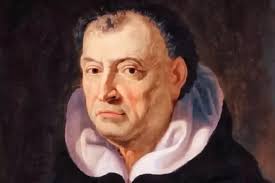
Tommaso Campanella was an Italian philosopher, poet and political actor, author of the treatise The City of the Sun — one of the most significant thinkers of the late Renaissance and a representative of utopian socialism.
He was born on 5 September 1568 in the little town of Stilo, the son of a cobbler, and was christened Giovanni Domenico. His mother died early, though the rest of the family survived an epidemic of plague. Of his early years little is known: legend has it that he learned the rudiments of alchemy and sorcery, and by fourteen he had mastered the elements of logic. In 1582 he entered the Dominican order, and it was in the monastery that the young man took the name Tommaso, in honour of Thomas Aquinas.
Before long, however, Campanella's freethinking in matters of religion drew down upon him the hatred of the theologians. Like other figures of the Renaissance, he also deified nature, comparing the Earth to a "great beast" and human beings to its parasites. The disgraced monk kept clear of serious trouble until 1598, when he took part in a conspiracy against the Spanish king, who was at the same time king of the Two Sicilies. He was charged, too, with a devotion to astrology — that is, with heresy. In 1599 Campanella was imprisoned; under torture he partly admitted his guilt, and resolved to feign madness in order to escape execution. Unluckily, his jailers overheard a conversation between the philosopher and his fellow prisoners, and Tommaso was subjected to fresh and terrible torments.
Although Cardinal Richelieu took his part, as did King Louis XIII — to whom Tommaso had successfully predicted the birth of a son — he was in the end condemned to life imprisonment "without any hope of freedom." The philosopher spent twenty-seven years in prison, and in that time wrote dozens of books, some of them published in Germany. Among them is the famous City of the Sun, inspired by Sir Thomas More's Utopia and Plato's Republic, though with an unmistakable astrological undercurrent.
The book describes a society of equals who hold no property and have no families. The state raises the children, while the adult inhabitants farm and keep livestock, working only four hours a day. The city was to be governed by men of learning, who were also priests of the Sun. Remarkably, The City of the Sun was no mere theoretical exercise: Campanella had worked out its social programme while preparing his uprising, preaching to his fellow conspirators about the ideal republic he intended to rule himself. He had calculated that a great transformation of the world was due in 1600, and believed that this was the date on which his ideal state would come into being.
Campanella was freed in 1626 and vindicated three years later. He spent the rest of his life in France, where he drew a pension from Cardinal Richelieu. He died in Paris on 21 May 1639, ten days short of the date he had predicted for his own death.