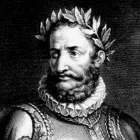
Luís de Camões — more exactly, in the Portuguese manner, Luís Vaz de Camões — was the great Portuguese poet of the sixteenth century, author of the epic The Lusiads. In Portugal and Brazil his work carries a significance all its own: the day of his death, 10 June, is kept by the Portuguese community as the Day of Portugal — the Day of Camões.
What is known of his life is exceedingly scanty and at times contradictory. He is thought to have been born in 1524, probably in Lisbon. He came of an old and wealthy family of Galician stock; one of its members, Vasco Pires de Camões, fled to Portugal in 1370 for political reasons, and was not only a distinguished soldier but a brilliant troubadour poet. The poet's maternal grandfather, Antão, was married to a kinswoman of Vasco da Gama. His mother, Dona Ana de Sá e Macedo, died very early; his father, Simão Vaz de Camões, married again and sailed for India as a ship's captain, was wrecked near Goa and died soon afterwards. Camões passed his childhood in the company of a solicitous and loving stepmother, under the guardianship of his uncle, Dom Bento, a learned and ascetic monk.
He studied at Coimbra, first in the monastery school and then at the university, where he acquired his languages and a wide reading in ancient and modern Latin, Greek, Spanish, Italian and Portuguese poetry, and in history both general and national. In the years 1537–1542 he attended the University of Coimbra, and there he began to write, his first efforts falling in with the school of Sá de Miranda — though already a love of everything popular is evident in him: legends, tales, proverbs, songs and ballads. His comedy Amphitryon presumably belongs to the university period. A love affair brought on a quarrel with his uncle, in consequence of which Camões left the university without taking a degree.
Around 1542, reconciled with his uncle, he went to seek his fortune in Lisbon, where he obtained a place as tutor in the household of the Count of Noronha. Seeing in church for the first time, in 1544, Caterina de Ataíde, a lady-in-waiting to the queen and daughter of a highly placed courtier, Camões fell passionately in love with her at once. The wish to see her more often moved him to seek admission to court, which he achieved through the good offices of the Count of Noronha. As poet-improviser, playwright, director and actor in the entertainments he mounted during court festivities, he had occasion to distinguish himself in the presence of his beloved, to see her more often and to seek her favour. His love did not remain a secret; it roused the indignation of the Ataíde family; enviers and rivals drew the poet into quarrels and unpleasantness, and at the beginning of 1549 Camões was banished from Lisbon by royal decree.
His helpless position forced him into military service. Posted to the garrison at Ceuta, he fought bravely in chance skirmishes, losing his right eye in one of them. After two years of a soldier's life he returned to Lisbon in 1551. During a church procession he gravely wounded a highly placed courtier and was thrown into prison. The inquiry dragged on for nine months, and though the poet was pardoned by King João III, the pardon came on condition that he depart to serve in India.
In March 1553 he sailed for Goa as a common seaman. During the six-month voyage, as earlier during his imprisonment, Camões wrote the first cantos of the epic that would make his name. In India he took part in several engagements (in Malabar), then spent more than a year in Goa, writing verse and joining an expedition towards Mecca. Through the active and adventure-filled life he led in Africa and India the poet, as he says of Caesar in The Lusiads, took up "now the sword, now the pen." Appointed in 1556 to a fairly prominent administrative post in Macau — trustee of the property of persons absent or missing — Camões finished The Lusiads at Goa; but one of the temporary commandants of Macau then accused him of misconduct in office and carried him off, a prisoner, aboard ship. Bound for Ayutthaya, the capital of Siam, the vessel went astray in the Gulf of Siam, entered the Mae Klong instead of the Chao Phraya, and ran aground there. The poet had to make for the shore clinging to a piece of timber — and contrived, even so, to save the manuscript of The Lusiads. Reaching Goa, he demanded a fair trial and was acquitted. After various further misadventures he managed at last, in 1570, to return to his homeland "with a sick heart and an empty purse." While still in Goa, in 1561, he had received news of the death of his beloved; the force and duration of his grief are attested by numerous poems.
In 1570 Camões reached Lisbon and set about securing the publication of The Lusiads. The poem appeared in print in 1572, celebrating Vasco da Gama's discovery of India. Camões dedicated it to King Sebastian, who granted him a small lifetime pension that just barely kept want at bay: its amount was four times below the average earnings of a carpenter. Additional money came from a servant boy he had brought from Mozambique, who gathered alms in the streets of Lisbon. Though the poem excited general admiration, the creator of The Lusiads had to live out his days in poverty, to which was joined his grief over the loss of Portugal's independence. "I die not only in my fatherland but with it," the poet exclaims in a letter to a friend.
In The Lusiads Camões sings the descendants of Lusus — friend or son of Bacchus, who according to legend settled in Portugal and was king there. The poem consists of ten cantos comprising 1,102 octaves. No other European people possesses a national epic to compare with The Lusiads. Camões celebrates everything that constitutes the glory of the Portuguese, all the outstanding events and occurrences of their history; he recounts Vasco da Gama's discovery, weaving into the narrative episodes from the Portuguese past. An ardent patriot, Camões strove to immortalise the heroic deeds and national traditions of his countrymen. To the charm of its verse the poem joins a faithful rendering of fact, so that Camões may be called the best historian of his country. He is a great master of painting nature; his descriptions of the sea succeed above all. The "Portuguese Homer" was also a superb lyric poet: his tender and graceful songs, odes, elegies and eclogues mirror the whole of his unhappy life. The first collection of his shorter poems, the Verses divided into five parts, appeared only after his death, in 1595; a second part, the Rhymes, followed in 1616. In his youth Camões wrote three plays — King Seleucus, The Play of Filodemo and Amphitryon — which had no lasting success.
The poem has been translated into all the European languages, several times over — in French alone there are nine versions; excerpts were rendered into Russian by Zhukovsky. Camões's life has inspired many poets and dramatists: António de Castilho, Friedrich Halm, Delanda. Best known is Almeida Garrett's poem Camões, whose closing stanzas contain a bitter reproach to his countrymen for the poet's cruel fate. Today the fame of Camões in Portugal is immense. The ardent patriotism that pervades The Lusiads did much to further the awakening of Portuguese nationhood in 1640. By resolution of parliament a monument to Camões, the work of the sculptor Bastos, was erected in Lisbon in 1860.
Stricken with plague, he died on 10 June 1580 and was buried in the church of St Anne. Sixteen years later Dom Gonçalo Coutinho placed a gravestone with an inscription on the spot presumed to be his grave. The Lisbon earthquake of 1755 razed the church of St Anne to its foundations. In 1855 the presumed remains of Camões were gathered and reburied, and in 1880, before the solemn celebrations of the tercentenary of his death, these presumed remains — like the remains of Vasco da Gama — were translated with royal honours and interred in the Jerónimos monastery at Belém, a district of Lisbon: the coffin with Vasco da Gama's ashes on the left hand, and that with Camões's on the right, of the tomb of King Sebastian. His gravestone stands there in the Jerónimos monastery.
A note on the name: in modern Portuguese pronunciation the poet's full name sounds approximately as "Luish Vash de Camoinsh," the sibilant pronunciation of the final consonants having been first recorded by Luís António Verney in the middle of the eighteenth century; renderings of the name in other languages have varied considerably over the centuries, from the age of the earliest translations onward.