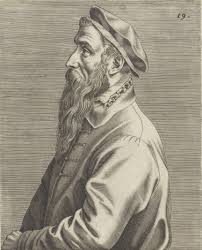
He died in 1569, leaving a few dozen paintings. Most of them show peasants. They drink, eat, brawl, dance, fall into ditches, drag ploughs, slaughter pigs. No heroism. No moral. Just life as it is.
Pieter Bruegel the Elder — nicknamed "Peasant" Bruegel. The paradox: he was no peasant himself. Born around 1525, he trained in Antwerp under a good master, travelled to Italy, and worked for wealthy Antwerp merchants. He painted for people who knew how to read allegories.
His peasants are allegory. The Land of Cockaigne: men sprawled around a table, nobody working, food walking into their mouths of its own accord. That is satire. The Blind Leading the Blind: a chain of blind men, the first tumbling into a ditch, the rest strung out behind him. That is a parable.
Hunters in the Snow: winter, a village, hunters trudging home with a meagre catch, children skating on the ice below. The space here is vast, the sky flat, the world seen from above. It is not a landscape — it is a map of human life.
His Tower of Babel: the construction goes on, but the tower plainly will never reach heaven. People bustle about its base, never seeing the whole.
His sons became painters too — Pieter Brueghel the Younger and Jan Brueghel. But only one of them is called "Peasant."
Why have his paintings survived so well? They hung in the private collections of rich merchants, not in churches where one had to please. He could do as he liked.