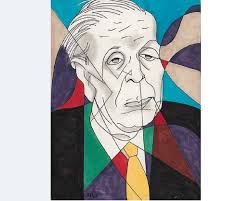
Jorge Luis Borges (August 24, 1899, Buenos Aires — June 14, 1986, Geneva) was an Argentine prose writer, poet, and essayist. His full name was Jorge Francisco Isidoro Luis Borges Acevedo, though, in the Argentine manner, he never used it. On his father's side Borges had Spanish and Irish roots; his mother apparently came from a family of Portuguese Jews — her parents' surnames, Acevedo and Pinedo, belong to the best-known Jewish families of Portuguese descent in Buenos Aires. Borges himself claimed to have Basque, Andalusian, Jewish, English, Portuguese, and Norman blood. At home the family spoke both Spanish and English.
At ten Borges translated Oscar Wilde's famous tale "The Happy Prince." He described his own entry into literature this way: "From my earliest childhood, when my father was struck by blindness, it was tacitly understood in our family that I was to accomplish in literature what circumstances had denied my father. This was taken for granted (and a conviction of that kind is far stronger than any spoken wish). I was expected to be a writer. I began writing at six or seven."
In 1914 the family went to Europe for a holiday, but the First World War delayed their return to Argentina. In 1918 Jorge moved to Spain, where he joined the Ultraists, an avant-garde group of poets. On December 31, 1919, his first poem appeared in the Spanish magazine Grecia.
Back in Argentina in 1921, Borges put Ultraism into practice in unrhymed verse about Buenos Aires. Even his early work glittered with erudition, with languages and philosophy, with a masterly command of the word. In time he moved away from poetry and began writing his "fantastical" prose. Many of his finest stories were gathered in Ficciones (1944), Labyrinths (1960), and Doctor Brodie's Report (El Informe de Brodie, 1971). In "Death and the Compass" the struggle of the human intellect with chaos takes the form of a criminal investigation; "Funes the Memorious" draws the portrait of a man literally flooded with memories.
From 1937 to 1946 Borges worked as a librarian — "nine deeply unhappy years," he later called them, though it was precisely then that his first masterpieces appeared. When Peron came to power in 1946, Borges was dismissed from his post. In 1955 fate returned him to the library, and in the most honorable way — as director of the National Library of Argentina — but by then Borges was blind. He held the directorship until 1973.
Together with Adolfo Bioy Casares and Silvina Ocampo, Borges helped create the famous Anthology of Fantastic Literature in 1940 and the Anthology of Argentine Poetry in 1941. In the early 1950s he returned to verse; the poems of this period are largely elegiac, written in classical meters, with rhyme. In them, as in the rest of his work, the ruling themes are the labyrinth, the mirror, and the world construed as an endless book.